Yao Jiansen, Wang Haipeng, Yan Jingjing, Shao Di, Sun Qiang, Yin Xiao
Center for Health Management and Policy Research, School of Public Health, Shandong University, Jinan, People's Republic of China.
Institute for Hospital Management, Tsinghua University, Shenzhen, People's Republic of China.
Patient Prefer Adherence. 2021 Feb 22;15:399-409. doi: 10.2147/PPA.S292086. eCollection 2021.
Blood glucose monitoring is essential in diabetic care and management. Monitoring using glucometers in home and in laboratories by professionals in certain health institutes were the common methods of blood glucose monitoring in clinical practice. This study aimed to characterize the profiles of blood glucose monitoring in the view of the discrepancy in methods and frequency conducted by the patients with type 2 diabetes mellitus (T2DM) in China, and to explore factors influencing the profiles.
A cross-sectional, community-based study was conducted in Shandong province, China, with a multi-stage stratified sampling. A total of 2166 T2DM patients completed the structured questionnaires about the real-world status of blood glucose monitoring and other questions composed of demographic and clinical characteristic as well as the diabetes-related cognitive scales. Latent profile analysis (LPA) was used to identify the underlying profiles of blood glucose monitoring based on self-reported frequency of blood glucose monitoring through different methods. Univariate and multivariate logistic regression were used to analyze the characteristics of the profiles and to explore the factors associated with it.
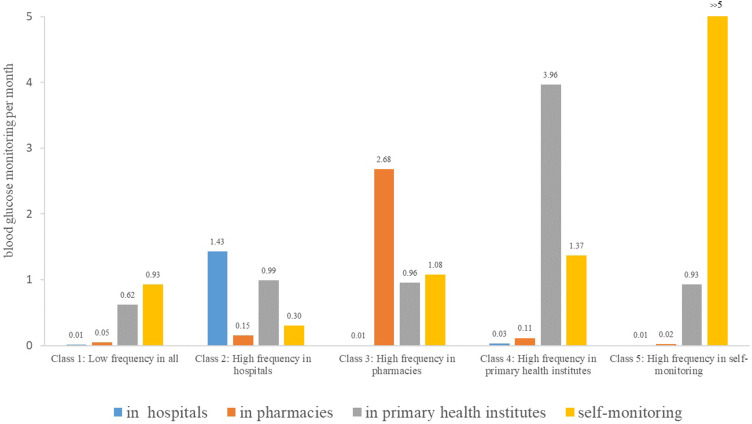
Among the 2166 participants, the mean frequency of blood glucose monitoring was 2.77 times (standard deviation: 7.67) per month. LPA indicated that five-class model was the best solution for classifying the latent groups of blood glucose monitoring: Class 1 "Low frequency in all", Class 2 "High frequency in hospitals", Class 3 "High frequency in primary health institutes", Class 4 "High frequency in pharmacies", and Class 5 "High frequency in self-monitoring". The proportions of the patients in class 1, class 2, class 3, class 4, and class 5 were 88.1% (n=1909), 1.3% (n=28), 3.1% (n=67), 6.1% (n=133) and 1.3% (n=29), respectively. Multivariate logistic regression showed that participants who had higher income (OR: 1.58, 95% CI: 1.042.41, p<0.05), had diabetes complication(s) (OR=1.37, 95% CI: 1.031.02, p=0.03) and had a good knowledge of blood glucose control (OR=1.59, 95% CI: 1.172.16, p<0.01) were more likely to have high frequency of blood glucose monitoring (in class 2, 3, 4, 5), and the rural patients were less likely to had high frequency of blood glucose monitoring (OR=0.47, 95% CI: 0.350.63, p<0.01).
Low frequency dominates the characteristics of the profiles of blood glucose monitoring among T2DM patients in China, though distinct blood glucose monitoring groups can be identified by LPA. Educational and financial supports were recommended to increase the frequency of blood glucose monitoring in patients with T2DM, focusing on the patients with low socioeconomic status.
血糖监测在糖尿病护理和管理中至关重要。在临床实践中,使用血糖仪在家庭中进行监测以及由某些健康机构的专业人员在实验室进行监测是常见的血糖监测方法。本研究旨在从中国2型糖尿病(T2DM)患者进行血糖监测的方法和频率差异的角度,描述血糖监测的特征,并探索影响这些特征的因素。
在中国山东省进行了一项基于社区的横断面研究,采用多阶段分层抽样。共有2166名T2DM患者完成了关于血糖监测实际情况的结构化问卷以及由人口统计学和临床特征以及糖尿病相关认知量表组成的其他问题。基于通过不同方法自我报告的血糖监测频率,使用潜在类别分析(LPA)来识别血糖监测的潜在特征。单因素和多因素逻辑回归用于分析这些特征的特点,并探索与之相关的因素。
在2166名参与者中,每月血糖监测的平均频率为2.77次(标准差:7.67)。LPA表明,五类模型是对血糖监测潜在类别进行分类的最佳解决方案:第1类“各类频率均低”,第2类“在医院频率高”,第3类“在基层医疗卫生机构频率高”,第4类“在药店频率高”,第5类“自我监测频率高”。第1、2、3、4和5类患者的比例分别为88.1%(n = 1909)、1.3%(n = 28)、3.1%(n = 67)、6.1%(n = 133)和1.3%(n = 29)。多因素逻辑回归显示,收入较高(比值比:1.58,95%置信区间:1.042.41,p<0.05)、有糖尿病并发症(比值比 = 1.37,95%置信区间:1.031.02,p = 0.03)且对血糖控制有良好认知(比值比 = 1.59,95%置信区间:1.172.16,p<0.01)的参与者更有可能有高频率的血糖监测(属于第2、3、4、5类),而农村患者进行高频率血糖监测的可能性较小(比值比 = 0.47,95%置信区间:0.350.63,p<0.01)。
在中国T2DM患者中,血糖监测特征以低频率为主,尽管通过LPA可以识别出不同的血糖监测组。建议提供教育和经济支持,以提高T2DM患者的血糖监测频率,重点关注社会经济地位较低的患者。
