St John Freya A V, Mason Tom H E, Bunnefeld Nils
School of Natural Sciences, Bangor University, Bangor, UK.
Conservation Ecology Group, Department of Biosciences, Durham University, Durham, UK.
Conserv Sci Pract. 2020 Nov 11;3(2):e316. doi: 10.1111/csp2.316. eCollection 2021 Feb.
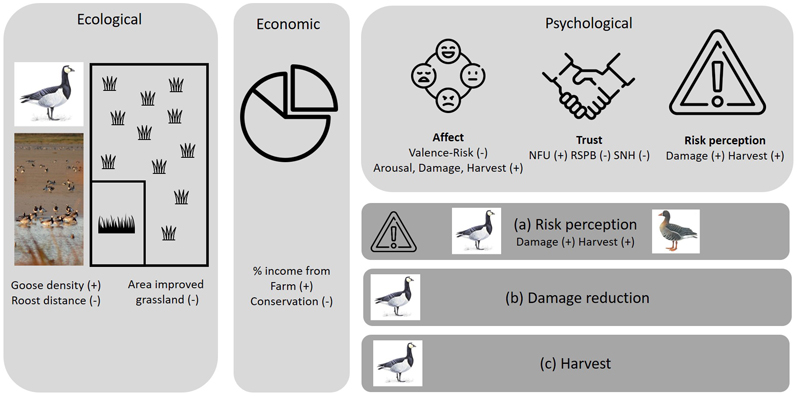
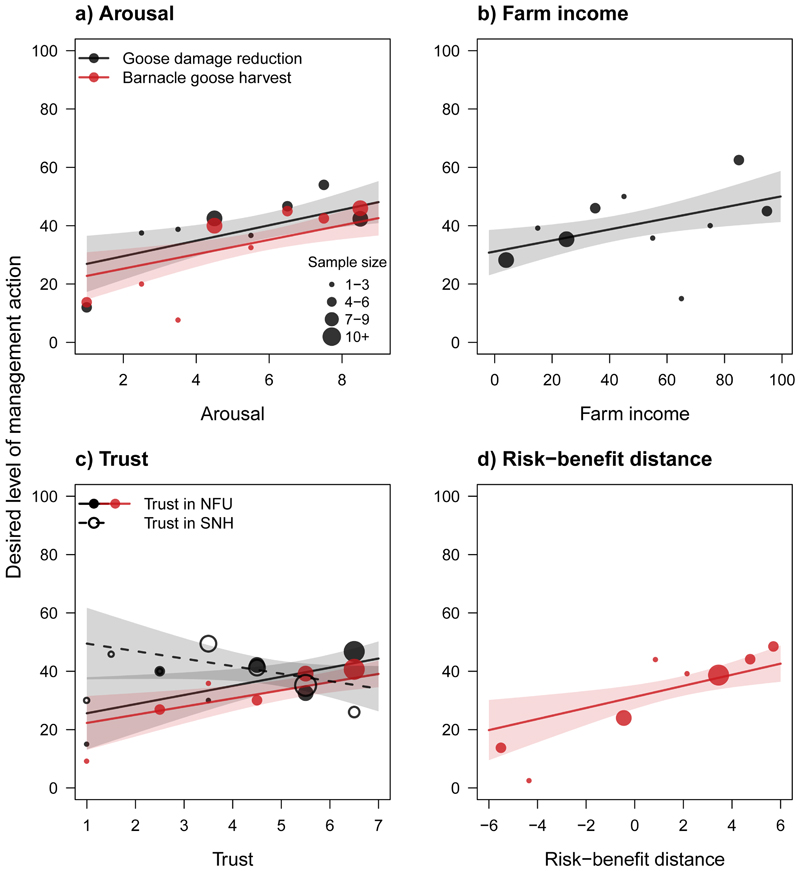
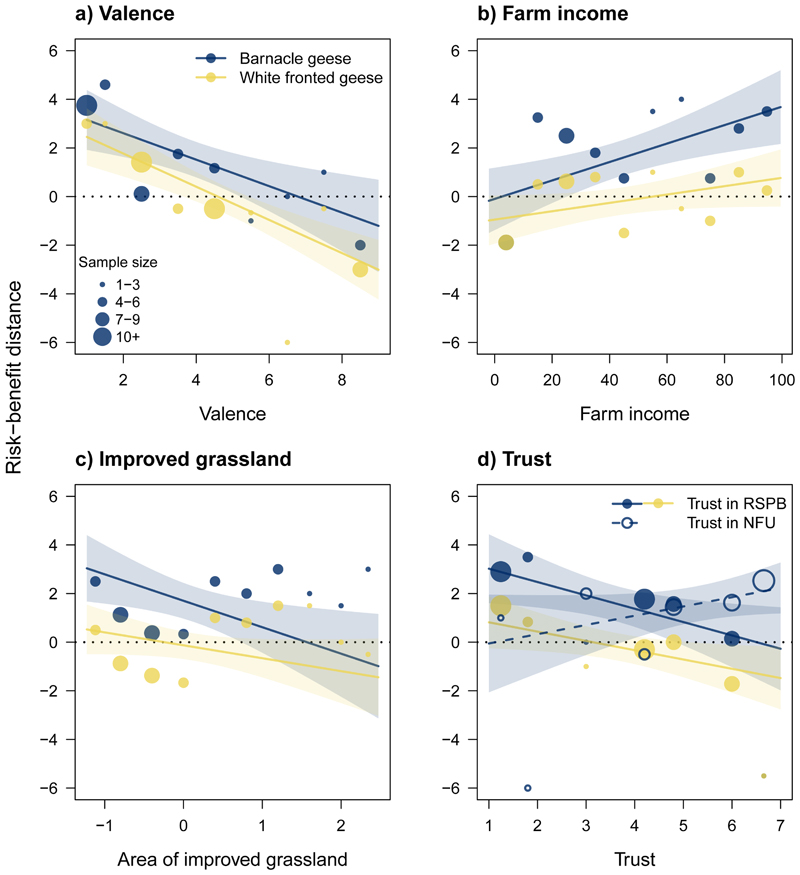
Conservation conflicts are damaging for humans and wildlife, with differences in people's objectives fuelling challenges of managing complex, dynamic systems. We investigate the relative importance of economic, psychological (affect, trust and risk perception) and ecological factors in determining farmers' management preferences, using Greenland barnacle geese () on Islay, Scotland, as a case study. Barnacle geese reduce agricultural productivity on Islay, negatively impacting household economies. Since 1992, farmers have received partial compensation but a new culling scheme has escalated conflict between conservation and agricultural interests. Using a questionnaire, we collected data from 75% of the farmers receiving goose payments. We found that affect was a strong driver of both risk perception and management preferences. However, we revealed complexity in these relationships, with trust and economic factors also influencing decision-making. Psychological and economic factors surrounding wildlife management must be understood if we are to achieve conservation objectives in human dominated landscapes.
保护冲突对人类和野生动物都具有破坏性,人们目标的差异加剧了管理复杂动态系统的挑战。我们以苏格兰艾莱岛的格陵兰白额雁为例,研究经济、心理(情感、信任和风险认知)和生态因素在决定农民管理偏好方面的相对重要性。白额雁降低了艾莱岛的农业生产力,对家庭经济产生负面影响。自1992年以来,农民获得了部分补偿,但一项新的捕杀计划加剧了保护与农业利益之间的冲突。我们通过问卷调查收集了75%领取雁补偿款农民的数据。我们发现情感是风险认知和管理偏好的强大驱动因素。然而,我们揭示了这些关系的复杂性,信任和经济因素也影响决策。如果我们要在人类主导的景观中实现保护目标,就必须了解围绕野生动物管理的心理和经济因素。