First Department of Medicine, University of Szeged, Korányi Fasor 8-10, Szeged, 6720, Hungary.
Department of Medical Physics and Informatics, University of Szeged, Szeged, Hungary.
BMC Gastroenterol. 2021 Mar 3;21(1):98. doi: 10.1186/s12876-021-01670-3.
Health care professionals in endoscopic labs have an elevated risk for COVID-19 infection, therefore, we aimed to determine the effect of current pandemic on the workflow and infection prevention and control strategies of endoscopy units in real-life setting.
All members of Hungarian Society of Gastroenterology were invited between 7 and 17 April 2020 to participate in this cross-section survey study and to complete an online, anonymous questionnaire.
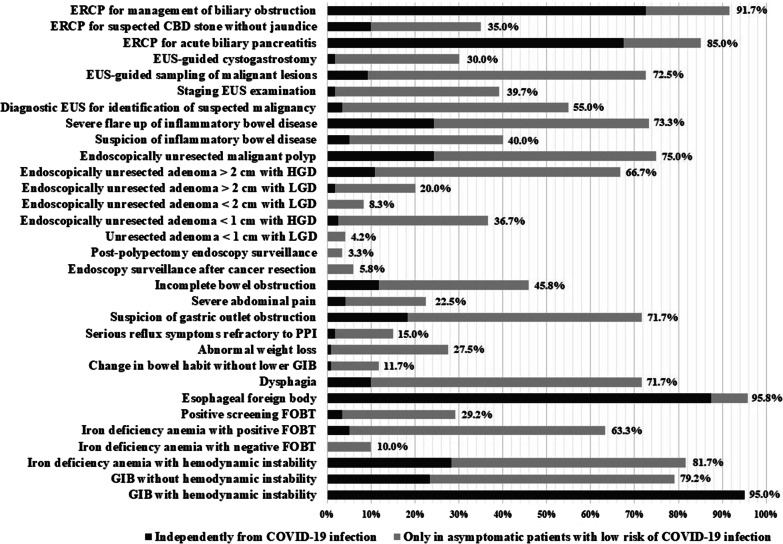
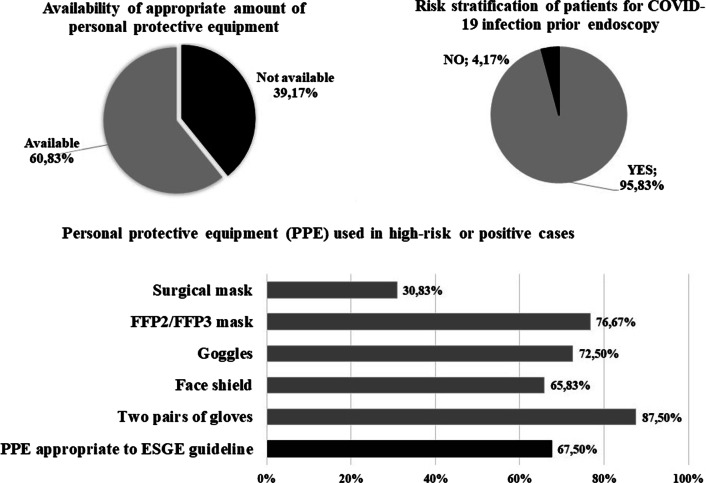
Total of 120 endoscopists from 83 institutes were enrolled of which 35.83% worked in regions with high cumulative incidence of COVID-19. Only 33.33% of them had undergone training about infection prevention in their workplace. 95.83% of endoscopists regularly used risk stratification of patients for infection prior endoscopy. While indications of examinations in low risk patients varied widely, in high-risk or positive patients endoscopy was limited to gastrointestinal bleeding (95.00%), removal of foreign body from esophagus (87.50%), management of obstructive jaundice (72.50%) and biliary pancreatitis (67.50%). Appropriate amount of personal protective equipment was available in 60.85% of endoscopy units. In high-risk or positive patients, surgical mask, filtering facepiece mask, protective eyewear and two pairs of gloves were applied in 30.83%, 76.67%, 90.00% and 87.50% of cases, respectively. Personal protective equipment fully complied with European guideline only in 67.50% of cases.
Survey found large variability in indications of endoscopy and relative weak compliance to national and international practical recommendations in terms of protective equipment. This could be improved by adequate training about infection prevention.
内镜室的医疗保健专业人员感染 COVID-19 的风险较高,因此,我们旨在确定当前大流行对现实环境中内镜单位的工作流程和感染预防控制策略的影响。
2020 年 4 月 7 日至 17 日,邀请匈牙利胃肠病学会的所有成员参加这项横断面调查研究,并完成在线匿名问卷调查。
共招募了 120 名来自 83 个研究所的内镜医生,其中 35.83%在 COVID-19 累计发病率高的地区工作。只有 33.33%的人在工作场所接受过感染预防培训。95.83%的内镜医生在进行内镜检查前会对患者进行感染风险分层。虽然低风险患者的检查指征差异很大,但在高风险或阳性患者中,内镜检查仅限于胃肠道出血(95.00%)、食管异物取出(87.50%)、梗阻性黄疸(72.50%)和胆胰炎(67.50%)。60.85%的内镜室有足够数量的个人防护设备。在高风险或阳性患者中,分别有 30.83%、76.67%、90.00%和 87.50%的患者使用外科口罩、过滤式口罩、防护眼镜和两副手套。只有 67.50%的情况完全符合欧洲指南的个人防护设备要求。
调查发现内镜检查指征差异较大,在防护设备方面相对较弱地遵守国家和国际实用建议。通过适当的感染预防培训可以改善这种情况。