Inamori Go, Kamoto Umihiro, Nakamura Fumika, Isoda Yutaka, Uozumi Azusa, Matsuda Ryosuke, Shimamura Masaki, Okubo Yusuke, Ito Shuichi, Ota Hiroki
Department of Mechanical Engineering, Yokohama National University, 79-5 Tokiwadai, Hodogaya-ku, Yokohama, Kanagawa 240-8501, Japan.
Graduate School of System Integration, Yokohama National University, 79-5 Tokiwadai, Hodogaya-ku, Yokohama, Kanagawa 240-8501, Japan.
Sci Adv. 2021 Mar 3;7(10). doi: 10.1126/sciadv.abe3793. Print 2021 Mar.
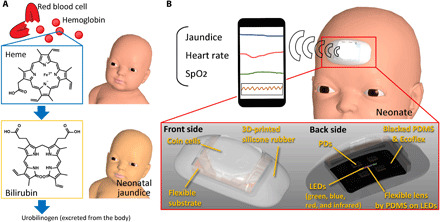
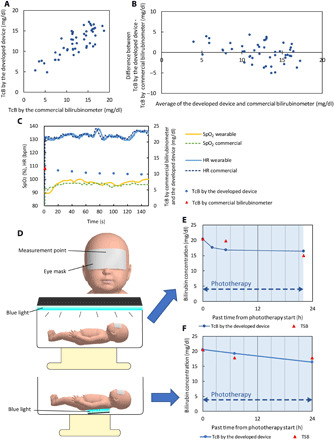
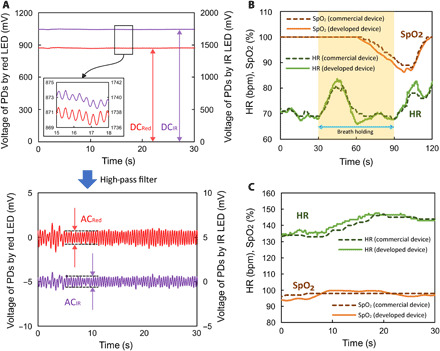
Neonatal jaundice occurs in >80% of newborns in the first week of life owing to physiological hyperbilirubinemia. Severe hyperbilirubinemia could cause brain damage owing to its neurotoxicity, a state commonly known as kernicterus. Therefore, periodic bilirubin monitoring is essential to identify infants at-risk and to initiate treatment including phototherapy. However, devices for continuous measurements of bilirubin have not been developed yet. Here, we established a wearable transcutaneous bilirubinometer that also has oxygen saturation (SpO) and heart rate (HR) sensing functionalities. Clinical experiments with neonates demonstrated the possibility of simultaneous detection of bilirubin, SpO, and HR. Moreover, our device could consistently measure bilirubin during phototherapy. These results demonstrate the potential for development of a combined treatment approach with an automatic link via the wearable bilirubinometer and phototherapy device for optimization of the treatment of neonatal jaundice.
由于生理性高胆红素血症,超过80%的新生儿在出生后第一周会出现新生儿黄疸。严重的高胆红素血症因其神经毒性可导致脑损伤,这种状态通常被称为核黄疸。因此,定期监测胆红素对于识别高危婴儿并启动包括光疗在内的治疗至关重要。然而,目前尚未开发出用于连续测量胆红素的设备。在此,我们开发了一种可穿戴式经皮胆红素仪,其还具备血氧饱和度(SpO)和心率(HR)传感功能。对新生儿进行的临床实验证明了同时检测胆红素、SpO和HR的可能性。此外,我们的设备能够在光疗期间持续测量胆红素。这些结果表明,通过可穿戴式胆红素仪与光疗设备之间的自动连接来开发联合治疗方法以优化新生儿黄疸治疗具有潜力。