Division of Neuroimmunology, Joint Research Center for Human Retrovirus Infection, Kagoshima University, Kagoshima City, Japan
Division of Neuroimmunology, Joint Research Center for Human Retrovirus Infection, Kagoshima University, Kagoshima City, Japan.
J Clin Microbiol. 2021 Apr 20;59(5). doi: 10.1128/JCM.03230-20.
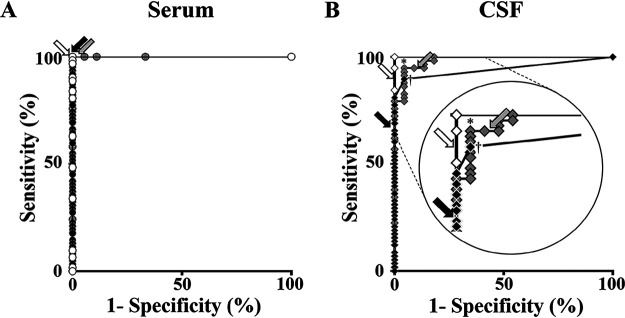
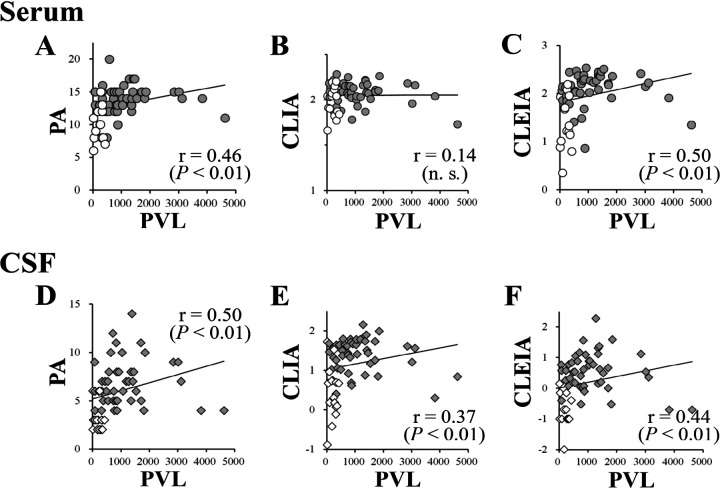
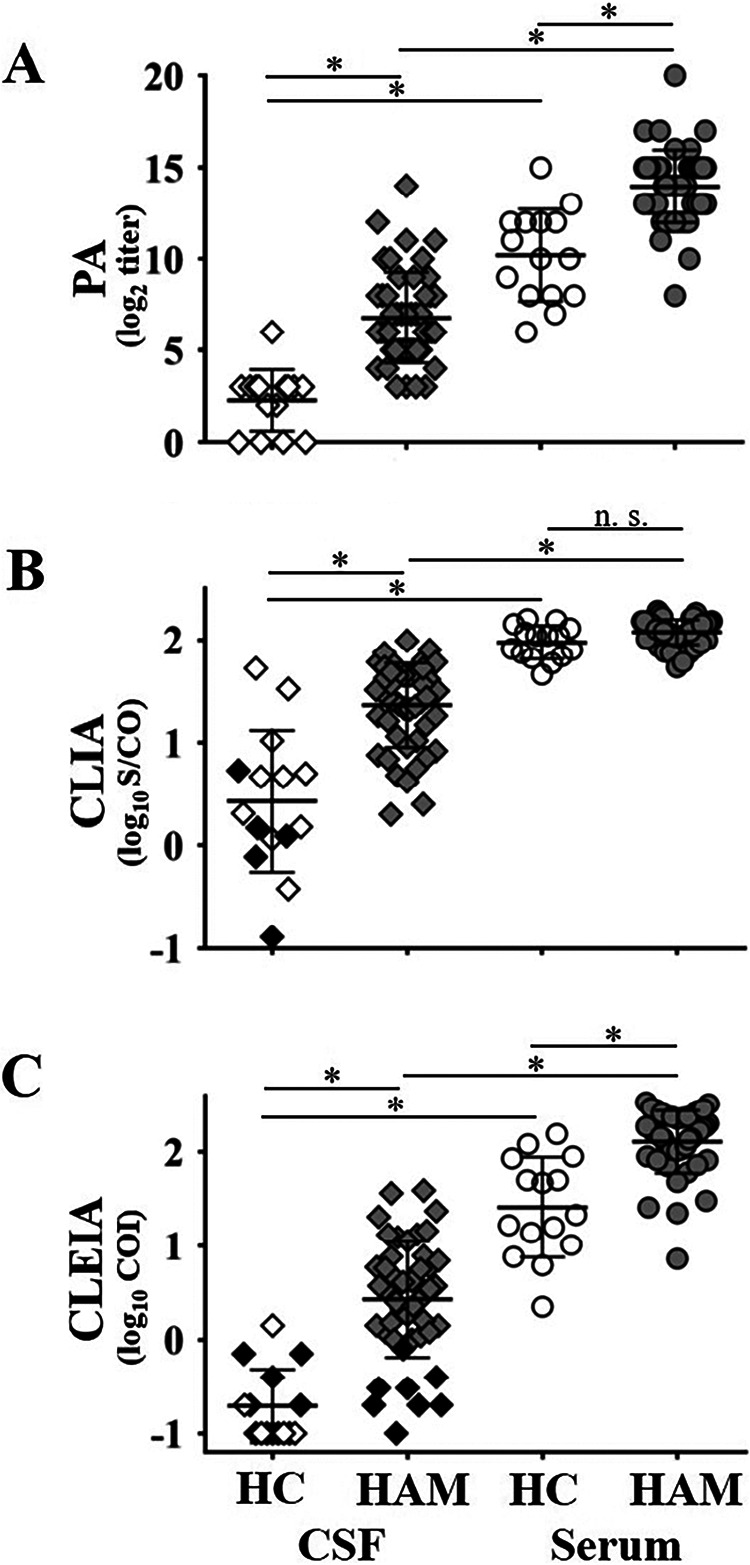
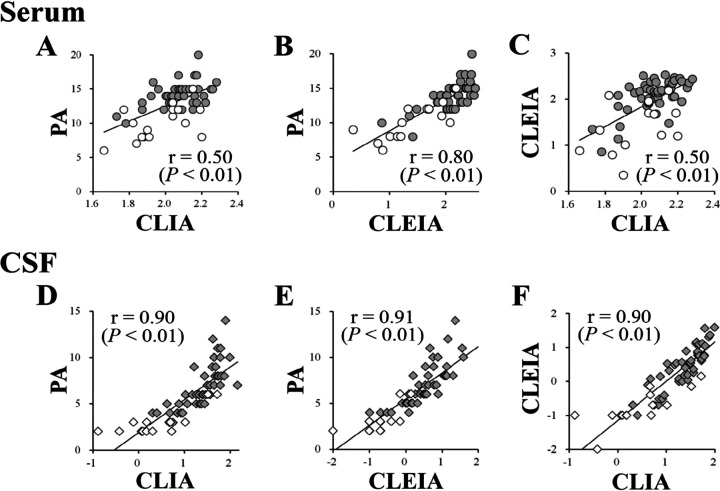
The anti-human T-cell leukemia virus type 1 (HTLV-1) antibody assay in common use has changed from the particle agglutination (PA) method to chemiluminescent immunoassay (CLIA) and chemiluminescent enzyme immunoassay (CLEIA). These assays were validated in serum but not in cerebrospinal fluid (CSF). However, anti-HTLV-1 antibody positivity in CSF is a requisite for diagnosing HTLV-1-associated myelopathy/tropical spastic paraparesis (HAM/TSP). We qualitatively compared the assays in CSF from 47 HAM/TSP patients diagnosed using PA, 15 HTLV-1 carriers (HCs), and 18 negative controls. In determining the positivity or negativity of CSF anti-HTLV-1 antibodies, we used serum cutoff points for CLIA and CLEIA because CSF cutoff points had not been decided. Truth table analysis revealed that the performance of CLIA was closer to that of PA and that CLEIA had low sensitivity. CSF antibodies from HAM/TSP patients were all positive by PA and CLIA but 83.0% positive by CLEIA. CSF antibodies from HCs were positive in 73.3%, 80.0%, and 6.7% by PA, CLIA, and CLEIA, respectively. Receiver operator characteristic curve analysis for CSF revealed that with the default cutoff point used for serum, CLIA and PA had comparable performances and CLEIA was less sensitive. The best performances of CLIA and CLEIA with adjusted cutoff points were 94.8% sensitivity and 95.5% specificity and 89.7% sensitivity and 95.5% specificity, respectively. We conclude that low-sensitivity CLEIA can underdiagnose HAM/TSP and that CLIA is a better alternative to PA in anti-HTLV-1 antibody assay for CSF with the current cutoff points.
抗人 T 细胞白血病病毒 1 型(HTLV-1)抗体检测常用的方法已从颗粒凝集(PA)法转变为化学发光免疫分析(CLIA)和化学发光酶免疫分析(CLEIA)。这些检测方法已经在血清中进行了验证,但尚未在脑脊液(CSF)中进行验证。然而,CSF 中抗 HTLV-1 抗体的阳性是诊断 HTLV-1 相关脊髓病/热带痉挛性截瘫(HAM/TSP)的必要条件。我们定性比较了 47 例使用 PA 诊断的 HAM/TSP 患者、15 例 HTLV-1 携带者(HCs)和 18 例阴性对照者的 CSF 中的检测方法。在确定 CSF 抗 HTLV-1 抗体的阳性或阴性时,我们使用了 CLIA 和 CLEIA 的血清截断值,因为尚未确定 CSF 的截断值。真值表分析表明,CLIA 的性能更接近 PA,而 CLEIA 的敏感性较低。PA 和 CLIA 均显示 HAM/TSP 患者的 CSF 抗体均为阳性,但 CLEIA 有 83.0%为阳性。HCs 的 CSF 抗体在 PA、CLIA 和 CLEIA 中分别有 73.3%、80.0%和 6.7%为阳性。CSF 的受试者工作特征曲线分析显示,在使用血清默认截断值时,CLIA 和 PA 的性能相当,而 CLEIA 的敏感性较低。调整截断值后,CLIA 和 CLEIA 的最佳性能分别为 94.8%的敏感性和 95.5%的特异性,以及 89.7%的敏感性和 95.5%的特异性。我们得出结论,低敏感性的 CLEIA 可能会漏诊 HAM/TSP,并且在使用当前截断值的 CSF 抗 HTLV-1 抗体检测中,CLIA 是 PA 的更好替代方法。