Department of Neurosurgery, Faculty of Medicine, Hokkaido University.
Kashiwaba Neurosurgical Hospital.
Neurol Med Chir (Tokyo). 2021 Apr 15;61(4):245-252. doi: 10.2176/nmc.oa.2020-0308. Epub 2021 Mar 4.
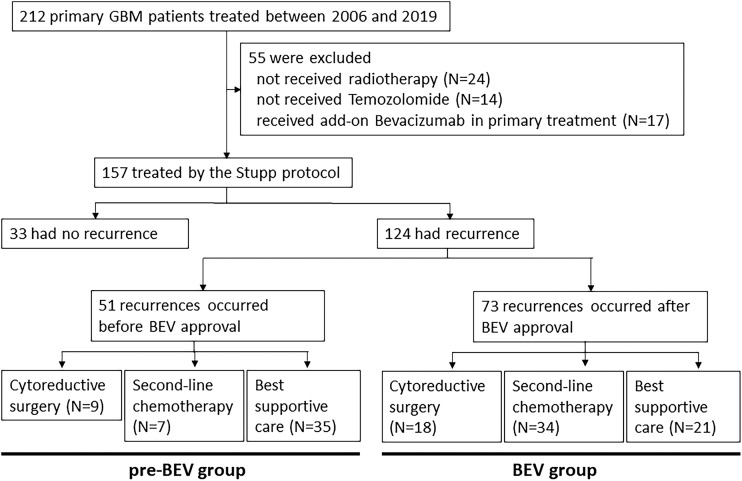
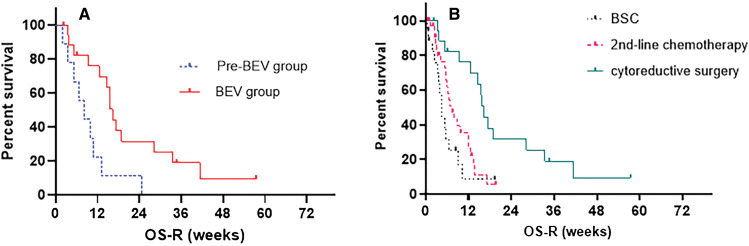
Bevacizumab (BEV) is a key anti-angiogenic agent used in the treatment for recurrent glioblastoma multiforme (GBM). The aim of this study was to investigate whether cytoreductive surgery prior to treatment with BEV contributes to prolongation of survival for patients with recurrent GBM. We retrospectively analyzed the treatment outcomes of 124 patients with recurrent GBM who were initially treated with the Stupp protocol between 2006 and 2019. Given that BEV has only been available in Japan since 2013, we grouped the patients into two groups according to the time of first recurrence: the pre-BEV group (N = 51) included patients who had recurrence before BEV approval, and the BEV group (N = 73) included patients with recurrence after BEV approval. The overall survival after first recurrence (OS-R) was analyzed according to the treatment strategy. Among 124 patients, 27 patients (19.4%) received cytoreductive surgery. There were nine cases in the pre-BEV group and 18 cases in the BEV group. Although the mean extent of resection for both groups was almost equal, OS-R was significantly different. The median OS-R was 8.1 m in the pre-BEV group and 16.3 m in the BEV group (P = 0.007). Multivariate analysis revealed that the unavailability of BEV postoperatively (P = 0.03) and decreasing performance status by surgery (P = 0.01) were significant poor prognostic factors for survival after surgery. With the advent of BEV, cytoreductive surgery might provide superior survival benefit at the time of GBM recurrence, especially in cases where surgery can be performed without deteriorating the patient's condition.
贝伐珠单抗(BEV)是一种用于治疗复发性多形性胶质母细胞瘤(GBM)的关键抗血管生成药物。本研究旨在探讨在接受 BEV 治疗之前进行细胞减灭术是否有助于延长复发性 GBM 患者的生存时间。我们回顾性分析了 2006 年至 2019 年间接受 Stupp 方案初始治疗的 124 例复发性 GBM 患者的治疗结果。由于 BEV 自 2013 年才在日本上市,我们根据首次复发时间将患者分为两组:BEV 前组(N = 51)包括 BEV 批准前复发的患者,BEV 组(N = 73)包括 BEV 批准后复发的患者。根据治疗策略分析首次复发后的总生存(OS-R)。在 124 例患者中,27 例(19.4%)接受了细胞减灭术。BEV 前组有 9 例,BEV 组有 18 例。尽管两组的平均切除程度几乎相等,但 OS-R 差异显著。BEV 前组的中位 OS-R 为 8.1 个月,BEV 组为 16.3 个月(P = 0.007)。多变量分析显示,术后无法使用 BEV(P = 0.03)和手术导致的功能状态下降(P = 0.01)是术后生存的显著不良预后因素。随着 BEV 的出现,在 GBM 复发时,细胞减灭术可能提供更好的生存获益,尤其是在手术不会使患者病情恶化的情况下。