Ji Li Li, Yeo Dongwook
The Laboratory of Physiological Hygiene and Exercise Science, School of Kinesiology, University of Minnesota Twin Cities, Minneapolis, Minnesota, USA.
Department of Orthopedic Surgery, Mayo Clinic, Rochester, Minnesota, USA.
Fac Rev. 2021 Feb 9;10:13. doi: 10.12703/r/10-13. eCollection 2021.
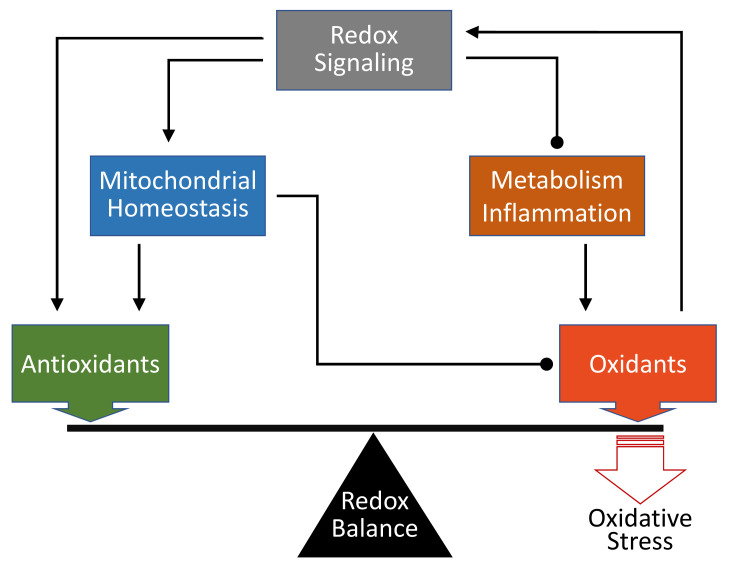
Thirty-five years ago, Sies and colleagues insightfully described the universal phenomenon that the generation of reactive oxygen species could modify macromolecules in living organisms, resulting in a wide range of measurable damage. They used the term "oxidative stress" to define the loss of the balance between oxidants and antioxidants in favor of the former. After decades of research, it became increasingly clear that cells are not simply passive receivers of oxidative modification but can act dynamically to resist and adapt to oxidants. Furthermore, many redox-sensitive pathways have been identified wherein certain oxidants (mainly hydrogen peroxide and nitric oxide) are used as messenger molecules to transduce the signals required for these adaptations. Since the turn of the century, redox signaling has developed into a vibrant multidisciplinary field of biology. To reflect the evolution of the study in this field, the definition of oxidative stress is postulated to define a state in which the pro-oxidative processes overwhelm cellular antioxidant defense due to the disruption of redox signaling and adaptation.
35年前,西厄斯及其同事深刻地描述了一个普遍现象:活性氧的产生会改变生物体内的大分子,从而导致一系列可测量的损伤。他们用“氧化应激”一词来定义氧化剂与抗氧化剂之间的平衡丧失,且前者占优的情况。经过数十年的研究,越来越清楚的是,细胞并非仅仅是氧化修饰的被动接受者,而是能够动态地采取行动来抵抗和适应氧化剂。此外,已经确定了许多氧化还原敏感途径,其中某些氧化剂(主要是过氧化氢和一氧化氮)被用作信使分子来传递这些适应性所需的信号。自世纪之交以来,氧化还原信号传导已发展成为一个充满活力的多学科生物学领域。为了反映该领域研究的演变,氧化应激的定义被假定为一种由于氧化还原信号传导和适应性破坏而导致促氧化过程压倒细胞抗氧化防御的状态。