
微型孤子微波源中色散波诱导噪声限制
Dispersive-wave induced noise limits in miniature soliton microwave sources.
作者信息
Yang Qi-Fan, Ji Qing-Xin, Wu Lue, Shen Boqiang, Wang Heming, Bao Chengying, Yuan Zhiquan, Vahala Kerry
机构信息
T. J. Watson Laboratory of Applied Physics, California Institute of Technology, Pasadena, CA, USA.
出版信息
Nat Commun. 2021 Mar 4;12(1):1442. doi: 10.1038/s41467-021-21658-7.
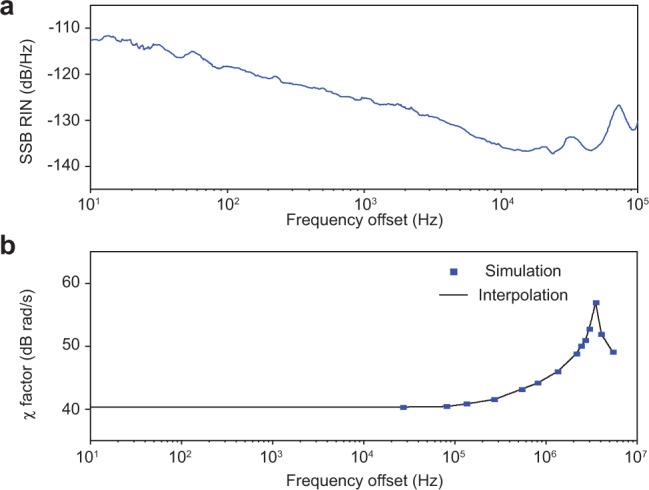
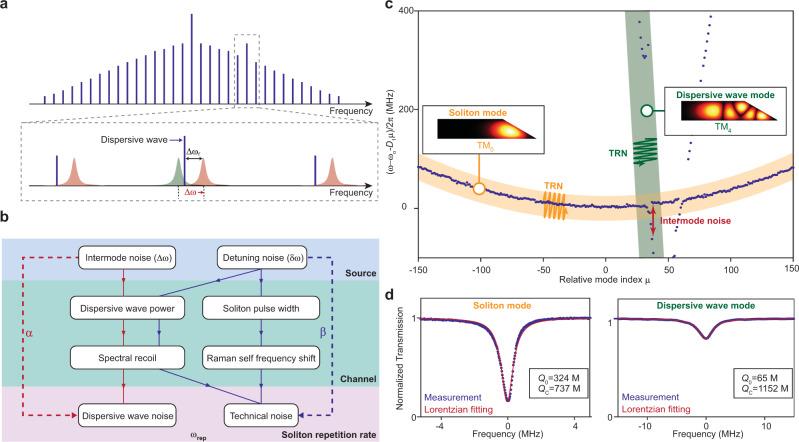
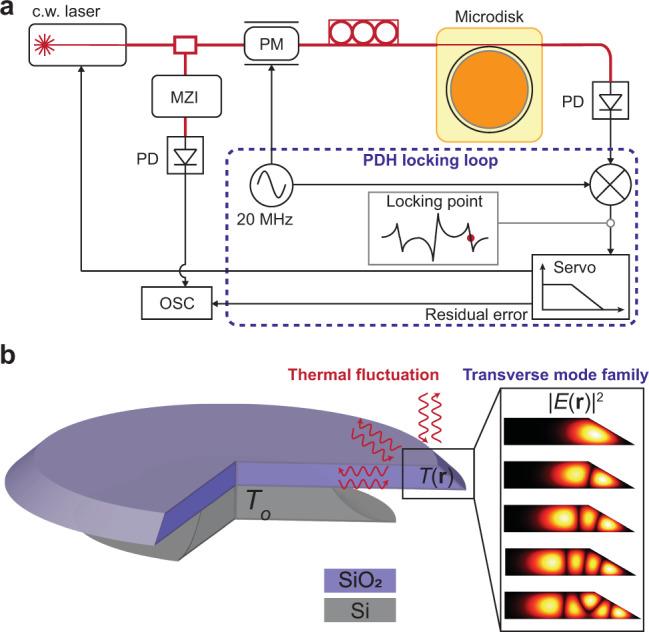
Compact, low-noise microwave sources are required throughout a wide range of application areas including frequency metrology, wireless-communications and airborne radar systems. And the photonic generation of microwaves using soliton microcombs offers a path towards integrated, low noise microwave signal sources. In these devices, a so called quiet-point of operation has been shown to reduce microwave frequency noise. Such operation decouples pump frequency noise from the soliton's motion by balancing the Raman self-frequency shift with dispersive-wave recoil. Here, we explore the limit of this noise suppression approach and reveal a fundamental noise mechanism associated with fluctuations of the dispersive wave frequency. At the same time, pump noise reduction by as much as 36 dB is demonstrated. This fundamental noise mechanism is expected to impact microwave noise (and pulse timing jitter) whenever solitons radiate into dispersive waves belonging to different spatial mode families.
在包括频率计量、无线通信和机载雷达系统在内的广泛应用领域中,都需要紧凑、低噪声的微波源。利用孤子微梳产生微波为实现集成、低噪声微波信号源提供了一条途径。在这些器件中,已证明存在一个所谓的工作静点可降低微波频率噪声。这种工作方式通过平衡拉曼自频移和色散波反冲,使泵浦频率噪声与孤子运动解耦。在此,我们探索这种噪声抑制方法的极限,并揭示一种与色散波频率波动相关的基本噪声机制。同时,展示了泵浦噪声降低高达36 dB的效果。每当孤子辐射到属于不同空间模式族的色散波中时,这种基本噪声机制预计会影响微波噪声(以及脉冲定时抖动)。




 Zotero 插件