Li Yan, Gou Hongchao, Chu Pinpin, Zhang Kunli, Jiang Zhiyong, Cai Rujian, Song Shuai, Bian Zhibiao, Li Chunling
Institute of Animal Health, Guangdong Academy of Agricultural Sciences, Guangzhou, China.
Guangdong Provincial Key Laboratory of Livestock Disease Prevention, Guangzhou, China.
Front Vet Sci. 2021 Feb 16;8:639141. doi: 10.3389/fvets.2021.639141. eCollection 2021.
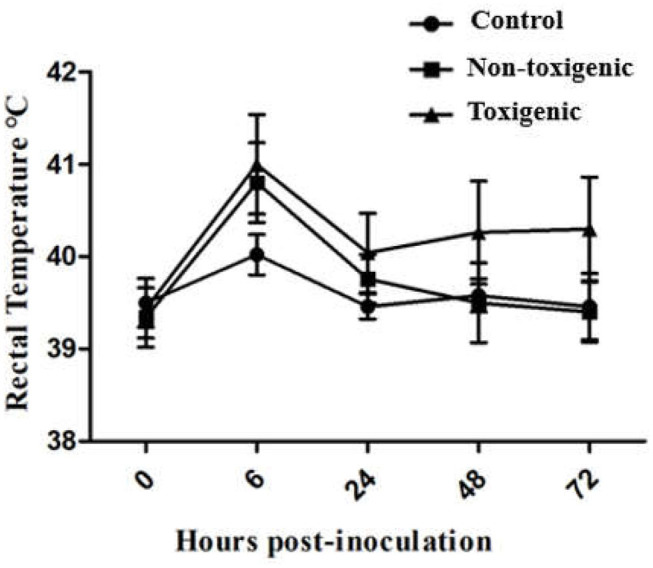
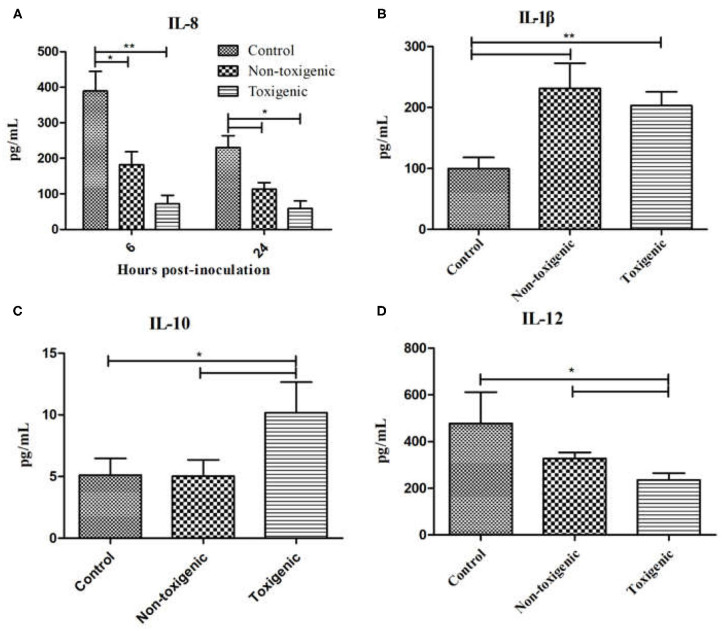
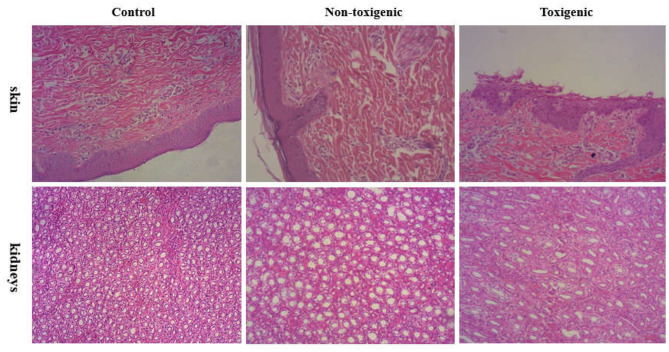
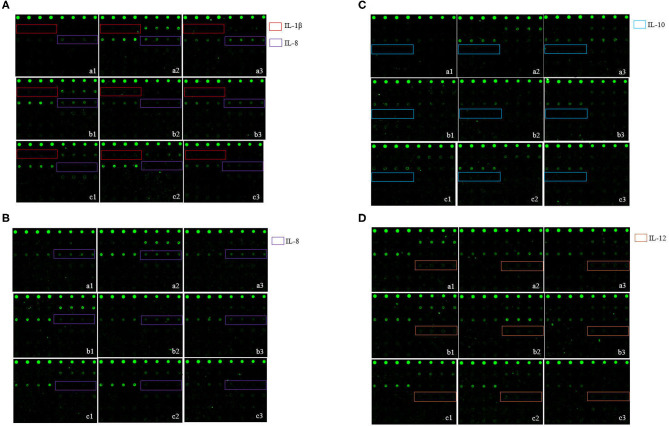
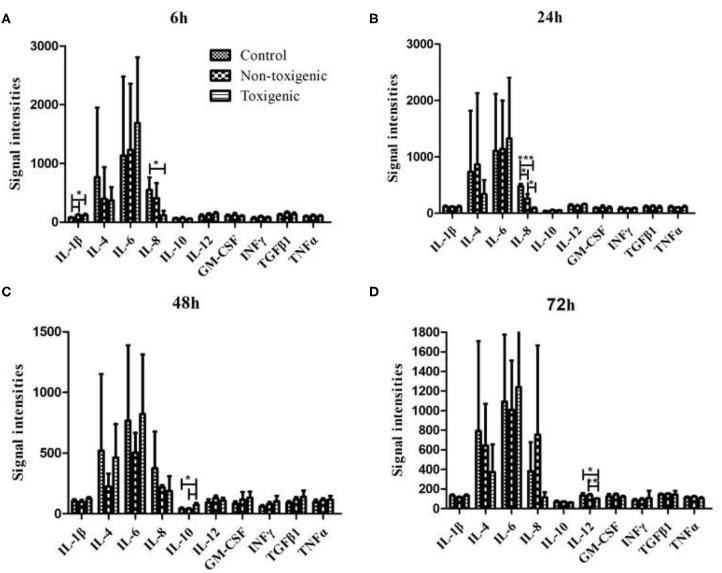
is the most common causative agent of exudative epidermitis (EE) in piglets. can be grouped into toxigenic and non-toxigenic strains based on its ability to cause EE in pigs. However, the inflammatory response of piglets infected with toxigenic and non-toxigenic has not been elucidated. In this study, we evaluated the serum cytokine profile in piglets inoculated with toxigenic and non-toxigenic strains and recorded the clinical signs in piglets. Fifteen piglets were divided into three groups ( = 5) and inoculated with a toxigenic strain (ZC-4), a non-toxigenic strain (CF-1), and PBS (control), respectively. The changes in serum levels of cytokines (interleukin [IL]-1β, IL-4, IL-6, IL-8, IL-10, IL-12, granulocyte-macrophage colony-stimulating factor, interferon-γ, transforming growth factor-β1, and tumor necrosis factor-α) were evaluated using a cytokine array at 6, 24, 48, and 72 h post inoculation. The results showed that piglets infected with the toxigenic strain exhibited more severe clinical signs and higher mortality than those infected with the non-toxigenic strain. The serum levels of pro-inflammatory cytokine IL-1β were significantly increased in toxigenic-and non-toxigenic-strain-infected piglets compared to those in the control group ( < 0.05), while the anti-inflammatory cytokine IL-10 was significantly up-regulated only in toxigenic group than in control group ( < 0.05). These results indicated that piglets infected with toxigenic and non-toxigenic showed differential infection status and inflammatory responses. Both toxigenic- and non-toxigenic- infection could induce a pro-inflammatory reaction in piglets. In addition, the toxigenic strain induced a strong anti-inflammatory response in piglets as indicated by the increased serum level of IL-10, which may be associated with the severe clinical signs and increased mortality and may be the key cytokine response responsible for pathogenic mechanisms of .
是仔猪渗出性皮炎(EE)最常见的致病因子。可根据其在猪中引起EE的能力分为产毒菌株和无毒菌株。然而,感染产毒和无毒菌株的仔猪的炎症反应尚未阐明。在本研究中,我们评估了接种产毒和无毒菌株的仔猪的血清细胞因子谱,并记录了仔猪的临床症状。15头仔猪分为三组(每组n = 5),分别接种产毒菌株(ZC-4)、无毒菌株(CF-1)和PBS(对照组)。在接种后6、24、48和72小时使用细胞因子阵列评估细胞因子(白细胞介素[IL]-1β、IL-4、IL-6、IL-8、IL-10、IL-12、粒细胞-巨噬细胞集落刺激因子、干扰素-γ、转化生长因子-β1和肿瘤坏死因子-α)血清水平的变化。结果表明,感染产毒菌株的仔猪比感染无毒菌株的仔猪表现出更严重的临床症状和更高的死亡率。与对照组相比,产毒和无毒菌株感染的仔猪中促炎细胞因子IL-1β的血清水平显著升高(P < 0.05),而抗炎细胞因子IL-10仅在产毒组中比对照组显著上调(P < 0.05)。这些结果表明,感染产毒和无毒菌株的仔猪表现出不同的感染状态和炎症反应。产毒和无毒菌株感染均可在仔猪中诱导促炎反应。此外,产毒菌株诱导仔猪产生强烈的抗炎反应,IL-10血清水平升高表明了这一点,这可能与严重的临床症状和死亡率增加有关,可能是负责致病机制的关键细胞因子反应。