Animal Disease Diagnostic Division, Animal and Plant Quarantine Agency, 177 Hyeoksin 8-ro, Gimcheon, 39660, Republic of Korea.
Bacterial Disease Division, Animal and Plant Quarantine Agency, Gimcheon, 39660, South Korea.
BMC Vet Res. 2024 Nov 28;20(1):533. doi: 10.1186/s12917-024-04396-y.
Staphylococcus hyicus causes porcine exudative epidermitis, predominantly affecting suckling and weaned piglets. This bacterium produces various exfoliative toxins (ExhA, ExhB, ExhC, ExhD, SHETA, and SHETB), which are responsible for the clinical manifestations of exudative epidermitis. However, treatment failure is common due to frequent antimicrobial resistance in porcine strains. Therefore, this study aimed to identify the genes encoding exfoliative toxins and assess the antimicrobial resistance profiles of S. hyicus. A total of 17 S. hyicus isolates were collected from piglets with skin lesions from 2014 to 2021. All strains were subjected to species-specific polymerase chain reaction targeting sodA to confirm the presence of S. hyicus, and polymerase chain reaction amplification of exfoliative toxin genes (exhA, exhB, exhC, exhD, sheta, and shetb) was performed to differentiate toxigenic strains. Pulsed-field gel electrophoresis analysis and minimum inhibitory concentration tests using broth microdilution were conducted to further analyze the strains.
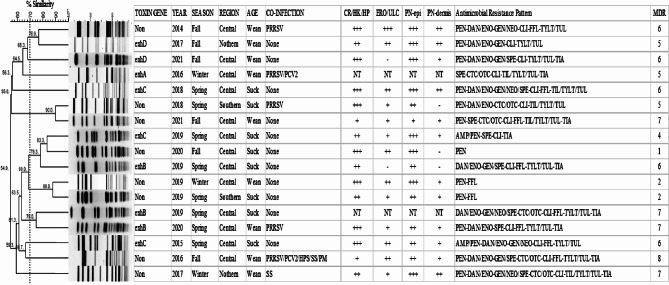
Exfoliative toxin genes were detected in 52.9% (n = 9) of the S. hyicus isolates, with notable detection of exhB (17.6%), exhC (17.6%), exhD (11.8%), exhA (5.9%), sheta (0%), and shetb (0%). Pulsed-field gel electrophoresis analysis categorized the isolates into 11 pulsotypes with 70% similarity. Among 18 tested antimicrobials, all isolates exhibited 100% susceptibility to ceftiofur and sulfonamides and high susceptibility rates to neomycin, tilmicosin, and tetracyclines. Whereas the susceptibility rate of spectinomycin was 0% in all isolates, multidrug resistance was observed in 82.4% of the isolates, and in all toxigenic strains.
These findings provide crucial insights for monitoring and devising effective treatment strategies for managing exudative epidermitis in pigs caused by S. hyicus.
猪葡萄球菌可引起猪渗出性皮炎,主要影响哺乳仔猪和断奶仔猪。该细菌产生各种脱落毒素(ExhA、ExhB、ExhC、ExhD、SHETA 和 SHETB),这些毒素是渗出性皮炎临床症状的原因。然而,由于猪株频繁出现抗菌药物耐药性,治疗失败很常见。因此,本研究旨在鉴定编码脱落毒素的基因,并评估猪葡萄球菌的抗菌药物耐药谱。从 2014 年至 2021 年,从患有皮肤病变的仔猪中收集了 17 株猪葡萄球菌分离株。所有菌株均进行了 sodA 种特异性聚合酶链反应,以确认存在猪葡萄球菌,并且进行了脱落毒素基因(exhA、exhB、exhC、exhD、shetA 和 shetB)的聚合酶链反应扩增,以区分产毒株。进行脉冲场凝胶电泳分析和肉汤微量稀释最小抑菌浓度试验,以进一步分析菌株。
在 52.9%(n=9)的猪葡萄球菌分离株中检测到脱落毒素基因,其中 exhB(17.6%)、exhC(17.6%)、exhD(11.8%)、exhA(5.9%)、shetA(0%)和 shetB(0%)的检出率较高。脉冲场凝胶电泳分析将分离株分为 11 个脉冲型,相似度为 70%。在 18 种测试的抗菌药物中,所有分离株对头孢噻呋和磺胺类药物均表现出 100%的敏感性,对新霉素、替米考星和四环素也表现出较高的敏感性。然而,所有分离株对大观霉素的敏感性均为 0%,82.4%的分离株表现出多重耐药性,所有产毒株均表现出多重耐药性。
这些发现为监测和制定针对猪葡萄球菌引起的猪渗出性皮炎的有效治疗策略提供了重要信息。