Department of Food and Nutrition, Obesity/Diabetes Research Center, Hoseo University, 165 Sechul-Ri, Baebang-Yup, Asan-Si, ChungNam-Do 336-795, Korea.
City Dermatologic Clinic, Daejeon 34141, Korea.
Int J Environ Res Public Health. 2021 Feb 19;18(4):2044. doi: 10.3390/ijerph18042044.
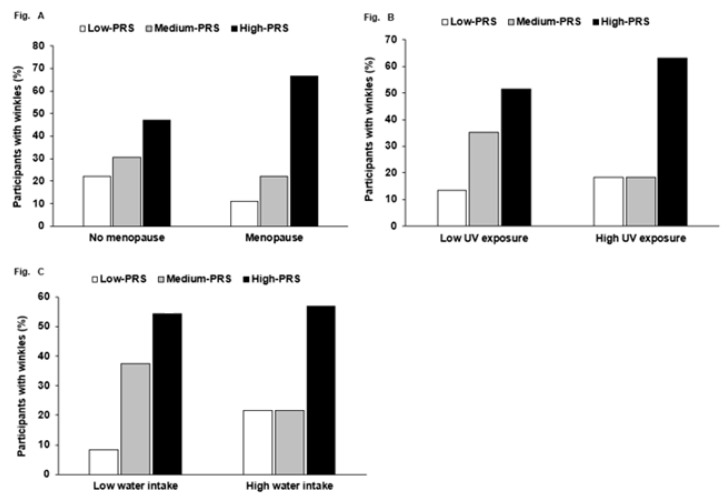
Genetic and environmental factors influence wrinkle development. We evaluated the polygenetic risk score (PRS) by pooling the selected single nucleotide polymorphisms (SNPs) from a genome-wide association study (GWAS) for wrinkles and the interaction of PRS with lifestyle factors in middle-aged women. Under the supervision of a dermatologist, the skin status of 128 women aged over 40 years old was evaluated with Mark-Vu, a skin diagnosis system. PRS was generated from the selected SNPs for wrinkle risk from the genome-wide association study. Lifestyle interactions with PRS were also evaluated for wrinkle risk. Participants in the wrinkled group were more likely to be post-menopausal, eat less fruit, take fewer vitamin supplements, exercise less, and be more tired after awakening in the morning than those in the less-wrinkled group. The PRS included _rs1861003, _rs6469206, and _rs805698. Subjects with high PRS had a wrinkle risk 15.39-fold higher than those with low PRS after adjusting for covariates, and they had a 10.64-fold higher risk of a large skin pore size. Menopause, UV exposure, and water intake interacted with PRS for wrinkle risk: the participants with high PRS had a much higher incidence of wrinkle risk than those with low PRS, only among post-menopausal women and those with UV exposure. Only with low water intake did the participants with medium PRS have increased wrinkle risk. In conclusion, women aged >40 years with high PRS-related collagen metabolism may possibly avoid wrinkle risk by avoiding UV exposure by applying sunscreen, maintaining sufficient water intake, and managing estrogen deficiency.
遗传和环境因素影响皱纹的发展。我们通过汇总来自一项针对皱纹的全基因组关联研究(GWAS)的选定单核苷酸多态性(SNP)和中年女性中PRS 与生活方式因素的相互作用,评估了多基因风险评分(PRS)。在皮肤科医生的监督下,使用 Mark-Vu 皮肤诊断系统评估了 128 名 40 岁以上女性的皮肤状况。PRS 是根据全基因组关联研究中与皱纹风险相关的选定 SNP 生成的。还评估了生活方式与 PRS 相互作用对皱纹风险的影响。皱纹组的参与者更有可能处于绝经后、水果吃得少、维生素补充剂吃得少、锻炼少,并且比皱纹少的组更容易在早晨醒来后感到疲倦。PRS 包括 _rs1861003、_rs6469206 和 _rs805698。调整协变量后,高 PRS 受试者的皱纹风险比低 PRS 受试者高 15.39 倍,大毛孔的风险高 10.64 倍。绝经、紫外线暴露和水摄入与 PRS 相互作用,影响皱纹风险:高 PRS 的参与者的皱纹风险比低 PRS 的参与者高得多,仅在绝经后女性和暴露于紫外线的女性中。只有低水摄入时,中 PRS 的参与者才会增加皱纹风险。总之,年龄>40 岁的女性,如果与胶原蛋白代谢相关的 PRS 较高,可能可以通过涂抹防晒霜避免紫外线暴露、保持充足的水分摄入和管理雌激素缺乏来避免皱纹风险。