Lang Angelica E, Lundquist Erik A
Department of Molecular Biosciences, The University of Kansas, Lawrence, KS 66046, USA.
J Dev Biol. 2021 Feb 19;9(1):7. doi: 10.3390/jdb9010007.
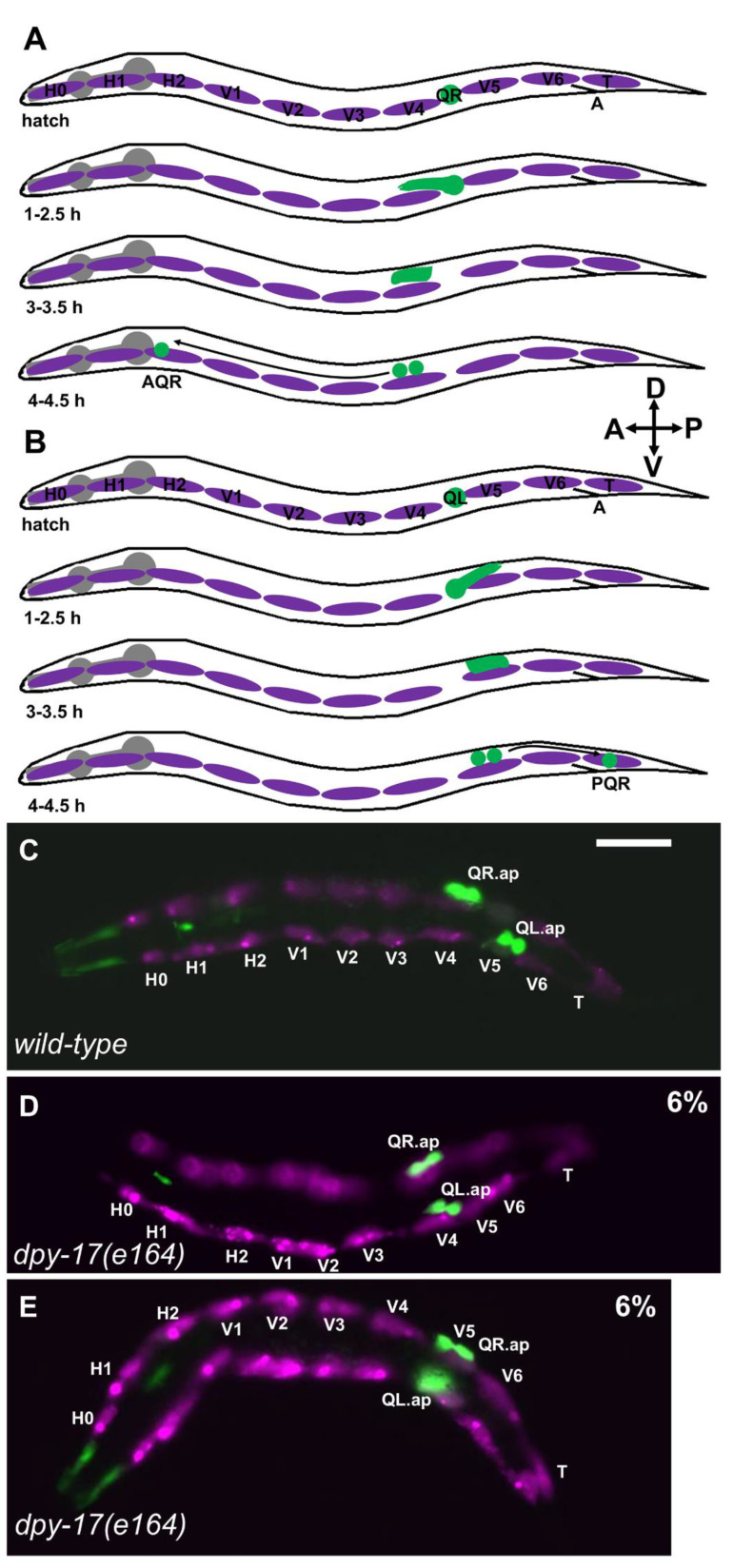
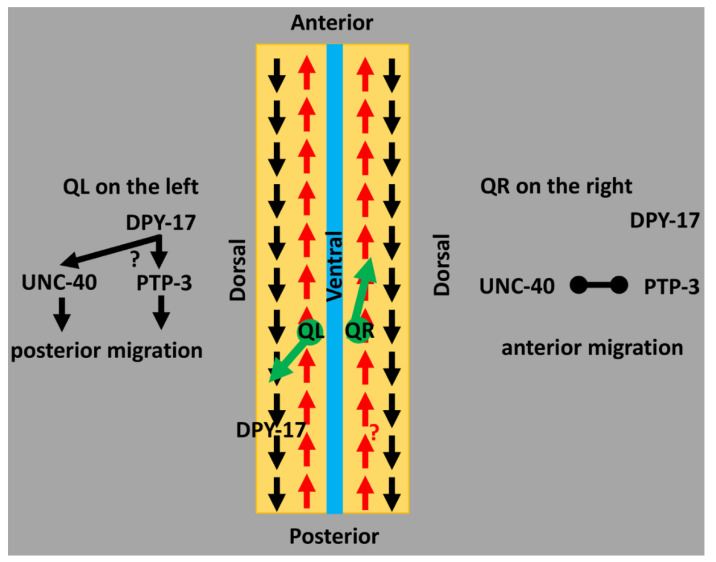
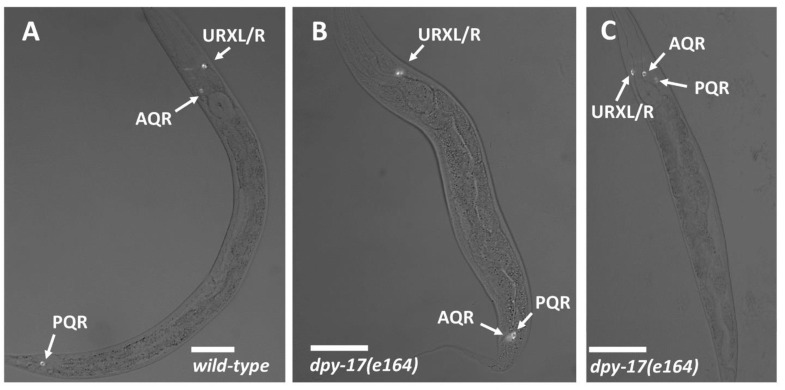
Cell adhesion molecules and their extracellular ligands control morphogenetic events such as directed cell migration. The migration of neuroblasts and neural crest cells establishes the structure of the central and peripheral nervous systems. In , the bilateral Q neuroblasts and their descendants undergo long-range migrations with left/right asymmetry. QR and its descendants on the right migrate anteriorly, and QL and its descendants on the left migrate posteriorly, despite identical patterns of cell division, cell death, and neuronal generation. The initial direction of protrusion of the Q cells relies on the left/right asymmetric functions of the transmembrane receptors UNC-40/DCC and PTP-3/LAR in the Q cells. Here, we show that Q cell left/right asymmetry of migration is independent of the GPA-16/Ga pathway which regulates other left/right asymmetries, including nervous system L/R asymmetry. No extracellular cue has been identified that guides initial Q anterior versus posterior migrations. We show that collagens DPY-17 and SQT-3 control initial Q direction of protrusion. Genetic interactions with UNC-40/DCC and PTP-3/LAR suggest that DPY-17 and SQT-3 drive posterior migration and might act with both receptors or in a parallel pathway. Analysis of mutants in other collagens and extracellular matrix components indicated that general perturbation of collagens and the extracellular matrix (ECM) did not result in directional defects, and that the effect of DPY-17 and SQT-3 on Q direction is specific. DPY-17 and SQT-3 are components of the cuticle, but a role in the basement membrane cannot be excluded. Possibly, DPY-17 and SQT-3 are part of a pattern in the cuticle and/or basement membrane that is oriented to the anterior-posterior axis of the animal and that is deciphered by the Q cells in a left-right asymmetric fashion. Alternatively, DPY-17 and SQT-3 might be involved in the production or stabilization of a guidance cue that directs Q migrations. In any case, these results describe a novel role for the DPY-17 and SQT-3 collagens in directing posterior Q neuroblast migration.
细胞黏附分子及其细胞外配体控制着诸如定向细胞迁移等形态发生事件。神经母细胞和神经嵴细胞的迁移建立了中枢和外周神经系统的结构。在[具体情境未提及]中,双侧的Q神经母细胞及其后代经历了具有左右不对称性的长距离迁移。右侧的QR及其后代向前迁移,而左侧的QL及其后代向后迁移,尽管它们的细胞分裂、细胞死亡和神经元生成模式相同。Q细胞突起的初始方向依赖于Q细胞中跨膜受体UNC-40/DCC和PTP-3/LAR的左右不对称功能。在这里,我们表明Q细胞迁移的左右不对称性独立于调节其他左右不对称性(包括神经系统左右不对称性)的GPA-16/Ga途径。尚未确定引导Q细胞初始前后迁移的细胞外信号。我们表明胶原蛋白DPY-17和SQT-3控制Q细胞突起的初始方向。与UNC-40/DCC和PTP-3/LAR基因相互作用表明,DPY-17和SQT-3驱动向后迁移,可能与这两种受体共同作用或通过平行途径发挥作用。对其他胶原蛋白和细胞外基质成分突变体的分析表明,胶原蛋白和细胞外基质(ECM)的普遍扰动不会导致方向缺陷,并且DPY-17和SQT-3对Q细胞方向的影响是特异性的。DPY-17和SQT-3是表皮的成分,但不能排除其在基底膜中的作用。可能,DPY-17和SQT-3是表皮和/或基底膜中一种模式的一部分,该模式与动物的前后轴定向,并且被Q细胞以左右不对称的方式解读。或者,DPY-17和SQT-3可能参与产生或稳定引导Q细胞迁移的引导信号。无论如何,这些结果描述了DPY-17和SQT-3胶原蛋白在引导Q神经母细胞向后迁移中的新作用。