Antov Petar, Krišt'ák L'uboš, Réh Roman, Savov Viktor, Papadopoulos Antonios N
Faculty of Forest Industry, University of Forestry, 1797 Sofia, Bulgaria.
Faculty of Wood Sciences and Technology, Technical University in Zvolen, 96001 Zvolen, Slovakia.
Polymers (Basel). 2021 Feb 21;13(4):639. doi: 10.3390/polym13040639.
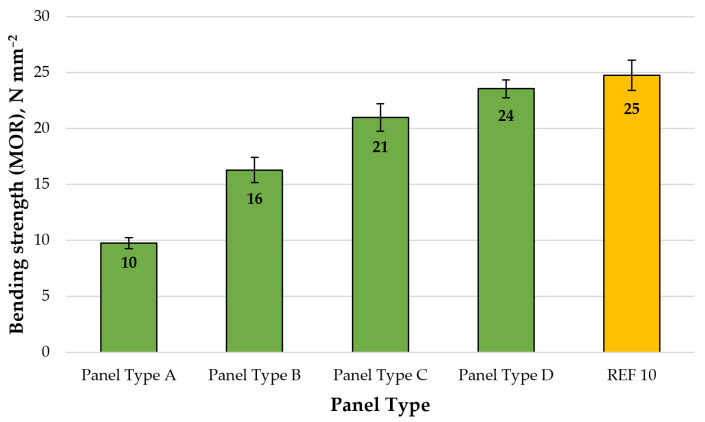
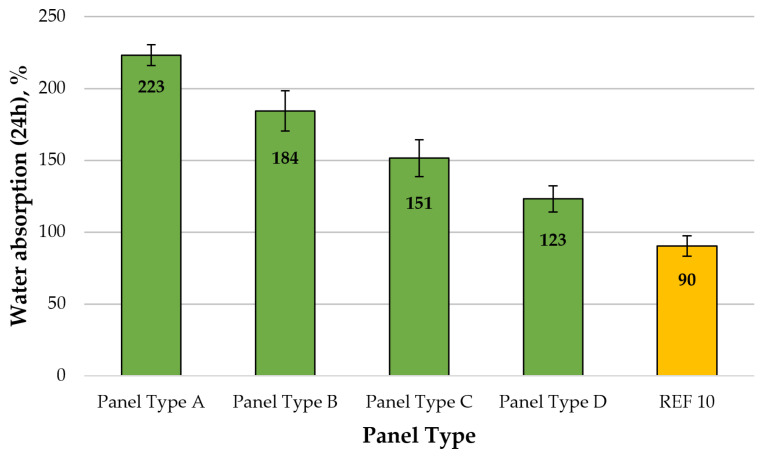
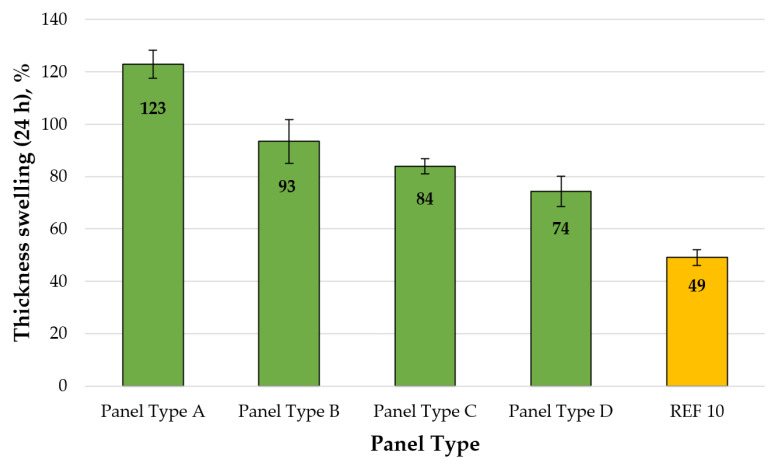
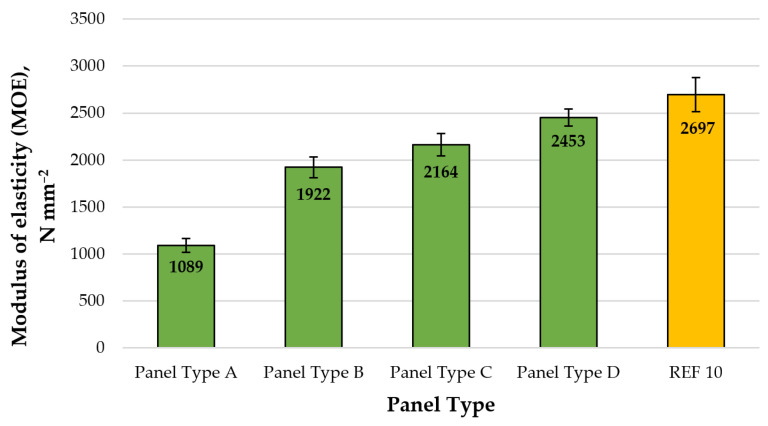
The potential of using residual softwood fibers from the pulp and paper industry for producing eco-friendly, zero-formaldehyde fiberboard panels, bonded with calcium lignosulfonate (CLS) as a lignin-based, formaldehyde free adhesive, was investigated in this work. Fiberboard panels were manufactured in the laboratory by applying CLS addition content ranging from 8% to 14% (on the dry fibers). The physical and mechanical properties of the developed composites, i.e., water absorption (WA), thickness swelling (TS), modulus of elasticity (MOE), bending strength (MOR), as well as the free formaldehyde emission, were evaluated according to the European norms. In general, only the composites, developed with 14% CLS content, exhibited MOE and MOR values, comparable with the standard requirements for medium-density fiberboards (MDF) for use in dry conditions. All laboratory-produced composites demonstrated significantly deteriorated moisture-related properties, i.e., WA (24 h) and TS (24 h), which is a major drawback. Noticeably, the fiberboards produced had a close-to-zero formaldehyde content, reaching the super E0 class (≤1.5 mg/100 g), with values, ranging from 0.8 mg/100 g to 1.1 mg/100 g, i.e., equivalent to formaldehyde emission of natural wood. The amount of CLS adhesive had no significant effect on formaldehyde content.
本研究探讨了利用制浆造纸工业剩余的软木纤维,生产环保型零甲醛纤维板面板的潜力,该面板采用木质素磺酸钙(CLS)作为无甲醛的木质素基粘合剂进行粘结。在实验室中,通过添加8%至14%(基于干纤维)的CLS来制造纤维板面板。根据欧洲标准,对所开发复合材料的物理和力学性能,即吸水率(WA)、厚度膨胀率(TS)、弹性模量(MOE)、抗弯强度(MOR)以及游离甲醛释放量进行了评估。总体而言,只有CLS含量为14%的复合材料的MOE和MOR值与用于干燥条件的中密度纤维板(MDF)的标准要求相当。所有实验室生产的复合材料均表现出与水分相关的性能显著恶化,即WA(24小时)和TS(24小时),这是一个主要缺点。值得注意的是,所生产的纤维板甲醛含量接近零,达到了超级E0级(≤1.5毫克/100克),其值在0.8毫克/100克至1.1毫克/100克之间,即相当于天然木材的甲醛释放量。CLS粘合剂的用量对甲醛含量没有显著影响。