Departamento de Medicina Preventiva y Salud Pública, Universidad de Navarra, 31008 Pamplona, Spain.
IdiSNA, Navarra Institute for Health Research, 31008 Pamplona, Spain.
Nutrients. 2021 Feb 21;13(2):687. doi: 10.3390/nu13020687.
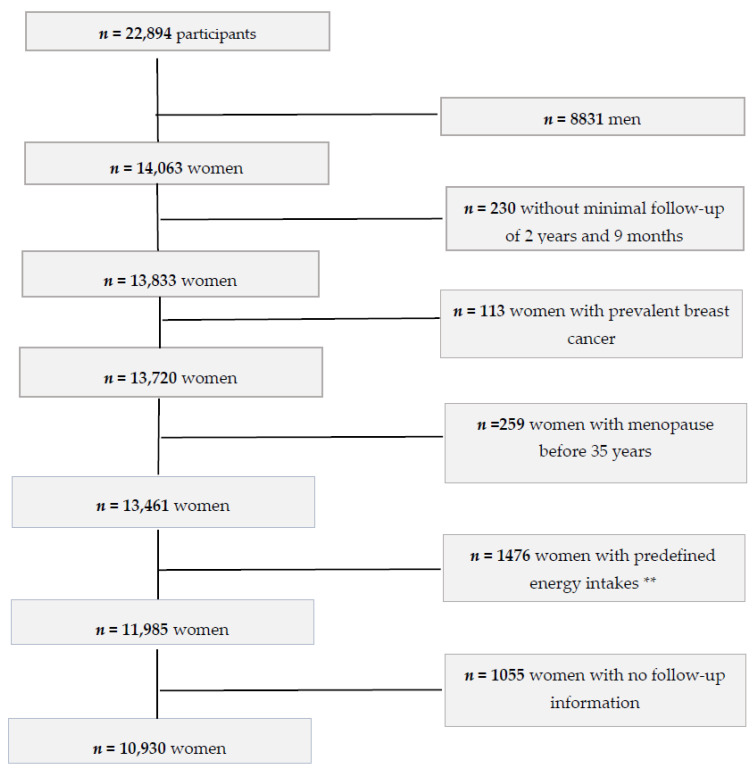
Dairy products might influence breast cancer (BC) risk. However, evidence is inconsistent. We sought to examine the association between dairy product consumption-and their subtypes-and incident BC in a Mediterranean cohort. The SUN ("Seguimiento Universidad de Navarra") Project is a Spanish dynamic ongoing cohort of university graduates. Dairy product consumption was estimated through a previously validated 136-item food frequency questionnaire (FFQ). Incident BC was reported in biennial follow-up questionnaires and confirmed with revision of medical records and consultation of the National Death Index. Hazard ratios (HR) and 95% confidence intervals (CI) were estimated with Cox regression models. Among 123,297 women-years of follow-up (10,930 women, median follow-up 12.1 years), we confirmed 119 incident BC cases. We found a nonlinear association between total dairy product consumption and BC incidence ( = 0.048) and a significant inverse association for women with moderate total dairy product consumption (HR = 0.49 (95% CI 0.28-0.84); HR = 0.49 (95% CI 0.29-0.84) = 0.623) and with moderate low-fat dairy product consumption (HR = 0.58 (95% CI 0.35-0.97); HR = 0.55 (95% CI 0.32-0.92), = 0.136). In stratified analyses, we found a significant inverse association between intermediate low-fat dairy product consumption and premenopausal BC and between medium total dairy product consumption and postmenopausal BC. Thus, dairy products, especially low-fat dairy products, may be considered within overall prudent dietary patterns.
乳制品可能会影响乳腺癌(BC)的发病风险。然而,现有证据并不一致。我们旨在研究在一个地中海队列中乳制品的摄入及其亚型与乳腺癌发病风险的相关性。SUN(“纳瓦拉大学随访研究”)项目是一个西班牙动态的正在进行的大学生队列研究。乳制品的摄入量是通过之前验证过的 136 项食物频率问卷(FFQ)来估计的。乳腺癌的发病情况通过两年一次的随访调查问卷进行报告,并通过复查病历和查阅国家死亡索引来进行确认。使用 Cox 回归模型估计了风险比(HR)和 95%置信区间(CI)。在 123,297 人年的随访期间(10,930 名女性,中位随访时间为 12.1 年),我们确认了 119 例乳腺癌发病病例。我们发现乳制品总摄入量与乳腺癌发病风险之间存在非线性关系( = 0.048),而对于中等乳制品总摄入量的女性,这种关联呈显著负相关(HR = 0.49(95%CI 0.28-0.84);HR = 0.49(95%CI 0.29-0.84), = 0.623),与中等低脂乳制品摄入量的女性呈显著负相关(HR = 0.58(95%CI 0.35-0.97);HR = 0.55(95%CI 0.32-0.92), = 0.136)。在分层分析中,我们发现中等低脂乳制品摄入量与绝经前乳腺癌和中等总乳制品摄入量与绝经后乳腺癌之间存在显著的负相关关系。因此,乳制品,特别是低脂乳制品,可能被认为是整体谨慎饮食模式的一部分。