Urh Kristian, Žlajpah Margareta, Zidar Nina, Boštjančič Emanuela
Faculty of Medicine, Institute of Pathology, University of Ljubljana, 1000 Ljubljana, Slovenia.
Biomedicines. 2021 Feb 11;9(2):179. doi: 10.3390/biomedicines9020179.
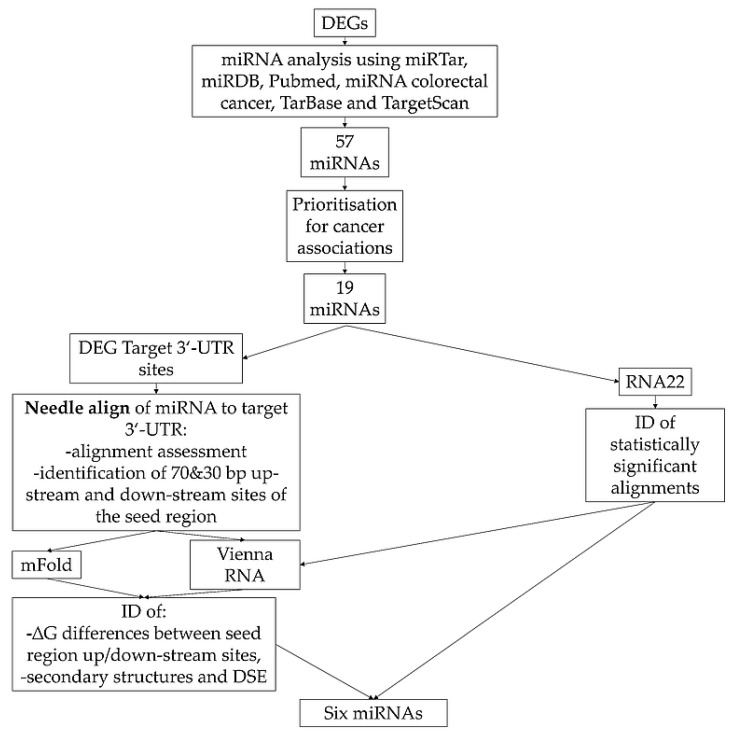
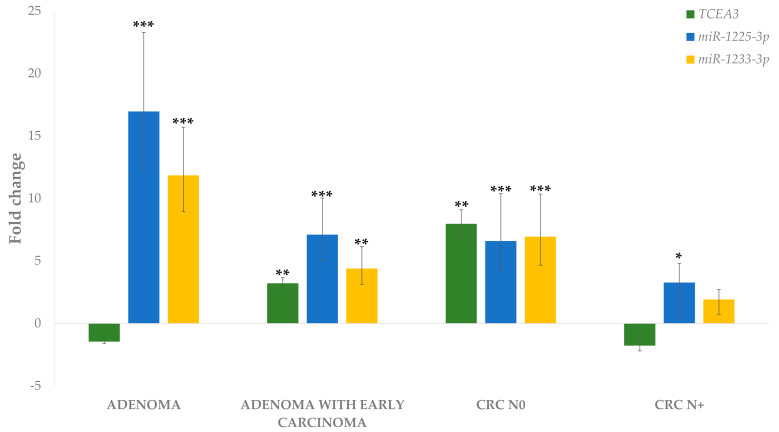
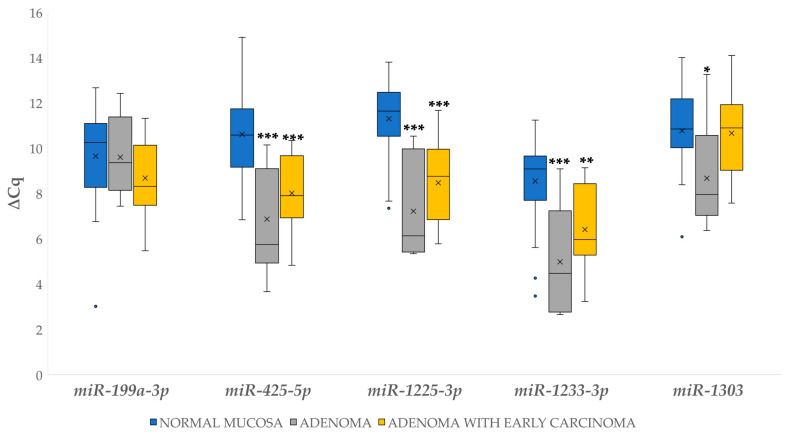
Significant progress has been made in the last decade in our understanding of the pathogenetic mechanisms of colorectal cancer (CRC). Cancer stem cells (CSC) have gained much attention and are now believed to play a crucial role in the pathogenesis of various cancers, including CRC. In the current study, we validated gene expression of four genes related to CSC, , , and , identified in a previous bioinformatics analysis. Using bioinformatics, potential miRNA-target gene correlations were prioritized. In total, 70 formalin-fixed paraffin-embedded biopsy samples from 47 patients with adenoma, adenoma with early carcinoma and CRC without and with lymph node metastases were included. The expression of selected genes and microRNAs (miRNAs) was evaluated using quantitative PCR. Differential expression of all investigated genes and four of six prioritized miRNAs (, , , , and ) was found in at least one group of CRC cancerogenesis. , , and were correlated to the level of malignancy. A negative correlation between and its predicted target was observed, showing potential for further experimental validation in CRC. Our results provide further evidence that CSC-related genes and their regulatory miRNAs are involved in CRC development and progression and suggest that some them, particularly and its target gene, are promising for further validation in CRC.
在过去十年中,我们对结直肠癌(CRC)发病机制的理解取得了重大进展。癌症干细胞(CSC)已备受关注,现在被认为在包括CRC在内的各种癌症的发病机制中起着关键作用。在当前研究中,我们验证了先前生物信息学分析中鉴定出的与CSC相关的四个基因(此处基因名称缺失)的基因表达。利用生物信息学,对潜在的miRNA-靶基因相关性进行了优先级排序。总共纳入了来自47例腺瘤、腺瘤伴早期癌以及有无淋巴结转移的CRC患者的70份福尔马林固定石蜡包埋活检样本。使用定量PCR评估所选基因和 microRNA(miRNA)的表达。在至少一组CRC发生过程中发现了所有研究基因以及六个优先级miRNA(此处miRNA名称缺失)中的四个(此处miRNA名称缺失)的差异表达。(此处基因名称缺失)与恶性程度相关。观察到(此处基因名称缺失)与其预测靶标(此处基因名称缺失)之间呈负相关,表明在CRC中具有进一步实验验证的潜力。我们的结果提供了进一步的证据,表明CSC相关基因及其调控miRNA参与了CRC的发生和发展,并表明其中一些基因,特别是(此处基因名称缺失)及其靶基因,在CRC中具有进一步验证的前景。