Institute of Aquaculture, University of Stirling, Stirling FK9 4LA, UK.
Department of Virology, Faculty of Veterinary Medicine, Ondokuz Mayis University, 55139 Samsun, Turkey.
Viruses. 2021 Feb 28;13(3):385. doi: 10.3390/v13030385.
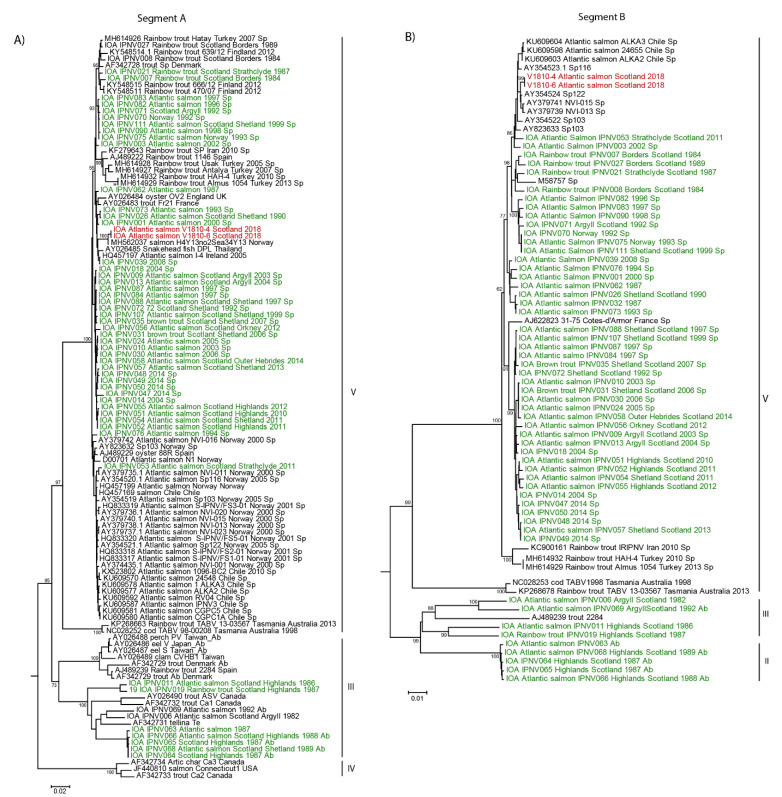
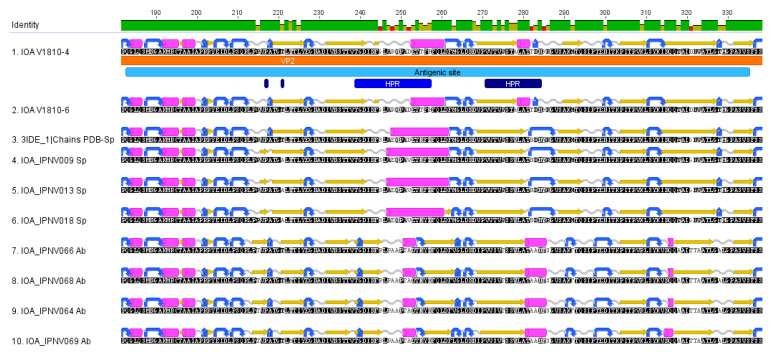
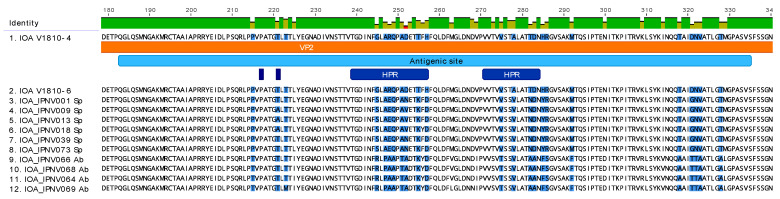
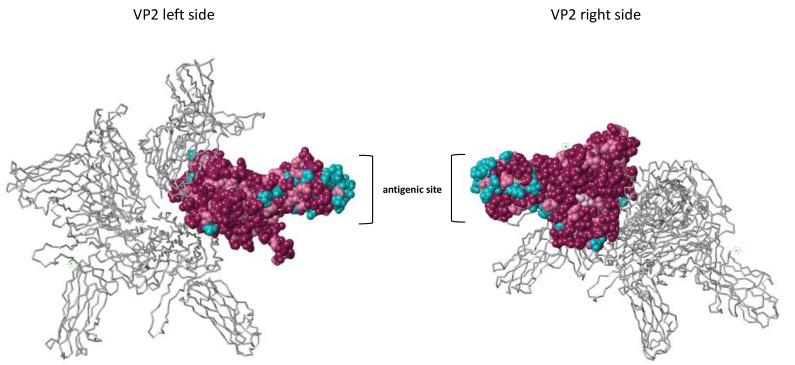
The aquatic virus, infectious pancreatic necrosis virus (IPNV), is known to infect various farmed fish, in particular salmonids, and is responsible for large economic losses in the aquaculture industry. Common practices to detect the virus include qPCR tests based on specific primers and serum neutralization tests for virus serotyping. Following the potential presence of IPNV viruses in a fish farm in Scotland containing vaccinated and IPNV-resistant fish, the common serotyping of the IPNV isolates was not made possible. This led us to determine the complete genome of the new IPNV isolates in order to investigate the cause of the serotyping discrepancy. Next-generation sequencing using the Illumina technology along with the sequence-independent single primer amplification (SISPA) approach was conducted to fully characterize the new Scottish isolates. With this approach, the full genome of two isolates, V1810-4 and V1810-6, was determined and analyzed. The potential origin of the virus isolates was investigated by phylogenetic analyses along with tridimensional and secondary protein structure analyses. These revealed the emergence of a new variant from one of the main virus serotypes, probably caused by the presence of selective pressure exerted by the vaccinated IPNV-resistant farmed fish.
水生病毒传染性胰脏坏死病毒(IPNV)已知会感染各种养殖鱼类,特别是鲑鱼科鱼类,是水产养殖业中造成巨大经济损失的原因。常见的病毒检测方法包括基于特定引物的 qPCR 测试和用于病毒血清分型的血清中和测试。在苏格兰的一个养殖鲑鱼的鱼场中发现疑似存在 IPNV 病毒后,无法对 IPNV 分离株进行常见的血清分型。这促使我们确定新的 IPNV 分离株的完整基因组,以调查血清分型差异的原因。使用 Illumina 技术进行下一代测序以及无序列依赖性单引物扩增(SISPA)方法,对新的苏格兰分离株进行了全面表征。通过这种方法,确定并分析了两个分离株 V1810-4 和 V1810-6 的完整基因组。通过与三维和二级蛋白质结构分析相结合的系统发育分析,研究了病毒分离株的潜在起源。这些结果表明,一种新的变体可能是由接种过 IPNV 疫苗的养殖鲑鱼所施加的选择性压力引起的,这种变体可能源自主要病毒血清型之一。