Mutoloki Stephen, Jøssund Trude B, Ritchie Gordon, Munang'andu Hetron M, Evensen Øystein
Faculty of Veterinary Medicine and Biosciences, Norwegian University of Life Sciences Oslo, Norway.
Marine Harvest ASA Bergen, Norway.
Front Microbiol. 2016 Aug 31;7:1393. doi: 10.3389/fmicb.2016.01393. eCollection 2016.
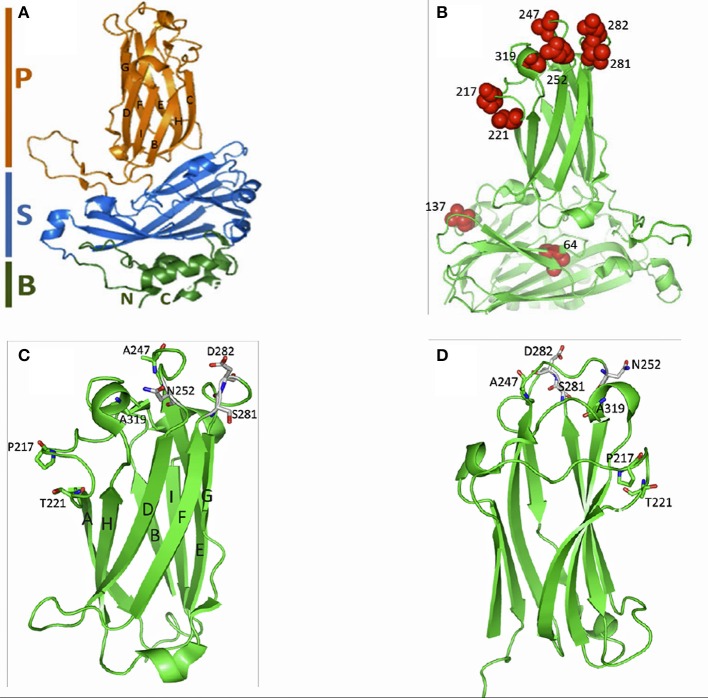
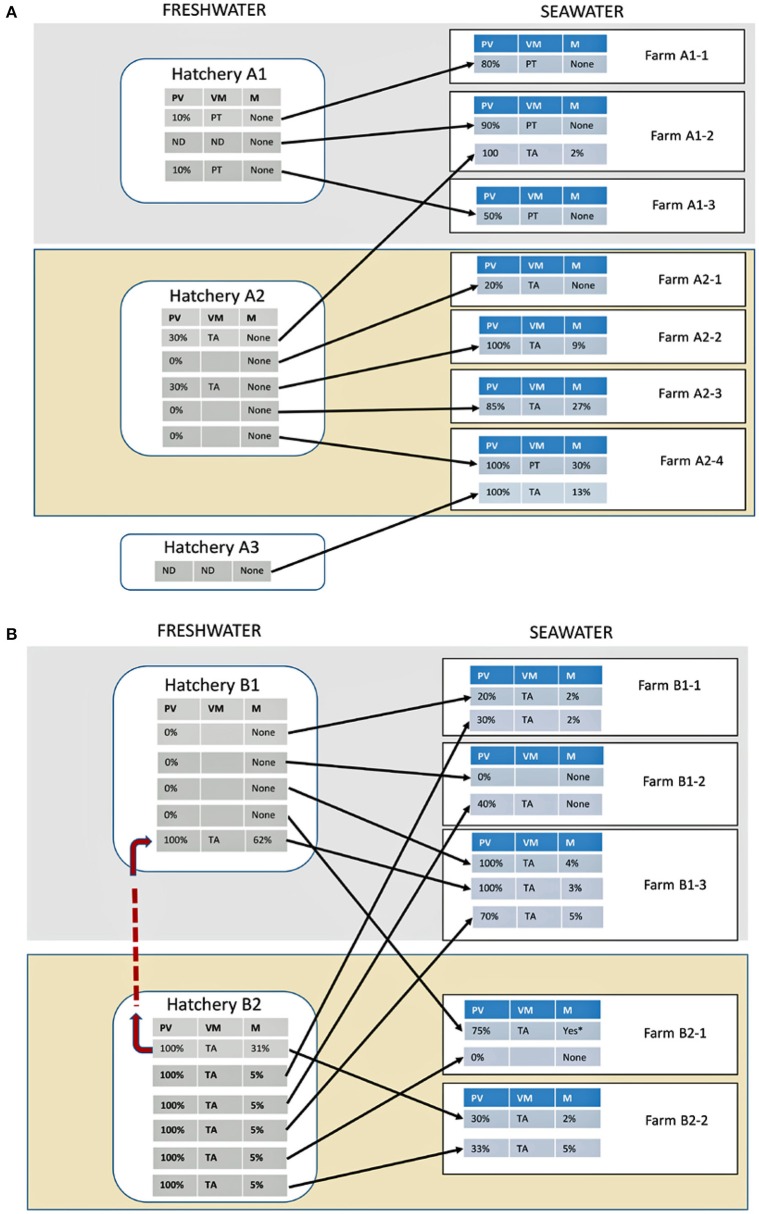
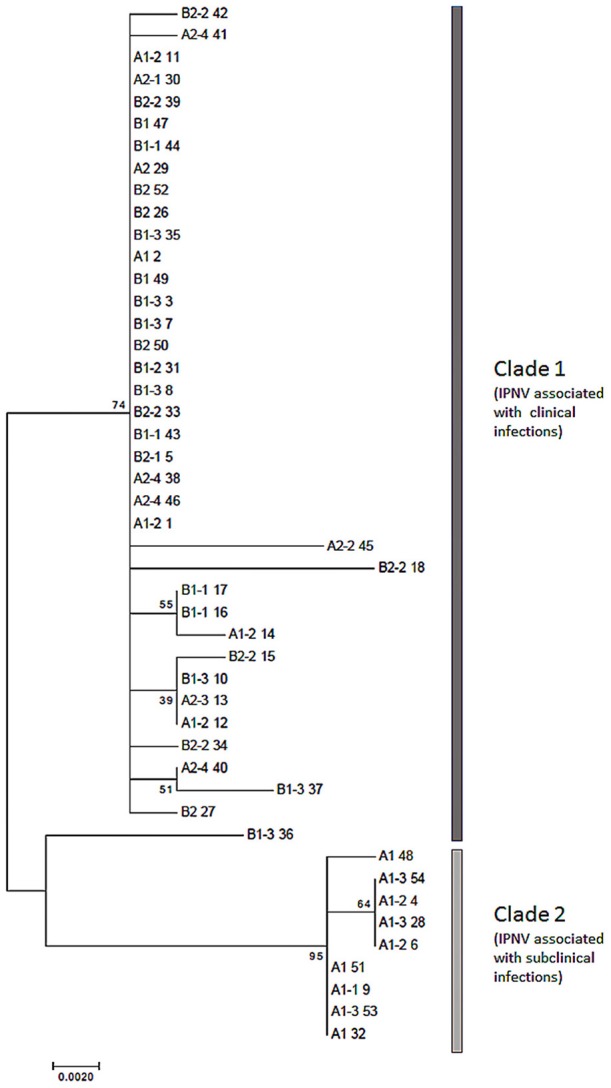
Infectious pancreatic necrosis virus (IPNV) is the causative agent of IPN, an important disease of salmonids. IPNV infections result in either sub-clinical or overt disease and the basis of this difference is not well-understood. The objective of the present study was to determine the VP2 gene of the virus associated with the different forms of clinical manifestation. Groups of Atlantic salmon (Salmo salar L.) reared in farms located in different IPN disease pressures were monitored from brood stock until grow-out over a 3 year period. Hatcheries A1 and B1 as well as cooperating seawater farms were located in a low disease risk area while hatcheries A2 and B2 as well as their cooperating seawater farms were in high IPN risk areas. Samples including eggs, milt, whole fry, kidney depending on the stage of production were collected during outbreaks or in apparently healthy populations where no outbreaks occurred. The virus was re-isolated in CHSE cells and the VP2 gene amplified by RT-PCR followed by sequencing. During the freshwater stage, there were no disease outbreaks at hatcheries A1, A2, and B1 (except in one fish group that originated from hatchery B2), although IPNV was isolated from some of the fish groups at all 3 hatcheries. By contrast, all fish groups at hatchery B2 suffered IPN outbreaks. In seawater, only groups of fish originating from hatchery A1 had no IPN outbreaks albeit virus being isolated from the fish. On the other hand, fish originating from hatcheries A2, B1, and B2 experienced outbreaks in seawater. The VP2 amino acid fingerprint of the virus associated with subclinical infections from A1 and co-operating seawater sites was V64A137P217T221A247N252S281D282E319. By contrast, all virus isolates associated with clinical infections had the motif I64T137T217A221T247V252T281N282A319, where underlined amino acids represent the avirulent and highly virulent motif, respectively. Phylogenetic analysis of amino acid sequences showed 2 clades, one of isolates associated with subclinical infections (from A1 and cooperating seawater farms) and the other of isolates from fish with overt disease (all other sites). Furthermore, the clustering pattern of isolates suggests more circulation of virus within fish groups rather than between them.
传染性胰腺坏死病毒(IPNV)是鲑鱼重要疾病——传染性胰腺坏死(IPN)的病原体。IPNV感染可导致亚临床疾病或显性疾病,而这种差异的基础尚不清楚。本研究的目的是确定与不同临床表现形式相关的病毒VP2基因。对位于不同IPN疾病压力地区养殖场的大西洋鲑(Salmo salar L.)群体进行了为期3年的监测,从亲鱼到养成阶段。孵化场A1和B1以及合作的海水养殖场位于低疾病风险地区,而孵化场A2和B2以及它们合作的海水养殖场处于高IPN风险地区。在疫情爆发期间或在未发生疫情的明显健康种群中,根据生产阶段收集包括鱼卵、精液、整尾鱼苗、肾脏等样本。病毒在CHSE细胞中重新分离,并通过RT-PCR扩增VP2基因,随后进行测序。在淡水阶段,孵化场A1、A2和B1(除了一组源自孵化场B2的鱼)没有疾病爆发,尽管在所有3个孵化场的一些鱼群中分离到了IPNV。相比之下,孵化场B2的所有鱼群都遭受了IPN疫情爆发。在海水中,只有源自孵化场A1的鱼群没有IPN疫情爆发,尽管从鱼中分离到了病毒。另一方面,源自孵化场A2、B1和B2的鱼在海水中经历了疫情爆发。与来自A1和合作海水养殖场的亚临床感染相关的病毒VP2氨基酸指纹图谱为V64A137P217T221A247N252S281D282E319。相比之下,所有与临床感染相关的病毒分离株都具有基序I64T137T217A221T247V252T281N282A319,其中带下划线的氨基酸分别代表无毒和高毒基序。氨基酸序列的系统发育分析显示有两个分支,一个是与亚临床感染相关的分离株(来自A1和合作海水养殖场),另一个是来自显性疾病鱼的分离株(所有其他地点)。此外,分离株的聚类模式表明病毒在鱼群内部的传播多于在鱼群之间的传播。