Department of Nutritional Sciences, Faculty of Life Sciences, University of Vienna, 1090 Vienna, Austria.
Colorectal Cancer Group, ONCOBELL Program, Bellvitge Biomedical Research Institute (IDIBELL), L'Hospitalet de Llobregat, 8908 Barcelona, Spain.
Cells. 2021 Feb 15;10(2):394. doi: 10.3390/cells10020394.
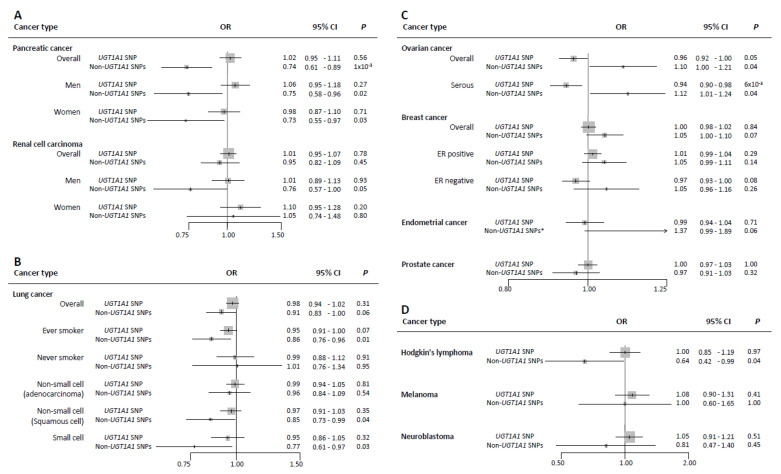
Bilirubin, an endogenous antioxidant, may play a protective role in cancer development. We applied two-sample Mendelian randomization to investigate whether genetically raised bilirubin levels are causally associated with the risk of ten cancers (pancreas, kidney, endometrium, ovary, breast, prostate, lung, Hodgkin's lymphoma, melanoma, and neuroblastoma). The number of cases and their matched controls of European descent ranged from 122,977 and 105,974 for breast cancer to 1200 and 6417 for Hodgkin's lymphoma, respectively. A total of 115 single-nucleotide polymorphisms (SNPs) associated ( < 5 × 10) with circulating total bilirubin, extracted from a genome-wide association study in the UK Biobank, were used as instrumental variables. One SNP (rs6431625) in the promoter region of the uridine-diphosphoglucuronate glucuronosyltransferase1A1 ( gene explained 16.9% and the remaining 114 SNPs (non- SNPs) explained 3.1% of phenotypic variance in circulating bilirubin levels. A one-standarddeviation increment in circulating bilirubin (≈ 4.4 µmol/L), predicted by non- SNPs, was inversely associated with risk of squamous cell lung cancer and Hodgkin's lymphoma (odds ratio (OR) 0.85, 95% confidence interval (CI) 0.73-0.99, 0.04 and OR 0.64, 95% CI 0.42-0.99, 0.04, respectively), which was confirmed after removing potential pleiotropic SNPs. In contrast, a positive association was observed with the risk of breast cancer after removing potential pleiotropic SNPs (OR 1.12, 95% CI 1.04-1.20, 0.002). There was little evidence for robust associations with the other seven cancers investigated. Genetically raised bilirubin levels were inversely associated with risk of squamous cell lung cancer as well as Hodgkin's lymphoma and positively associated with risk of breast cancer. Further studies are required to investigate the utility of bilirubin as a low-cost clinical marker to improve risk prediction for certain cancers.
胆红素是一种内源性抗氧化剂,可能在癌症发展中发挥保护作用。我们应用两样本孟德尔随机化研究来探讨遗传升高的胆红素水平是否与十种癌症(胰腺癌、肾癌、子宫内膜癌、卵巢癌、乳腺癌、前列腺癌、肺癌、霍奇金淋巴瘤、黑色素瘤和神经母细胞瘤)的发病风险相关。欧洲血统的病例和匹配对照的数量范围从乳腺癌的 122977 例和 105974 例到霍奇金淋巴瘤的 1200 例和 6417 例。从英国生物库全基因组关联研究中提取的 115 个与循环总胆红素相关的(<5×10)单核苷酸多态性(SNP)被用作工具变量。位于尿苷二磷酸葡萄糖醛酸转移酶 1A1(基因)启动子区域的一个 SNP(rs6431625)解释了 16.9%的循环胆红素水平表型变异,其余 114 个 SNP(非 SNP)解释了 3.1%。非 SNP 预测的循环胆红素水平增加一个标准差(约 4.4µmol/L)与鳞状细胞肺癌和霍奇金淋巴瘤的风险呈负相关(比值比(OR)0.85,95%置信区间(CI)0.73-0.99, 0.04 和 OR 0.64,95% CI 0.42-0.99, 0.04,分别),去除潜在的多效性 SNP 后得到了证实。相反,在去除潜在的多效性 SNP 后,与乳腺癌风险呈正相关(OR 1.12,95% CI 1.04-1.20, 0.002)。对于其他七种研究的癌症,几乎没有证据表明存在稳健的相关性。遗传升高的胆红素水平与鳞状细胞肺癌和霍奇金淋巴瘤的风险呈负相关,与乳腺癌的风险呈正相关。需要进一步的研究来探讨胆红素作为一种低成本的临床标志物在改善某些癌症风险预测中的应用。