College of Horticulture and Forestry Sciences, Huazhong Agricultural University, Wuhan 430070, China.
Department of Horticulture, Muhammad Nawaz Shareef University of Agriculture, Multan 60000, Pakistan.
Int J Mol Sci. 2021 Feb 12;22(4):1819. doi: 10.3390/ijms22041819.
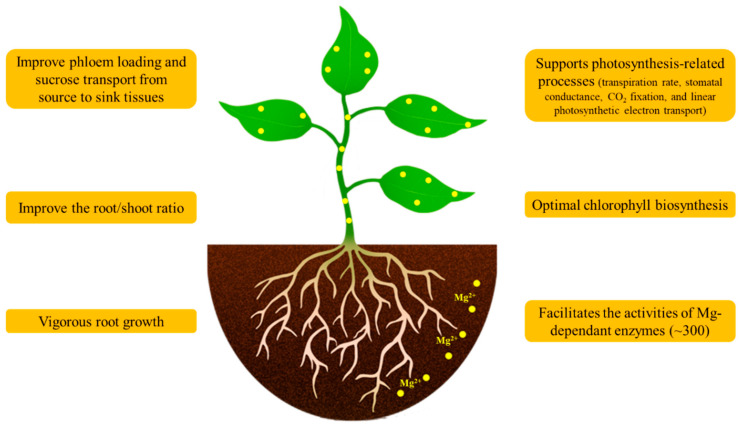
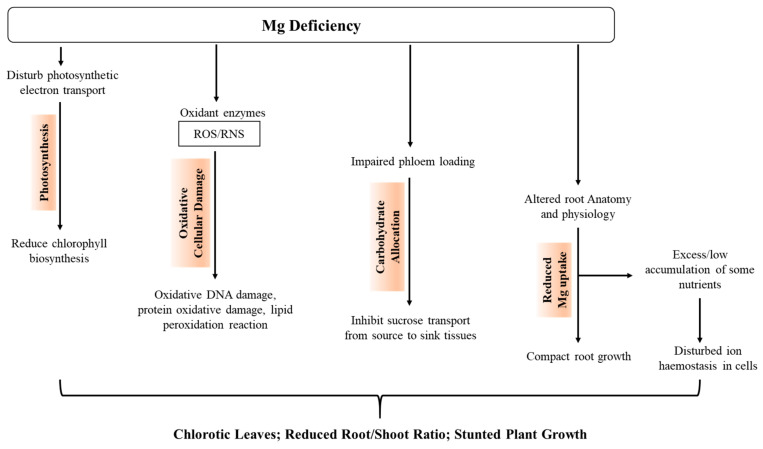
The productivity of agricultural produce is fairly dependent on the availability of nutrients and efficient use. Magnesium (Mg) is an essential macronutrient of living cells and is the second most prevalent free divalent cation in plants. Mg plays a role in several physiological processes that support plant growth and development. However, it has been largely forgotten in fertilization management strategies to increase crop production, which leads to severe reductions in plant growth and yield. In this review, we discuss how the Mg shortage induces several responses in plants at different levels: morphological, physiological, biochemical and molecular. Additionally, the Mg uptake and transport mechanisms in different cellular organelles and the role of Mg transporters in regulating Mg homeostasis are also discussed. Overall, in this review, we critically summarize the available information about the responses of Mg deficiency on plant growth and development, which would facilitate plant scientists to create Mg-deficiency-resilient crops through agronomic and genetic biofortification.
农业生产的生产力相当依赖于养分的可用性和有效利用。镁(Mg)是活细胞的必需大量营养素,是植物中第二丰富的游离二价阳离子。Mg 在支持植物生长和发育的几个生理过程中发挥作用。然而,在提高作物产量的施肥管理策略中,它在很大程度上被忽视了,这导致植物生长和产量严重减少。在这篇综述中,我们讨论了镁缺乏如何在不同水平上诱导植物产生多种反应:形态、生理、生化和分子。此外,还讨论了不同细胞细胞器中 Mg 的吸收和运输机制以及 Mg 转运蛋白在调节 Mg 稳态中的作用。总的来说,在这篇综述中,我们批判性地总结了关于 Mg 缺乏对植物生长和发育影响的现有信息,这将有助于植物科学家通过农业和遗传生物强化来创造对 Mg 缺乏有抗性的作物。