Greiner-Haas Franziska, Bergen Martin von, Sawers Gary, Lechner Ute, Türkowsky Dominique
Institute of Biology/Microbiology, Martin-Luther University Halle-Wittenberg, 06120 Halle (Saale), Germany.
Department of Molecular Systems Biology, Helmholtz Centre for Environmental Research-UFZ, 04318 Leipzig, Germany.
Microorganisms. 2021 Feb 12;9(2):365. doi: 10.3390/microorganisms9020365.
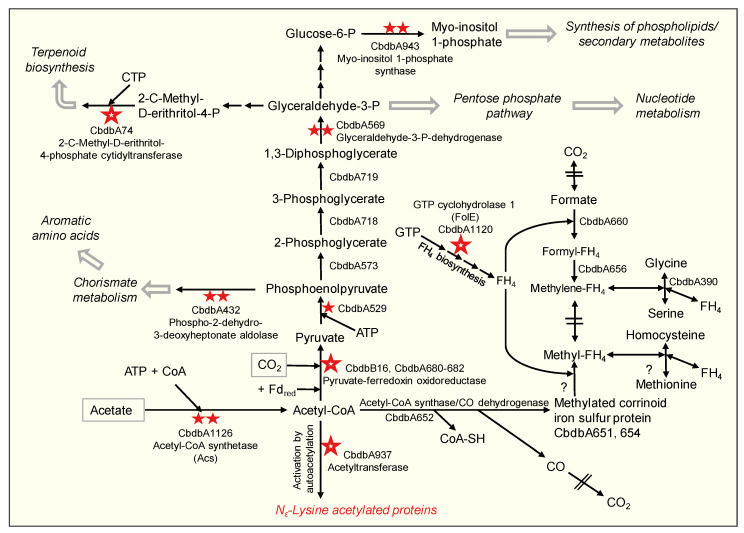
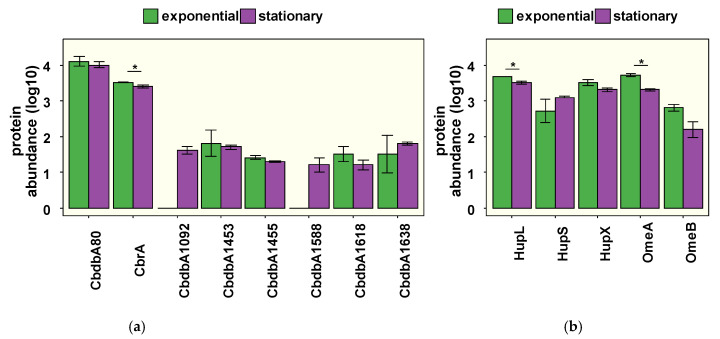
The strictly anaerobic bactGIerium obligatorily depends on organohalide respiration for energy conservation and growth. The bacterium also plays an important role in bioremediation. Since there is no guarantee of a continuous supply of halogenated substrates in its natural environment, the question arises of how maintains the synthesis and activity of dehalogenating enzymes under these conditions. Acetylation is a means by which energy-restricted microorganisms can modulate and maintain protein levels and their functionality. Here, we analyzed the proteome and Nε-lysine acetylome of strain CBDB1 during growth with 1,2,3-trichlorobenzene as an electron acceptor. The high abundance of the membrane-localized organohalide respiration complex, consisting of the reductive dehalogenases CbrA and CbdbA80, the uptake hydrogenase HupLS, and the organohalide respiration-associated molybdoenzyme OmeA, was shown throughout growth. In addition, the number of acetylated proteins increased from 5% to 11% during the transition from the exponential to the stationary phase. Acetylation of the key proteins of central acetate metabolism and of CbrA, CbdbA80, and TatA, a component of the twin-arginine translocation machinery, suggests that acetylation might contribute to maintenance of the organohalide-respiring capacity of the bacterium during the stationary phase, thus providing a means of ensuring membrane protein integrity and a proton gradient.
这种严格厌氧细菌完全依赖有机卤化物呼吸作用来保存能量和生长。该细菌在生物修复中也发挥着重要作用。由于在其自然环境中不能保证持续供应卤化底物,因此出现了一个问题,即它如何在这些条件下维持脱卤酶的合成和活性。乙酰化是能量受限的微生物调节和维持蛋白质水平及其功能的一种方式。在这里,我们分析了以1,2,3 - 三氯苯作为电子受体生长期间菌株CBDB1的蛋白质组和Nε-赖氨酸乙酰化组。在整个生长过程中,由还原脱卤酶CbrA和CdbA80、摄取氢化酶HupLS以及与有机卤化物呼吸作用相关的钼酶OmeA组成的膜定位有机卤化物呼吸复合体含量很高。此外,在从指数生长期到稳定期的转变过程中,乙酰化蛋白质的数量从5%增加到了11%。中央乙酸代谢关键蛋白以及CbrA、CdbA80和双精氨酸转运机制的一个组成部分TatA的乙酰化表明,乙酰化可能有助于在稳定期维持细菌的有机卤化物呼吸能力,从而提供一种确保膜蛋白完整性和质子梯度的方式。