Computational Health Informatics Program, Boston Children's Hospital, Boston, MA, USA.
Department of Epidemiology, Harvard T.H. Chan School of Public Health, Boston, MA, USA.
Sci Adv. 2021 Mar 5;7(10). doi: 10.1126/sciadv.abd6989. Print 2021 Mar.
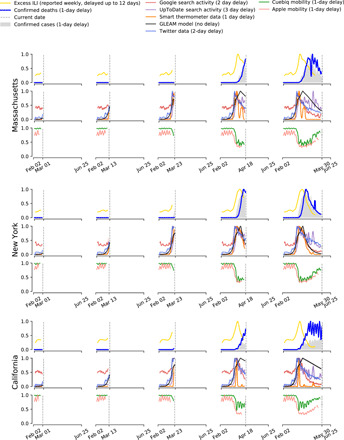
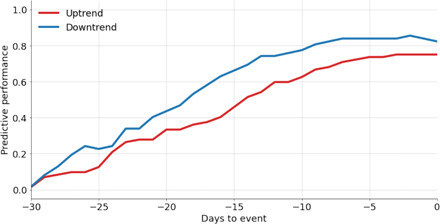
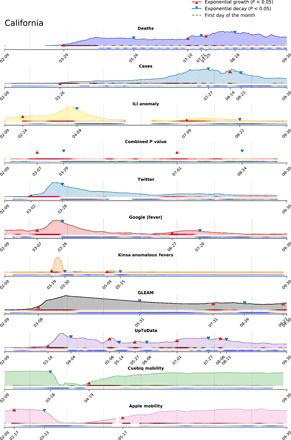
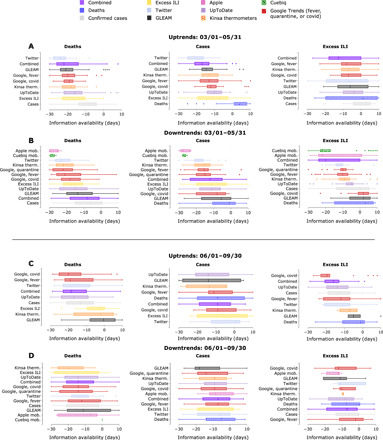
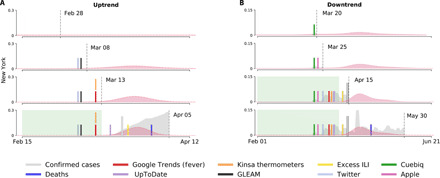
Given still-high levels of coronavirus disease 2019 (COVID-19) susceptibility and inconsistent transmission-containing strategies, outbreaks have continued to emerge across the United States. Until effective vaccines are widely deployed, curbing COVID-19 will require carefully timed nonpharmaceutical interventions (NPIs). A COVID-19 early warning system is vital for this. Here, we evaluate digital data streams as early indicators of state-level COVID-19 activity from 1 March to 30 September 2020. We observe that increases in digital data stream activity anticipate increases in confirmed cases and deaths by 2 to 3 weeks. Confirmed cases and deaths also decrease 2 to 4 weeks after NPI implementation, as measured by anonymized, phone-derived human mobility data. We propose a means of harmonizing these data streams to identify future COVID-19 outbreaks. Our results suggest that combining disparate health and behavioral data may help identify disease activity changes weeks before observation using traditional epidemiological monitoring.
鉴于 2019 年冠状病毒病(COVID-19)的高易感性和不一致的传播含策略,疫情仍在美国各地持续出现。在有效疫苗广泛部署之前,遏制 COVID-19 需要精心安排的非药物干预(NPIs)。COVID-19 早期预警系统对此至关重要。在这里,我们评估了从 2020 年 3 月 1 日至 9 月 30 日的数字数据流,作为州级 COVID-19 活动的早期指标。我们观察到,数字数据流活动的增加预示着确诊病例和死亡人数将增加 2 至 3 周。通过匿名的手机衍生人类移动数据进行测量,在实施 NPI 后 2 至 4 周,确诊病例和死亡人数也会下降。我们提出了一种协调这些数据流的方法,以识别未来的 COVID-19 疫情。我们的研究结果表明,结合不同的健康和行为数据可能有助于在使用传统流行病学监测方法观察之前数周识别疾病活动的变化。