Department of Pathology, Feinberg School of Medicine, Northwestern University, Chicago, IL, USA.
Department of Biomedical Informatics, Emory University School of Medicine, Atlanta, GA, USA.
Lab Invest. 2021 Jul;101(7):942-951. doi: 10.1038/s41374-021-00579-5. Epub 2021 Mar 5.
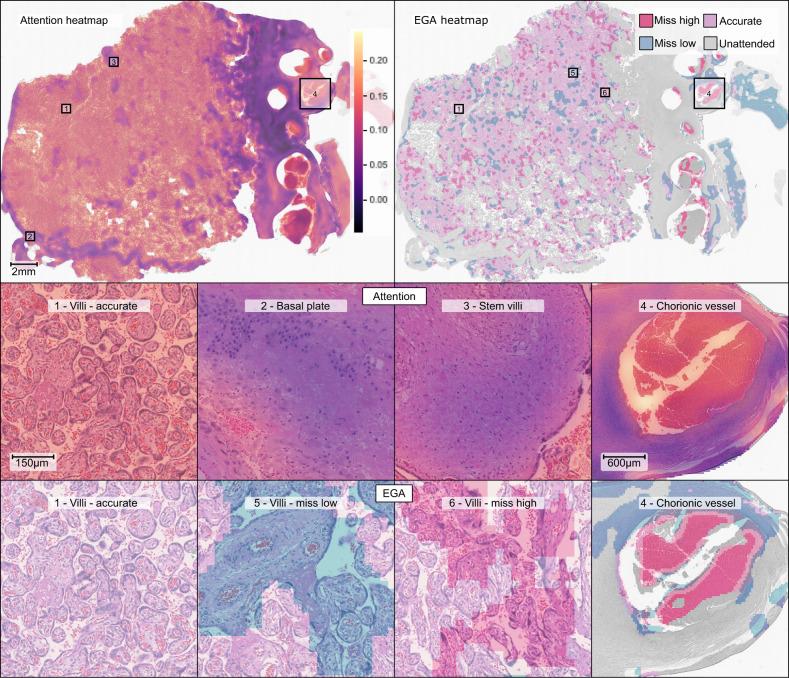
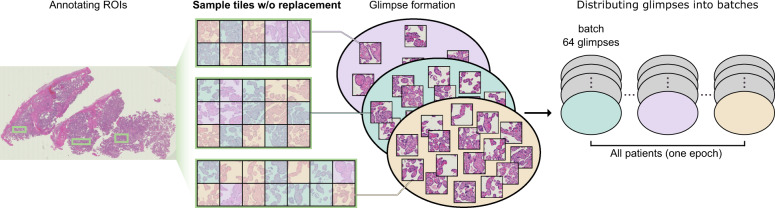
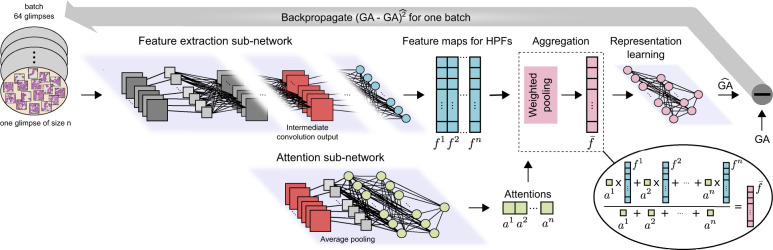
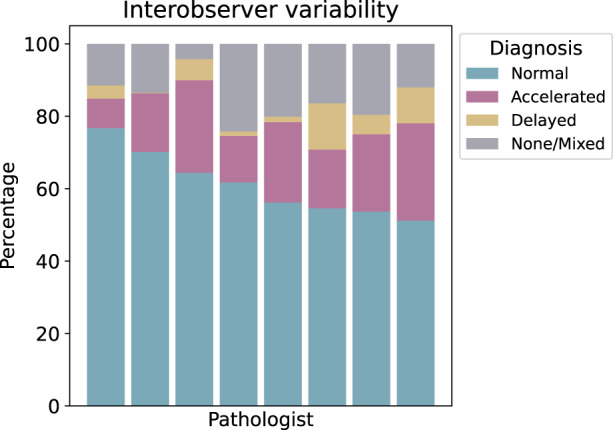
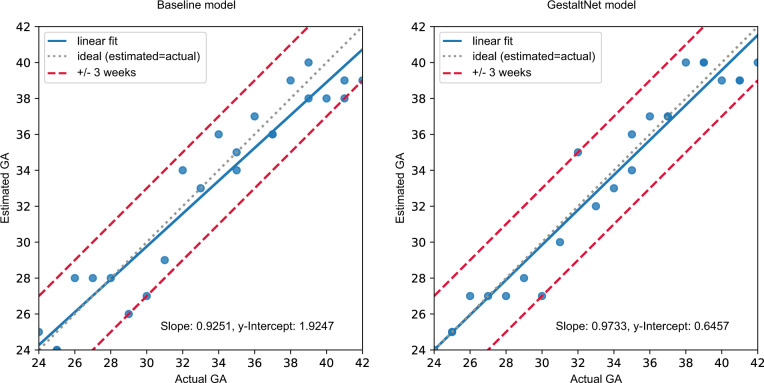
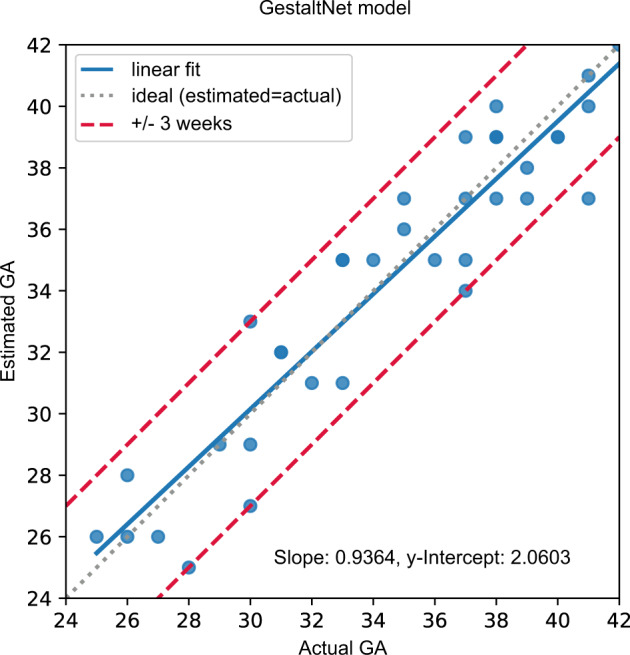
The placenta is the first organ to form and performs the functions of the lung, gut, kidney, and endocrine systems. Abnormalities in the placenta cause or reflect most abnormalities in gestation and can have life-long consequences for the mother and infant. Placental villi undergo a complex but reproducible sequence of maturation across the third-trimester. Abnormalities of villous maturation are a feature of gestational diabetes and preeclampsia, among others, but there is significant interobserver variability in their diagnosis. Machine learning has emerged as a powerful tool for research in pathology. To capture the volume of data and manage heterogeneity within the placenta, we developed GestaltNet, which emulates human attention to high-yield areas and aggregation across regions. We used this network to estimate the gestational age (GA) of scanned placental slides and compared it to a baseline model lacking the attention and aggregation functions. In the test set, GestaltNet showed a higher r (0.9444 vs. 0.9220) than the baseline model. The mean absolute error (MAE) between the estimated and actual GA was also better in the GestaltNet (1.0847 weeks vs. 1.4505 weeks). On whole-slide images, we found the attention sub-network discriminates areas of terminal villi from other placental structures. Using this behavior, we estimated GA for 36 whole slides not previously seen by the model. In this task, similar to that faced by human pathologists, the model showed an r of 0.8859 with an MAE of 1.3671 weeks. We show that villous maturation is machine-recognizable. Machine-estimated GA could be useful when GA is unknown or to study abnormalities of villous maturation, including those in gestational diabetes or preeclampsia. GestaltNet points toward a future of genuinely whole-slide digital pathology by incorporating human-like behaviors of attention and aggregation.
胎盘是第一个形成并发挥肺、肠、肾和内分泌系统功能的器官。胎盘异常会导致或反映妊娠的大多数异常,并可能对母婴产生终身影响。胎盘绒毛在整个孕晚期经历一个复杂但可重复的成熟过程。绒毛成熟异常是妊娠期糖尿病和子痫前期等疾病的特征之一,但在其诊断中存在显著的观察者间变异性。机器学习已成为病理学研究的有力工具。为了捕捉数据量并管理胎盘内的异质性,我们开发了 GestaltNet,它模拟了人类对高产量区域的注意力和跨区域的聚集。我们使用该网络来估计扫描胎盘切片的胎龄(GA),并将其与缺乏注意力和聚合功能的基线模型进行比较。在测试集中,GestaltNet 的 r 值(0.9444 与 0.9220)高于基线模型。GestaltNet 的估计 GA 与实际 GA 之间的平均绝对误差(MAE)也更好(1.0847 周与 1.4505 周)。在全幻灯片图像上,我们发现注意力子网络可将终末绒毛区域与其他胎盘结构区分开来。利用这种行为,我们对 36 张以前未被模型看到的全幻灯片进行了 GA 估计。在这项任务中,与人类病理学家面临的任务类似,该模型的 r 值为 0.8859,MAE 为 1.3671 周。我们表明,绒毛成熟是可以被机器识别的。当 GA 未知或研究绒毛成熟异常时,包括妊娠期糖尿病或子痫前期中的异常,机器估计的 GA 可能会很有用。GestaltNet 通过结合人类注意力和聚合行为,为真正的全幻灯片数字病理学指明了未来的方向。