Institute of Neuroscience & Physiology, Department of Psychiatry & Neurochemistry, Sahlgrenska Academy, University of Gothenburg, House V3/SU, SE-431 80, Mölndal, Sweden.
Department of Old Age Psychiatry, Institute of Psychiatry, Psychology & Neuroscience, King's College London, London, UK.
Eur J Nucl Med Mol Imaging. 2021 Jul;48(7):2140-2156. doi: 10.1007/s00259-021-05253-y. Epub 2021 Mar 6.
The development of blood biomarkers that reflect Alzheimer's disease (AD) pathophysiology (phosphorylated tau and amyloid-β) has offered potential as scalable tests for dementia differential diagnosis and early detection. In 2019, the Geneva AD Biomarker Roadmap Initiative included blood biomarkers in the systematic validation of AD biomarkers.
A panel of experts convened in November 2019 at a two-day workshop in Geneva. The level of maturity (fully achieved, partly achieved, preliminary evidence, not achieved, unsuccessful) of blood biomarkers was assessed based on the Biomarker Roadmap methodology and discussed fully during the workshop which also evaluated cerebrospinal fluid (CSF) and positron emission tomography (PET) biomarkers.
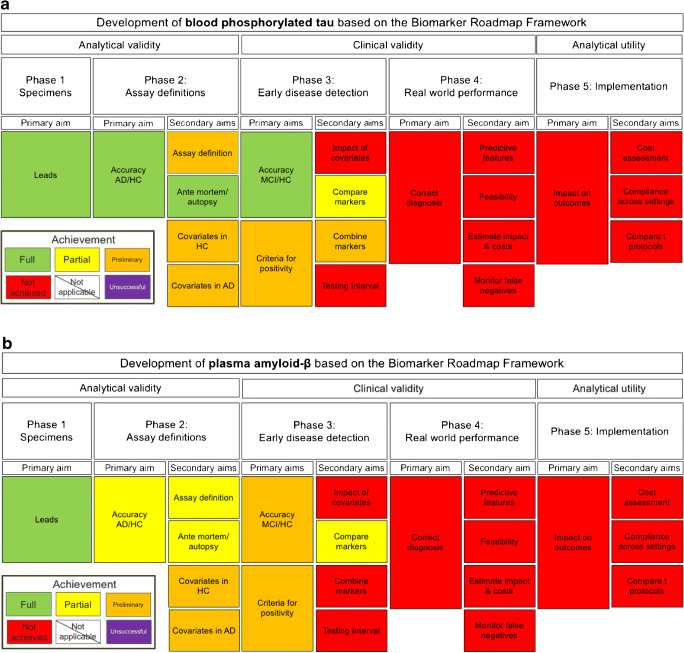
Plasma p-tau has shown analytical validity (phase 2 primary aim 1) and first evidence of clinical validity (phase 3 primary aim 1), whereas the maturity level for Aβ remains to be partially achieved. Full and partial achievement has been assigned to p-tau and Aβ, respectively, in their associations to ante-mortem measures (phase 2 secondary aim 2). However, only preliminary evidence exists for the influence of covariates, assay comparison and cut-off criteria.
Despite the relative infancy of blood biomarkers, in comparison to CSF biomarkers, much has already been achieved for phases 1 through 3 - with p-tau having greater success in detecting AD and predicting disease progression. However, sufficient data about the effect of covariates on the biomarker measurement is lacking. No phase 4 (real-world performance) or phase 5 (assessment of impact/cost) aim has been tested, thus not achieved.
反映阿尔茨海默病(AD)病理生理学的血液生物标志物(磷酸化 tau 和淀粉样蛋白-β)的发展为痴呆症鉴别诊断和早期检测提供了潜在的可扩展测试。2019 年,日内瓦 AD 生物标志物路线图倡议将血液生物标志物纳入 AD 生物标志物的系统验证中。
一组专家于 2019 年 11 月在日内瓦举行的为期两天的研讨会上举行。根据生物标志物路线图方法评估血液生物标志物的成熟度(完全实现、部分实现、初步证据、未实现、不成功)水平,并在研讨会上进行了充分讨论,还评估了脑脊液(CSF)和正电子发射断层扫描(PET)生物标志物。
血浆 p-tau 已显示出分析有效性(第 2 阶段主要目标 1)和临床有效性的初步证据(第 3 阶段主要目标 1),而 Aβ 的成熟度水平仍有待部分实现。p-tau 和 Aβ 分别在其与生前测量的关联中被赋予了完全和部分实现(第 2 阶段次要目标 2)。然而,仅存在关于协变量、分析比较和截止标准影响的初步证据。
尽管与 CSF 生物标志物相比,血液生物标志物相对处于早期阶段,但已经在第 1 至 3 阶段取得了很大的进展- p-tau 在检测 AD 和预测疾病进展方面具有更大的成功。然而,关于生物标志物测量受协变量影响的数据还不够充分。尚未测试第 4 阶段(真实世界表现)或第 5 阶段(评估影响/成本)目标,因此未实现。