Comprehensive Heart Failure Centre, University Hospital Würzburg, Würzburg, Germany.
Department of Internal Medicine I, University Hospital Würzburg, Würzburg, Germany.
Front Immunol. 2021 Feb 19;12:584538. doi: 10.3389/fimmu.2021.584538. eCollection 2021.
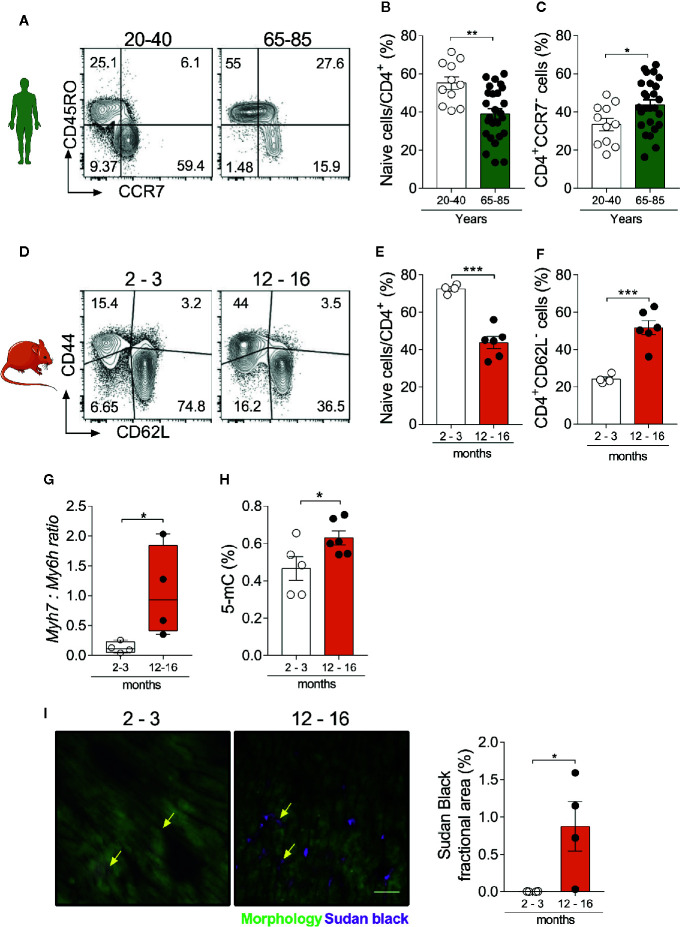
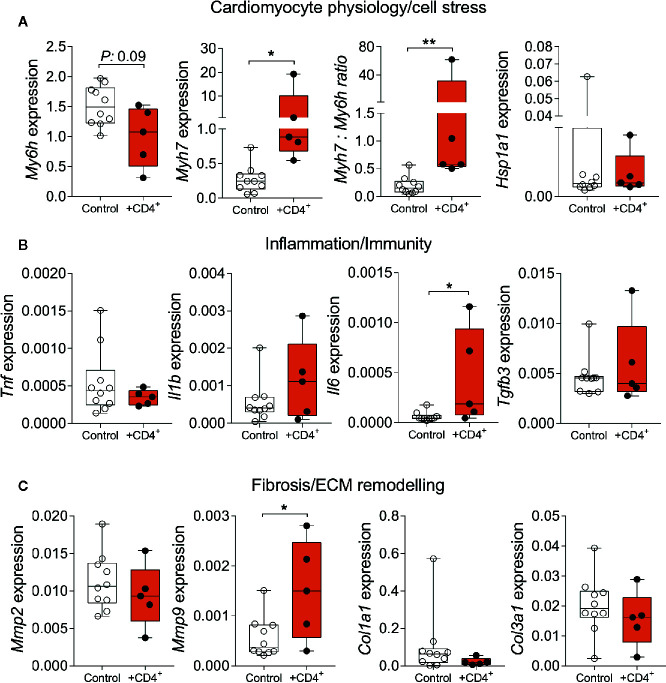
The cardiovascular and immune systems undergo profound and intertwined alterations with aging. Recent studies have reported that an accumulation of memory and terminally differentiated T cells in elderly subjects can fuel myocardial aging and boost the progression of heart diseases. Nevertheless, it remains unclear whether the immunological senescence profile is sufficient to cause age-related cardiac deterioration or merely acts as an amplifier of previous tissue-intrinsic damage. Herein, we sought to decompose the causality in this cardio-immune crosstalk by studying young mice harboring a senescent-like expanded CD4 T cell compartment. Thus, immunodeficient NSG-DR1 mice expressing HLA-DRB1*01:01 were transplanted with human CD4 T cells purified from matching donors that rapidly engrafted and expanded in the recipients without causing xenograft reactions. In the donor subjects, the CD4 T cell compartment was primarily composed of naïve cells defined as CCR7CD45RO. However, when transplanted into young lymphocyte-deficient mice, CD4 T cells underwent homeostatic expansion, upregulated expression of PD-1 receptor and strongly shifted towards effector/memory (CCR7 CD45RO) and terminally-differentiated phenotypes (CCR7CD45RO), as typically seen in elderly. Differentiated CD4 T cells also infiltrated the myocardium of recipient mice at comparable levels to what is observed during physiological aging. In addition, young mice harboring an expanded CD4 T cell compartment showed increased numbers of infiltrating monocytes, macrophages and dendritic cells in the heart. Bulk mRNA sequencing analyses further confirmed that expanding T-cells promote myocardial inflammaging, marked by a distinct age-related transcriptomic signature. Altogether, these data indicate that exaggerated CD4 T-cell expansion and differentiation, a hallmark of the aging immune system, is sufficient to promote myocardial alterations compatible with inflammaging in juvenile healthy mice.
心血管系统和免疫系统随着衰老发生深刻且相互交织的改变。最近的研究报告称,老年受试者中记忆性和终末分化 T 细胞的积累会促进心肌衰老,并加速心脏病的进展。然而,免疫衰老表型是否足以导致与年龄相关的心脏恶化,或者仅仅是先前组织内在损伤的放大器,目前仍不清楚。在此,我们通过研究携带衰老样扩增 CD4 T 细胞区室的年轻小鼠,试图分解这种心脏免疫串扰中的因果关系。因此,表达 HLA-DRB1*01:01 的免疫缺陷 NSG-DR1 小鼠被移植了来自匹配供体的纯化人 CD4 T 细胞,这些细胞在受体中迅速植入并扩增,而不会引起异种移植物反应。在供体中,CD4 T 细胞区室主要由幼稚细胞组成,定义为 CCR7CD45RO。然而,当移植到年轻的淋巴细胞缺陷小鼠中时,CD4 T 细胞经历了稳态扩增,PD-1 受体表达上调,并强烈向效应/记忆(CCR7CD45RO)和终末分化表型(CCR7CD45RO)转变,这与老年时通常观察到的情况类似。分化的 CD4 T 细胞也以与生理衰老期间观察到的相当水平浸润到受体小鼠的心肌中。此外,携带扩增 CD4 T 细胞区室的年轻小鼠心脏中浸润的单核细胞、巨噬细胞和树突状细胞数量增加。批量 mRNA 测序分析进一步证实,扩增的 T 细胞促进心肌炎症老化,其特征是与年龄相关的独特转录组特征。总之,这些数据表明,衰老免疫系统中标志性的过度扩增和分化的 CD4 T 细胞足以促进与幼年健康小鼠的炎症老化相兼容的心肌改变。