VisMederi srl, Siena, Italy.
Infectivology and Clinical Trials Research Area, Primary Immunodeficiencies Research Unit, Bambino Gesù Children's Hospital, Istituto di Ricovero e Cura a Carattere Scientifico, Rome, Italy.
Front Immunol. 2021 Feb 19;12:616853. doi: 10.3389/fimmu.2021.616853. eCollection 2021.
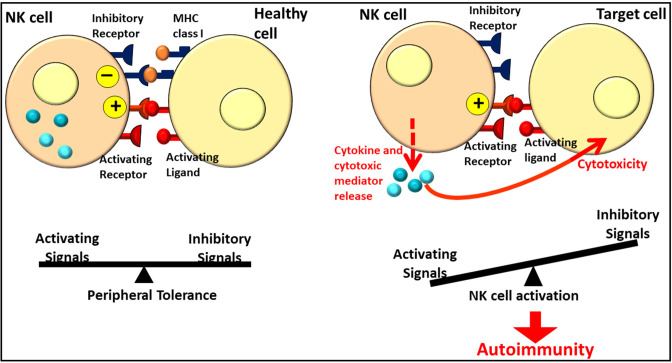
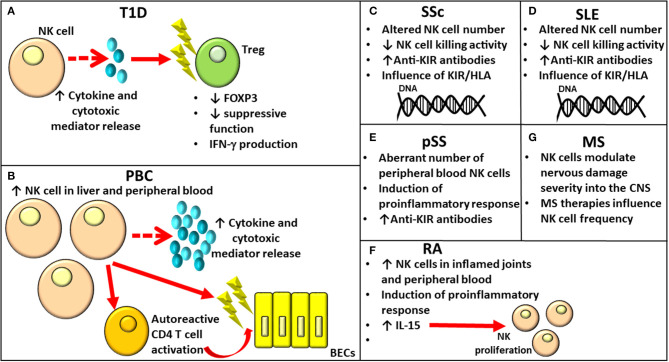
Autoimmune diseases recognize a multifactorial pathogenesis, although the exact mechanism responsible for their onset remains to be fully elucidated. Over the past few years, the role of natural killer (NK) cells in shaping immune responses has been highlighted even though their involvement is profoundly linked to the subpopulation involved and to the site where such interaction takes place. The aberrant number and functionality of NK cells have been reported in several different autoimmune disorders. In the present review, we report the most recent findings regarding the involvement of NK cells in both systemic and organ-specific autoimmune diseases, including type 1 diabetes (T1D), primary biliary cholangitis (PBC), systemic sclerosis, systemic lupus erythematosus (SLE), primary Sjögren syndrome, rheumatoid arthritis, and multiple sclerosis. In T1D, innate inflammation induces NK cell activation, disrupting the Treg function. In addition, certain genetic variants identified as risk factors for T1D influenced the activation of NK cells promoting their cytotoxic activity. The role of NK cells has also been demonstrated in the pathogenesis of PBC mediating direct or indirect biliary epithelial cell destruction. NK cell frequency and number were enhanced in both the peripheral blood and the liver of patients and associated with increased NK cell cytotoxic activity and perforin expression levels. NK cells were also involved in the perpetuation of disease through autoreactive CD4 T cell activation in the presence of antigen-presenting cells. In systemic sclerosis (SSc), in addition to phenotypic abnormalities, patients presented a reduction in CD56 NK-cells. Moreover, NK cells presented a deficient killing activity. The influence of the activating and inhibitory killer cell immunoglobulin-like receptors (KIRs) has been investigated in SSc and SLE susceptibility. Furthermore, autoantibodies to KIRs have been identified in different systemic autoimmune conditions. Because of its role in modulating the immune-mediated pathology, NK subpopulation could represent a potential marker for disease activity and target for therapeutic intervention.
自身免疫性疾病的发病机制具有多因素性,尽管其确切发病机制仍有待充分阐明。在过去的几年中,自然杀伤 (NK) 细胞在塑造免疫反应中的作用已被强调,尽管它们的参与与所涉及的亚群以及这种相互作用发生的部位密切相关。在几种不同的自身免疫性疾病中,已经报道了 NK 细胞数量和功能的异常。在本综述中,我们报告了最近关于 NK 细胞参与系统性和器官特异性自身免疫性疾病的研究结果,包括 1 型糖尿病 (T1D)、原发性胆汁性胆管炎 (PBC)、系统性硬化症、系统性红斑狼疮 (SLE)、原发性干燥综合征、类风湿关节炎和多发性硬化症。在 T1D 中,先天炎症诱导 NK 细胞激活,破坏 Treg 功能。此外,某些被确定为 T1D 风险因素的遗传变异影响 NK 细胞的激活,促进其细胞毒性活性。NK 细胞在 PBC 的发病机制中也发挥了作用,介导直接或间接的胆管上皮细胞破坏。患者的外周血和肝脏中 NK 细胞的频率和数量增加,并与 NK 细胞的细胞毒性活性和穿孔素表达水平增加相关。在抗原呈递细胞存在的情况下,NK 细胞还通过自身反应性 CD4 T 细胞的激活而参与疾病的持续存在。在系统性硬化症 (SSc) 中,除了表型异常外,患者还表现出 CD56 NK 细胞减少。此外,NK 细胞的杀伤活性降低。在 SSc 和 SLE 的易感性中,已经研究了激活和抑制性杀伤细胞免疫球蛋白样受体 (KIR) 的影响。此外,在不同的系统性自身免疫性疾病中已经鉴定出针对 KIR 的自身抗体。由于其在调节免疫介导的病理中的作用,NK 亚群可能代表疾病活动的潜在标志物和治疗干预的靶点。