Advanced Innovation Center for Human Brain Protection, Capital Medical University, Beijing, China.
National Engineering Laboratory for Risk Perception and Prevention, Beijing, China.
JMIR Mhealth Uhealth. 2021 Mar 8;9(3):e24365. doi: 10.2196/24365.
Major depressive disorder (MDD) is a common mental illness characterized by persistent sadness and a loss of interest in activities. Using smartphones and wearable devices to monitor the mental condition of patients with MDD has been examined in several studies. However, few studies have used passively collected data to monitor mood changes over time.
The aim of this study is to examine the feasibility of monitoring mood status and stability of patients with MDD using machine learning models trained by passively collected data, including phone use data, sleep data, and step count data.
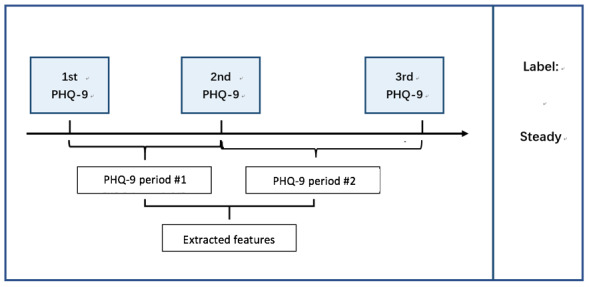
We constructed 950 data samples representing time spans during three consecutive Patient Health Questionnaire-9 assessments. Each data sample was labeled as Steady or Mood Swing, with subgroups Steady-remission, Steady-depressed, Mood Swing-drastic, and Mood Swing-moderate based on patients' Patient Health Questionnaire-9 scores from three visits. A total of 252 features were extracted, and 4 feature selection models were applied; 6 different combinations of types of data were experimented with using 6 different machine learning models.
A total of 334 participants with MDD were enrolled in this study. The highest average accuracy of classification between Steady and Mood Swing was 76.67% (SD 8.47%) and that of recall was 90.44% (SD 6.93%), with features from all types of data being used. Among the 6 combinations of types of data we experimented with, the overall best combination was using call logs, sleep data, step count data, and heart rate data. The accuracies of predicting between Steady-remission and Mood Swing-drastic, Steady-remission and Mood Swing-moderate, and Steady-depressed and Mood Swing-drastic were over 80%, and the accuracy of predicting between Steady-depressed and Mood Swing-moderate and the overall Steady to Mood Swing classification accuracy were over 75%. Comparing all 6 aforementioned combinations, we found that the overall prediction accuracies between Steady-remission and Mood Swing (drastic and moderate) are better than those between Steady-depressed and Mood Swing (drastic and moderate).
Our proposed method could be used to monitor mood changes in patients with MDD with promising accuracy by using passively collected data, which can be used as a reference by doctors for adjusting treatment plans or for warning patients and their guardians of a relapse.
Chinese Clinical Trial Registry ChiCTR1900021461; http://www.chictr.org.cn/showprojen.aspx?proj=36173.
重度抑郁症(MDD)是一种常见的精神疾病,其特征为持续悲伤和对活动失去兴趣。已有多项研究探讨了使用智能手机和可穿戴设备来监测 MDD 患者的精神状态。然而,很少有研究使用被动收集的数据来监测随时间变化的情绪变化。
本研究旨在使用机器学习模型通过被动收集的数据(包括手机使用数据、睡眠数据和步数数据)监测 MDD 患者的情绪状态和稳定性。
我们构建了 950 个数据样本,代表连续三次患者健康问卷-9 评估期间的时间段。每个数据样本均标记为稳定或情绪波动,根据患者三次就诊的患者健康问卷-9 评分,分为稳定缓解、稳定抑郁、情绪波动急剧和情绪波动中等亚组。共提取了 252 个特征,并应用了 4 种特征选择模型;使用 6 种不同的机器学习模型对 6 种不同类型的数据组合进行了实验。
共有 334 名 MDD 患者参与了本研究。稳定与情绪波动之间分类的最高平均准确率为 76.67%(SD 8.47%),召回率为 90.44%(SD 6.93%),使用了所有类型的数据的特征。在我们实验的 6 种类型数据组合中,整体最佳组合是使用通话记录、睡眠数据、步数数据和心率数据。预测稳定缓解与情绪波动急剧、稳定缓解与情绪波动中等以及稳定抑郁与情绪波动急剧之间的准确率均超过 80%,预测稳定抑郁与情绪波动中等以及整体稳定至情绪波动分类的准确率均超过 75%。比较所有 6 种上述组合,我们发现稳定缓解与情绪波动(急剧和中等)之间的整体预测准确率优于稳定抑郁与情绪波动(急剧和中等)之间的预测准确率。
我们提出的方法可以使用被动收集的数据来监测 MDD 患者的情绪变化,准确率有一定的保证,可以为医生调整治疗计划提供参考,或提醒患者及其监护人病情复发的风险。
中国临床试验注册中心 ChiCTR1900021461;http://www.chictr.org.cn/showprojen.aspx?proj=36173.