UCL Institute of Cognitive Neuroscience, University College London, London, UK.
Max Planck UCL Centre for Computational Psychiatry and Ageing Research, London, UK.
Dev Sci. 2021 Sep;24(5):e13101. doi: 10.1111/desc.13101. Epub 2021 Mar 8.
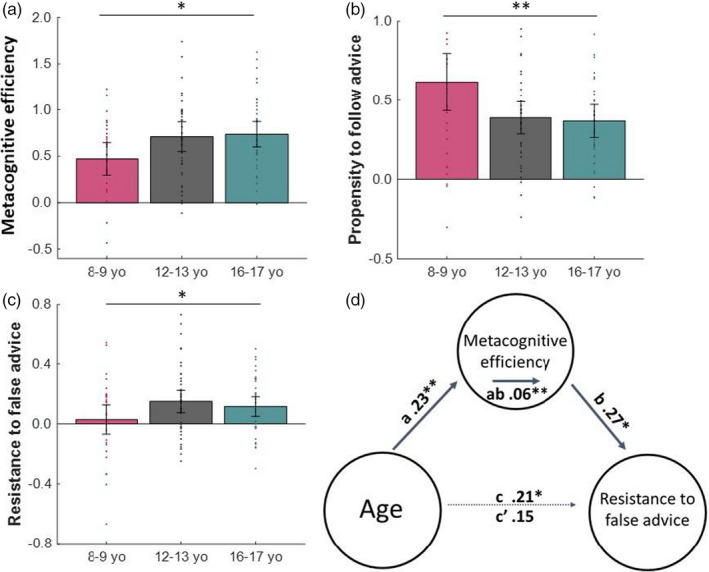
Adolescents aspire for independence. Successful independence means knowing when to rely on one's own knowledge and when to listen to others. A critical prerequisite thus is a well-developed metacognitive ability to accurately assess the quality of one's own knowledge. Little is known about whether the strive to become an independent decision maker in adolescence is underpinned by the necessary metacognitive skills. Here, we demonstrate that metacognition matures from childhood to adolescence (N = 107) and that this process coincides with greater independent decision-making. We show that adolescents, in contrast to children, take on others' advice less often, but only when the advice is misleading. Finally, we demonstrate that adolescents' reduced reliance on others' advice is explained by their increased metacognitive skills, suggesting that a developing ability to introspect may support independent decision-making in adolescence.
青少年渴望独立。成功的独立意味着知道何时依靠自己的知识,何时倾听他人的意见。因此,一个关键的前提条件是要有高度发达的元认知能力,能够准确评估自己知识的质量。目前尚不清楚青少年努力成为独立决策者的背后是否有必要的元认知技能支撑。在这里,我们证明元认知从儿童期到青春期逐渐成熟(N=107),这一过程与更大的独立决策能力相一致。我们发现,与儿童相比,青少年接受他人建议的频率较低,但只有在建议具有误导性时才会这样。最后,我们证明青少年减少对他人建议的依赖可以用他们不断增强的元认知技能来解释,这表明不断发展的内省能力可能会支持青少年的独立决策。