Guangdong Provincial People's Hospital, Guangdong Academy of Medical Sciences, Guangzhou, Guangdong, China.
Aging (Albany NY). 2021 Mar 3;13(6):8204-8213. doi: 10.18632/aging.202630.
The association between weak hand grip strength (HGS) and stroke recovery has been studied; however, few studies focused on the association of HGS with stroke prevalence and incidence.
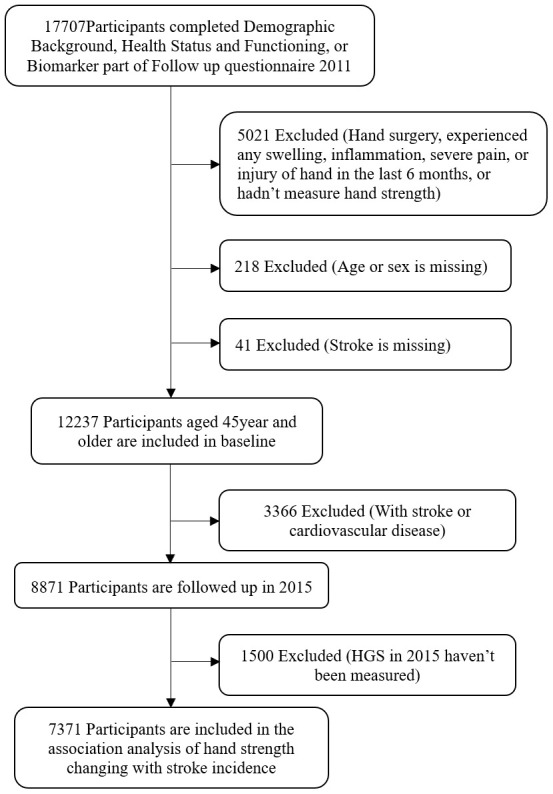
A prospective cohort baseline study of a nationally representative sample in Chinese adults aged 45 years and older in 2011 was followed up in 2015. 8871 participants without stroke at baseline were followed. The associations of HGS and its changes with stroke prevalence and incidence were investigated using logistic regression models and Cox proportional hazards regression models.
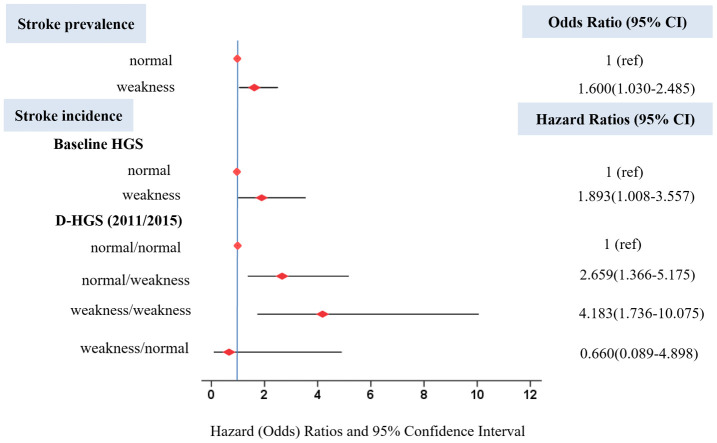
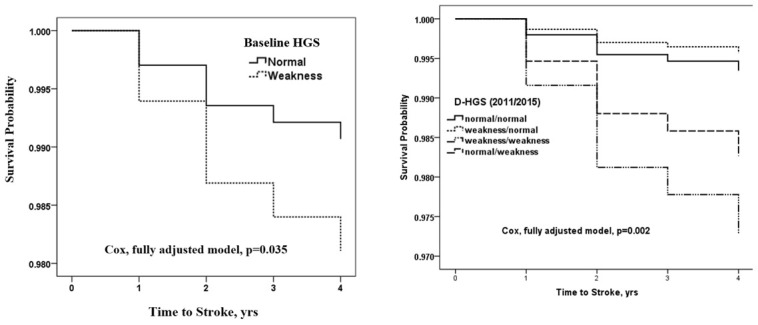
Association of HGS and stroke prevalence was significant. HGS weakness significantly increased risk of stroke incidence, with 89.3% higher risk when compared to normal HGS. During 35,263 person-years of follow-up, 112 stroke patients occurred. The four-year incidence rate ratio of stroke for participants with a HGS weakness was 2.15, compared to normal HGS participants. HGS changes in weakness/weakness from 2011 to 2015(D-HGS) and normal/weakness D-HGS had higher risks of stroke incidence when compared with those who had normal/normal D-HGS.
HGS weakness and decline of HGS were associated with stroke incidence for adults aged 45 years and older in China.
已有研究探讨了握力(HGS)与卒中康复之间的关联,但很少有研究关注 HGS 与卒中患病率和发病率之间的关系。
本研究对中国 2011 年年龄在 45 岁及以上的成年人进行了一项全国代表性样本的前瞻性队列基线研究,并于 2015 年进行了随访。共纳入了 8871 名基线时无卒中的参与者。采用 logistic 回归模型和 Cox 比例风险回归模型,探讨了 HGS 及其变化与卒中患病率和发病率的关系。
HGS 与卒中患病率之间存在显著关联。握力减弱显著增加了卒中发病的风险,与正常 HGS 相比,风险增加了 89.3%。在 35263 人年的随访期间,有 112 例卒中患者发生。与正常 HGS 参与者相比,HGS 减弱的参与者的四年卒中发生率比值为 2.15。与正常/正常 HGS 参与者相比,HGS 从 2011 年到 2015 年减弱/减弱(D-HGS)和正常/减弱 D-HGS 的参与者发生卒中的风险更高。
在中国,45 岁及以上成年人的握力减弱和握力下降与卒中发病率有关。