Paediatrics, Southend University Hospital NHS Foundation Trust, Westcliff-on-Sea, Essex, UK
Paediatrics, Southend University Hospital NHS Foundation Trust, Westcliff-on-Sea, Essex, UK.
BMJ Case Rep. 2021 Mar 10;14(3):e241405. doi: 10.1136/bcr-2020-241405.
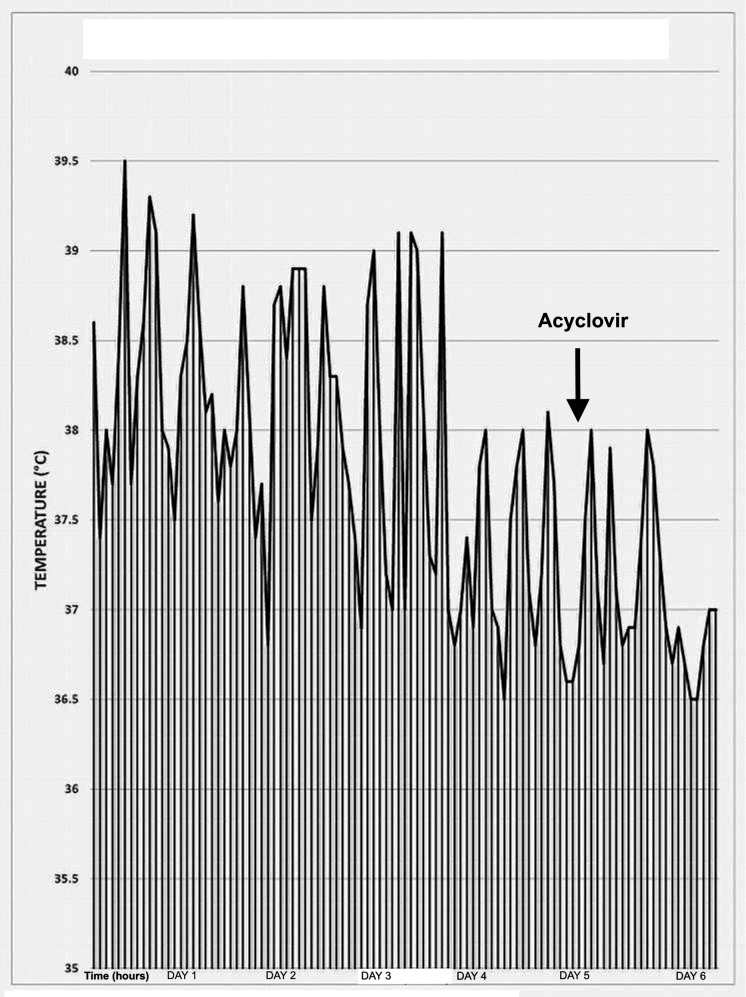
Neonatal herpes simplex virus (HSV) infection is rare, with an estimated incidence of 3.58 per 100 000 live births in the UK and should be suspected in any newborn with fever and bacterial culture-negative sepsis. We describe a case of a previously well full-term male neonate who presented with persistent fever and elevated ferritin level that was carried out during the era of the COVID-19 pandemic as part of SARS-CoV-2 panel investigations. Despite the initial negative HSV serology, HSV-1 PCR from a scalp lesion returned positive. He made a full recovery after acyclovir therapy. This case highlights the importance of maintaining a high clinical index of suspicion of HSV infection in any febrile neonate even with absence of maternal history and negative serology, particularly if associated with hyperferritinaemia. We also address the challenge of interpreting inflammatory biomarkers' results for SARS-CoV-2 infection in neonates.
新生儿单纯疱疹病毒(HSV)感染较为罕见,在英国的发病率估计为每 100000 例活产儿中有 3.58 例,对于任何有发热且细菌培养阴性的败血症的新生儿均应怀疑为本病。我们描述了一例先前健康的足月男性新生儿,其表现为持续性发热和铁蛋白水平升高,该患儿在 COVID-19 大流行期间作为 SARS-CoV-2 检测小组调查的一部分进行了检查。尽管最初的 HSV 血清学检查为阴性,但头皮病变的 HSV-1 PCR 结果为阳性。他在接受阿昔洛韦治疗后完全康复。本病例强调了在任何发热的新生儿中,即使无母体病史和阴性血清学检查,也应保持对 HSV 感染的高度临床怀疑指数,特别是如果伴有高铁蛋白血症。我们还讨论了在新生儿中解释 SARS-CoV-2 感染的炎症生物标志物结果的挑战。