Kim Shin-Hyang, Park Kiho, Yoon Seowon, Choi Younyoung, Lee Seung-Hwan, Choi Kee-Hong
School of Psychology, Korea University, Seoul, South Korea.
KU Mind Health Institute, Korea University, Seoul, South Korea.
Front Psychol. 2021 Feb 22;12:639366. doi: 10.3389/fpsyg.2021.639366. eCollection 2021.
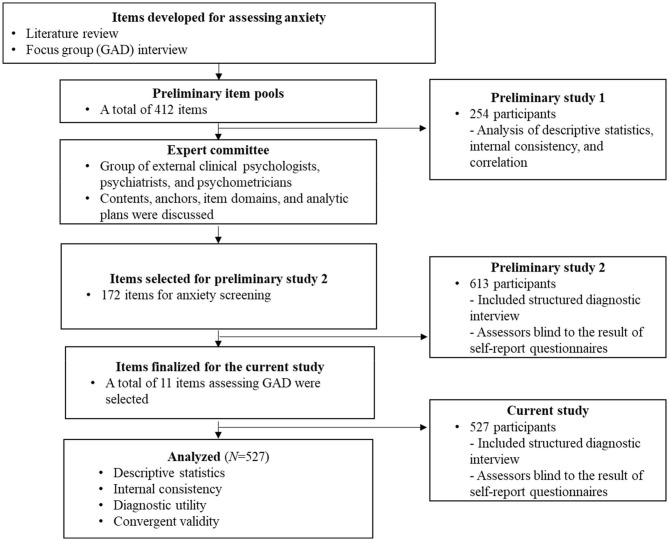
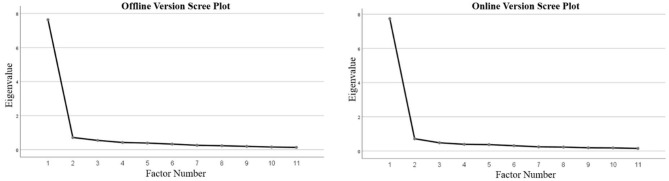
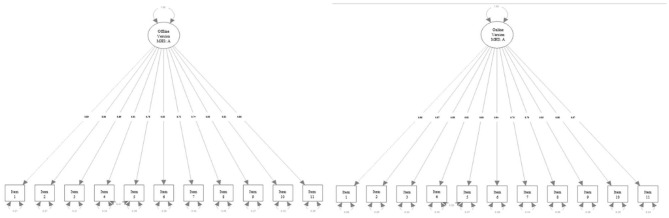
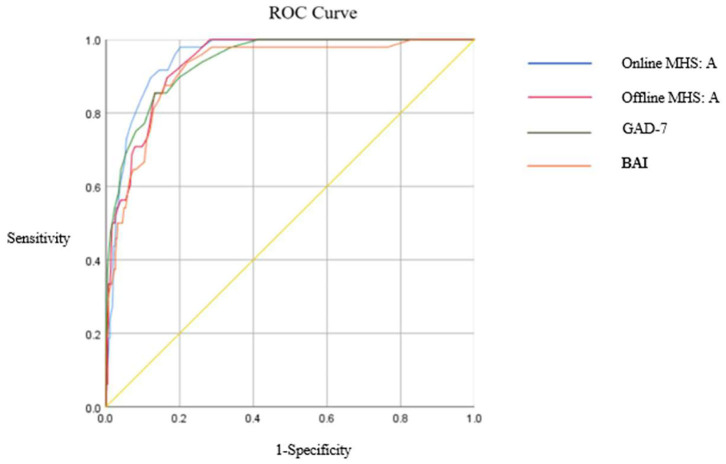
Generalized anxiety disorder (GAD) can cause significant socioeconomic burden and daily life dysfunction; hence, therapeutic intervention through early detection is important. This study was the final stage of a 3-year anxiety screening tool development project that evaluated the psychometric properties and diagnostic screening utility of the Mental Health Screening Tool for Anxiety Disorders (MHS: A), which measures GAD. A total of 527 Koreans completed online and offline (i.e., paper-and pencil) versions of the MHS: A, Beck Anxiety Inventory (BAI), Generalized Anxiety Disorder-7 (GAD-7), and Penn State Worry Questionnaire (PSWQ). The participants had an average age of 38.6 years and included 340 (64.5%) females. Participants were also administered the Mini-International Neuropsychiatric Interview (MINI). Internal consistency, convergent/criterion validity, item characteristics, and test information were assessed based on the item response theory (IRT), and a factor analysis and cut-off score analyses were conducted. The MHS: A had good internal consistency and good convergent validity with other anxiety scales. The two versions (online/offline) of the MHS: A were nearly identical ( = 0.908). It had a one-factor structure and showed better diagnostic accuracy (online/offline: sensitivity = 0.98/0.90, specificity = 0.80/0.83) for GAD detection than the GAD-7 and BAI. The IRT analysis indicated that the MHS: A was most informative as a screening tool for GAD. The MHS: A can serve as a clinically useful screening tool for GAD in Korea. Furthermore, it can be administered both online and offline and can be flexibly used as a brief mental health screener, especially with the current rise in telehealth.
广泛性焦虑障碍(GAD)会导致巨大的社会经济负担和日常生活功能障碍;因此,通过早期检测进行治疗干预很重要。本研究是一项为期3年的焦虑筛查工具开发项目的最后阶段,该项目评估了用于测量GAD的焦虑症心理健康筛查工具(MHS:A)的心理测量特性和诊断筛查效用。共有527名韩国人完成了MHS:A、贝克焦虑量表(BAI)、广泛性焦虑障碍7项量表(GAD-7)和宾夕法尼亚州立大学忧虑问卷(PSWQ)的在线和离线(即纸笔)版本。参与者的平均年龄为38.6岁,其中包括340名(64.5%)女性。参与者还接受了迷你国际神经精神病学访谈(MINI)。基于项目反应理论(IRT)评估了内部一致性、收敛/标准效度、项目特征和测试信息,并进行了因子分析和截断分数分析。MHS:A具有良好的内部一致性,与其他焦虑量表具有良好的收敛效度。MHS:A的两个版本(在线/离线)几乎相同(=0.908)。它具有单因素结构,在检测GAD方面比GAD-7和BAI具有更高的诊断准确性(在线/离线:敏感性=0.98/0.90,特异性=0.80/0.83)。IRT分析表明,MHS:A作为GAD的筛查工具信息最丰富。MHS:A可作为韩国临床上有用的GAD筛查工具。此外,它既可以在线管理,也可以离线管理,并且可以灵活地用作简短的心理健康筛查工具,尤其是在当前远程医疗兴起的情况下。