Department of Applied Chemistry, Graduate School of Engineering, The University of Tokyo, 7-3-1 Hongo, Bunkyo-ku, Tokyo 113-8656, Japan.
J Biochem. 2021 Sep 22;170(1):79-87. doi: 10.1093/jb/mvab022.
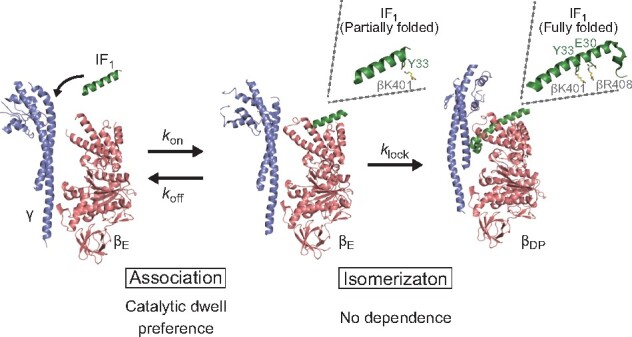
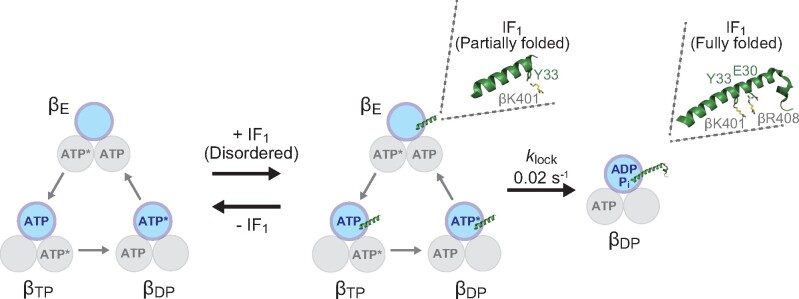
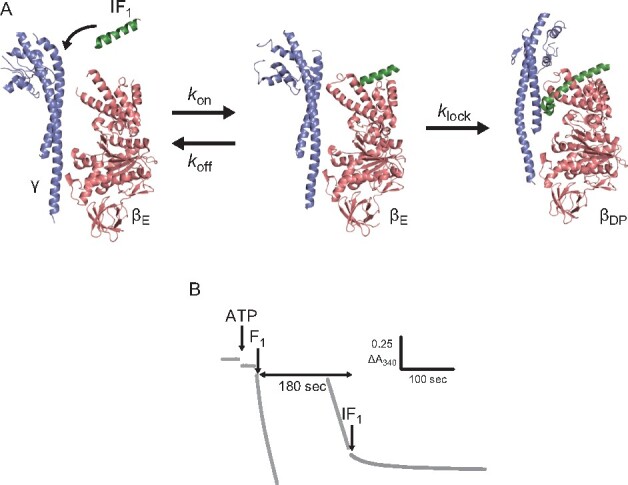
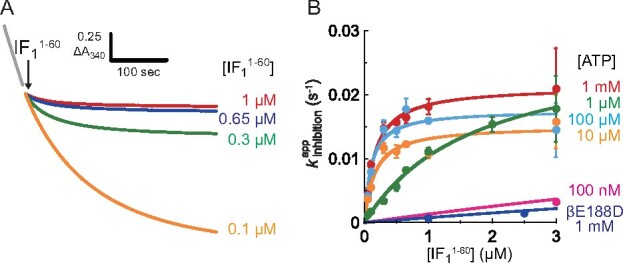
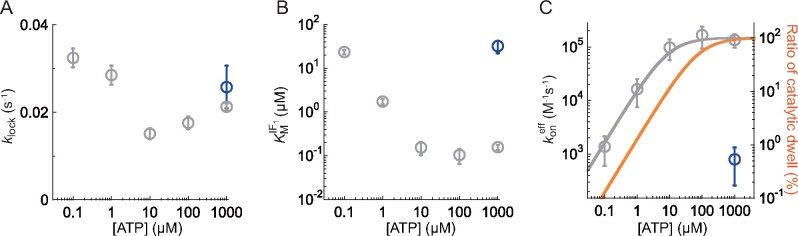
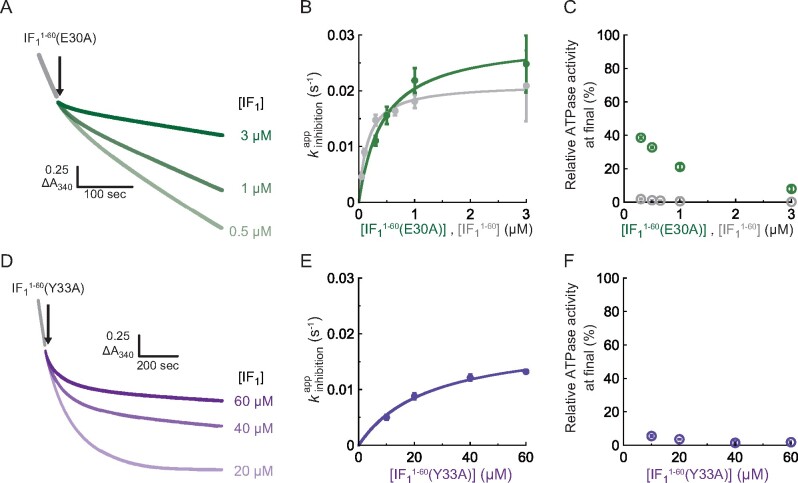
ATPase inhibitory factor 1 (IF1) is a mitochondrial regulatory protein that blocks ATP hydrolysis of F1-ATPase, by inserting its N-terminus into the rotor-stator interface of F1-ATPase. Although previous studies have proposed a two-step model for IF1-mediated inhibition, the underlying molecular mechanism remains unclear. Here, we analysed the kinetics of IF1-mediated inhibition under a wide range of [ATP]s and [IF1]s, using bovine mitochondrial IF1 and F1-ATPase. Typical hyperbolic curves of inhibition rates with [IF1]s were observed at all [ATP]s tested, suggesting a two-step mechanism: the initial association of IF1 to F1-ATPase and the locking process, where IF1 blocks rotation by inserting its N-terminus. The initial association was dependent on ATP. Considering two principal rotation dwells, binding dwell and catalytic dwell, in F1-ATPase, this result means that IF1 associates with F1-ATPase in the catalytic-waiting state. In contrast, the isomerization process to the locking state was almost independent of ATP, suggesting that it is also independent of the F1-ATPase state. Further, we investigated the role of Glu30 or Tyr33 of IF1 in the two-step mechanism. Kinetic analysis showed that Glu30 is involved in the isomerization, whereas Tyr33 contributes to the initial association. Based on these findings, we propose an IF1-mediated inhibition scheme.
ATP 酶抑制因子 1(IF1)是一种线粒体调节蛋白,通过将其 N 端插入 F1-ATP 酶的转子-定子接口,阻止 F1-ATP 酶的 ATP 水解。尽管先前的研究提出了 IF1 介导的抑制的两步模型,但潜在的分子机制仍不清楚。在这里,我们使用牛线粒体 IF1 和 F1-ATP 酶,在广泛的 [ATP] 和 [IF1] 条件下分析了 IF1 介导的抑制的动力学。在所有测试的 [ATP] 下,都观察到了抑制率与 [IF1] 的典型双曲线曲线,表明存在两步机制:IF1 与 F1-ATP 酶的初始结合和锁定过程,其中 IF1 通过插入其 N 端阻止旋转。初始结合依赖于 ATP。考虑到 F1-ATP 酶中的两个主要旋转停留,即结合停留和催化停留,这一结果意味着 IF1 与处于催化等待状态的 F1-ATP 酶结合。相比之下,向锁定状态的异构化过程几乎与 ATP 无关,表明它也与 F1-ATP 酶状态无关。此外,我们研究了 IF1 中的 Glu30 或 Tyr33 在两步机制中的作用。动力学分析表明,Glu30 参与异构化,而 Tyr33 有助于初始结合。基于这些发现,我们提出了 IF1 介导的抑制方案。