Department of Anatomy and Neuroscience, School of Medicine, College of Medicine & Health, and APC Microbiome Ireland, University College Cork, Cork, Ireland.
Int J Neuropsychopharmacol. 2021 Mar 17;24(3):216-220. doi: 10.1093/ijnp/pyaa088.
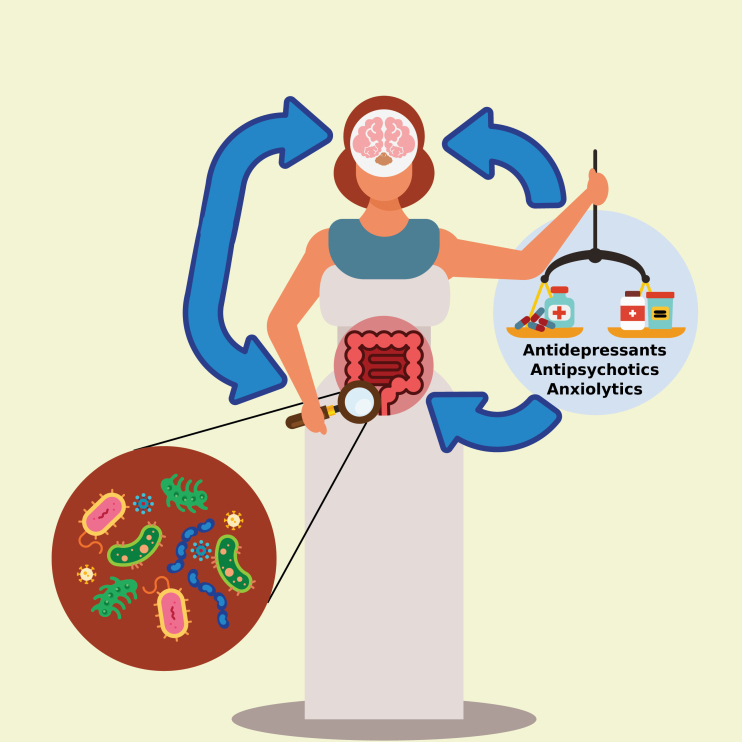
There is increasing evidence for the role of the microbiome in various mental health disorders. Moreover, there has been a growing understanding of the importance of the microbiome in mediating both the efficacy and side effects of various medications, including psychotropics. In this issue, Tomizawa and colleagues report on the effect of psychotropic drugs on the gut microbiome of 40 patients with depression and/or anxiety disorders. In their longitudinal cohort, the authors find that antipsychotics, but not anxiolytics, decrease microbiome alpha diversity. They further find that antipsychotics dosage was negatively correlated with alpha diversity in these patients. The health consequences of these microbiome alterations remain to be fully understood. In this commentary, we will discuss such findings through the lens of several recent studies on the microbiota-gut-brain axis. We also use the paper as a backdrop to discuss directionality and, by extension, causality in relation to microbiota-gut-brain-brain signaling.
越来越多的证据表明微生物组在各种心理健康障碍中发挥作用。此外,人们越来越认识到微生物组在调节各种药物(包括精神药物)的疗效和副作用方面的重要性。在本期中,Tomizawa 及其同事报告了精神药物对 40 名抑郁症和/或焦虑症患者肠道微生物组的影响。在他们的纵向队列研究中,作者发现抗精神病药,但不是抗焦虑药,会降低微生物组的 alpha 多样性。他们进一步发现,抗精神病药的剂量与这些患者的 alpha 多样性呈负相关。这些微生物组改变的健康后果仍有待充分理解。在这篇评论中,我们将通过最近几项关于微生物组-肠道-大脑轴的研究来讨论这些发现。我们还将本文作为背景,讨论与微生物组-肠道-大脑-大脑信号传递有关的方向性和因果关系。