Department of Health Policy and Management, Center for Health Decision Science, Harvard T.H. Chan School of Public Health, Boston, Massachusetts, United States of America.
Cancer Research Division, Cancer Council New South Wales, Sydney, Australia.
PLoS Med. 2021 Mar 11;18(3):e1003534. doi: 10.1371/journal.pmed.1003534. eCollection 2021 Mar.
A nonavalent human papillomavirus (HPV) vaccine has been licensed for use in women and men up to age 45 years in the United States. The cost-effectiveness of HPV vaccination for women and men aged 30 to 45 years in the context of cervical cancer screening practice was evaluated to inform national guidelines.
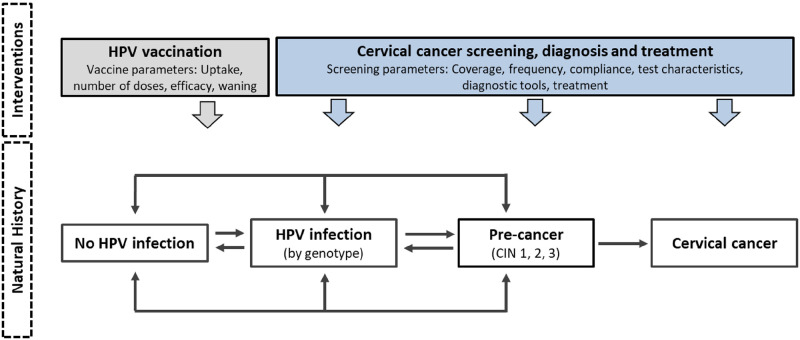
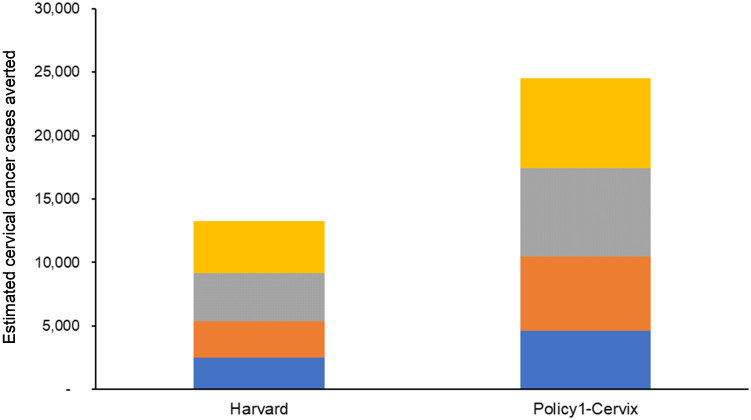
We utilized 2 independent HPV microsimulation models to evaluate the cost-effectiveness of extending the upper age limit of HPV vaccination in women (from age 26 years) and men (from age 21 years) up to age 30, 35, 40, or 45 years. The models were empirically calibrated to reflect the burden of HPV and related cancers in the US population and used standardized inputs regarding historical and future vaccination uptake, vaccine efficacy, cervical cancer screening, and costs. Disease outcomes included cervical, anal, oropharyngeal, vulvar, vaginal, and penile cancers, as well as genital warts. Both models projected higher costs and greater health benefits as the upper age limit of HPV vaccination increased. Strategies of vaccinating females and males up to ages 30, 35, and 40 years were found to be less cost-effective than vaccinating up to age 45 years, which had an incremental cost-effectiveness ratio (ICER) greater than a commonly accepted upper threshold of $200,000 per quality-adjusted life year (QALY) gained. When including all HPV-related outcomes, the ICER for vaccinating up to age 45 years ranged from $315,700 to $440,600 per QALY gained. Assumptions regarding cervical screening compliance, vaccine costs, and the natural history of noncervical HPV-related cancers had major impacts on the cost-effectiveness of the vaccination strategies. Key limitations of the study were related to uncertainties in the data used to inform the models, including the timing of vaccine impact on noncervical cancers and vaccine efficacy at older ages.
Our results from 2 independent models suggest that HPV vaccination for adult women and men aged 30 to 45 years is unlikely to represent good value for money in the US.
九价人乳头瘤病毒(HPV)疫苗已获准在美国用于年龄在 45 岁以下的女性和男性。为了为国家指南提供信息,评估了在宫颈癌筛查实践背景下为 30 至 45 岁的女性和男性接种 HPV 疫苗的成本效益。
我们使用 2 个独立的 HPV 微观模拟模型来评估将 HPV 疫苗接种的上限年龄从 26 岁延长至 30、35、40 或 45 岁的女性(从 21 岁)和男性的成本效益。该模型经过实证校准,以反映美国人口中 HPV 和相关癌症的负担,并使用有关历史和未来疫苗接种率、疫苗效力、宫颈癌筛查和成本的标准化投入。疾病结果包括宫颈癌、肛门癌、口咽癌、外阴癌、阴道癌和阴茎癌以及生殖器疣。随着 HPV 疫苗接种的上限年龄的增加,两个模型都预测到更高的成本和更大的健康效益。与接种至 45 岁相比,接种至 30、35 和 40 岁的女性和男性的策略被认为成本效益较低,其增量成本效益比(ICER)大于通常接受的每增加一个质量调整生命年(QALY)超过 200,000 美元的上限。当包括所有 HPV 相关结果时,接种至 45 岁的 ICER 范围为每增加一个 QALY 315,700 至 440,600 美元。接种疫苗策略的成本效益受到与模型相关的假设的影响,包括疫苗对非宫颈癌相关癌症的影响时间和疫苗在老年时的效力以及宫颈癌筛查的合规性、疫苗成本和非宫颈癌 HPV 相关癌症的自然史等数据。该研究的主要局限性与用于为模型提供信息的数据中的不确定性有关,包括疫苗对非宫颈癌癌症的影响时间和疫苗在老年时的效力。
我们从 2 个独立模型得出的结果表明,在美国,为 30 至 45 岁的女性和男性接种 HPV 疫苗不太可能具有良好的性价比。