Department of Animal Science, Veterinary School, Federal University of Minas Gerais, Belo Horizonte, Minas Gerais, Brazil.
Brazilian Agricultural Research Corporation-EMBRAPA, National Center for Research on Dairy Cattle, Juiz de Fora, Minas Gerais, Brazil.
PLoS One. 2021 Mar 11;16(3):e0231068. doi: 10.1371/journal.pone.0231068. eCollection 2021.
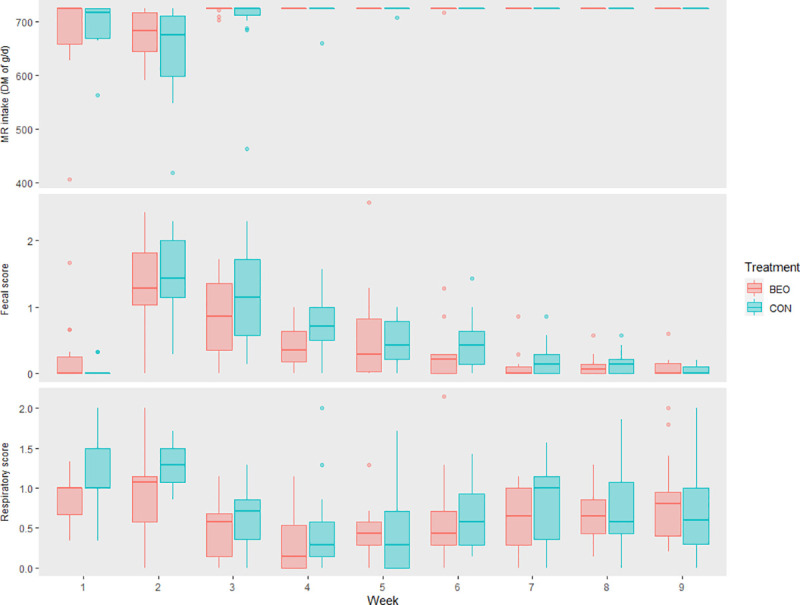
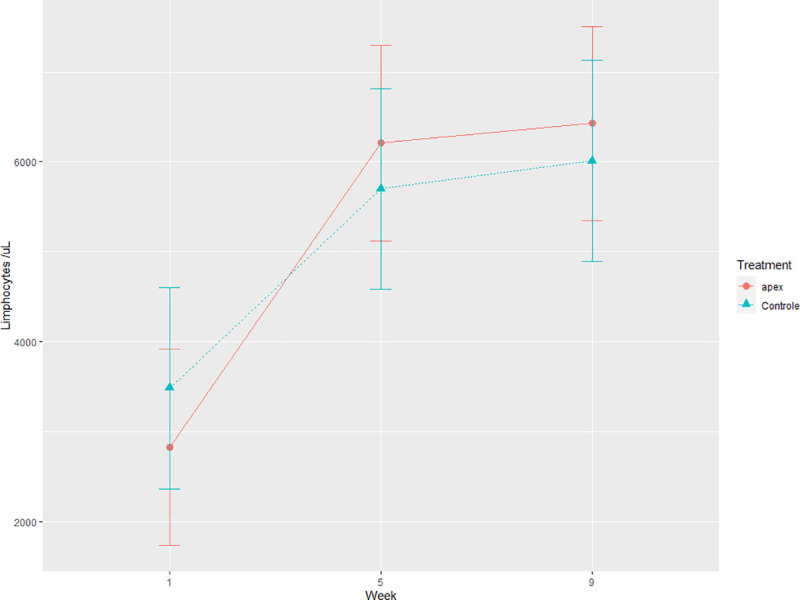
The aim of this study was to evaluate how the inclusion of a blend of essential oils in milk replacer (MR) affects different outcomes of dairy heifers. The outcomes evaluated: feed intake, performance, body development, blood cells and metabolites, insulin-like growth factor-1 (IGF-1), rumen fermentation, fecal scores, and respiratory scores. All outcomes were evaluated during pre-weaning (4-60 d of age), and carry-over effects during post-weaning (61-90 d of age) periods. The experimental units utilized were 29 newborn Holstein × Gyr crossbred dairy heifers, with genetic composition of 5/8 or more Holstein and 3/8 or less Gyr and body weight (BW) at birth of 32.2 ± 5.2 kg. Experimental units were assigned to either a control (CON, n = 15) or a blend of essential oil supplementation (BEO, n = 14) treatment, maintaining a balance of genetic composition. The BEO was supplemented in the MR with 1 g/d/calf of a blend of essential oils (Apex Calf, Adisseo, China) composed by plant extracts derived from anise, cinnamon, garlic, rosemary, and thyme. During the pre-weaning phase, all heifers were fed 5 L of MR/d reconstituted to 15% (dry matter basis), divided into two equal meals. Water and starter were provided ad libitum. During the post-weaning, animals received a maximum of 3 kg of starter/d, and ad libitum corn silage, divided into two meals. Feed intake, fecal and respiratory scores were evaluated daily. The BW was measured every three days, while body development was recorded weekly. Blood samples were collected on 0, 30, and 60 d of age for total blood cell count, weekly and on the weaning day to determinate ß-hydroxybutyrate, urea and glucose, and biweekly for IGF-1. Ruminal parameters (pH, volatile fatty acids, ammonia-N, and acetate:propionate proportion-C2:C3) were measured on days 14, 28, 42, 60, 74 and 90. A randomized complete block design with an interaction between treatment and week was the experimental method of choice to test the hypothesis of the BEO's effect on all outcomes. An ANOVA procedure was used for continuous outcomes, and a non-parametric test was used for the ordered categorical outcomes, both adopting a CI = 95%. Results indicated that there was not enough evidence to accept the alternative hypothesis of the effect of BEO in MR on feed intake, performance, body development, and blood metabolites during both pre-weaning and post-weaning periods. However, results indicated that the inclusion of BEO in MR significantly affects the proportion of C2:C3 during pre- and post-weaning (P = 0.05). Similarly, the effect was significant for basophil (P ≤ 0.001), and platelet (P = 0.04) counts pre-weaning. The interaction between week and treatment was also significant for lymphocytes (P ≤ 0.001), revealing a cumulative effect. Lastly, fecal scores were also significant (P = 0.04) during pre-weaning, with lower values for BEO. The BEO contributed to ruminal manipulation in pre-weaning and carry-over effects in post-weaning, immunity improvement, and decreased morbidity of neonatal diarrhea in the pre-weaning phase.
本研究旨在评估在代乳料中添加混合精油对奶牛犊牛的不同影响。评估的结果包括:采食量、性能、身体发育、血液细胞和代谢物、胰岛素样生长因子-1(IGF-1)、瘤胃发酵、粪便评分和呼吸评分。所有结果均在断奶前(4-60 日龄)进行评估,并在断奶后(61-90 日龄)进行持续效果评估。实验单位为 29 头新生荷斯坦×吉尔杂交奶牛犊,遗传组成 5/8 或更多的荷斯坦和 3/8 或更少的吉尔,出生体重为 32.2±5.2 公斤。实验单位分为对照组(CON,n=15)或混合精油补充组(BEO,n=14),保持遗传组成平衡。BEO 以 1 g/d/犊牛的剂量添加到代乳料中,混合了由茴芹、肉桂、大蒜、迷迭香和百里香植物提取物组成的精油(Apex Calf,Adisseo,中国)。在断奶前阶段,所有犊牛每天喂食 5 L 经配制的 15%(干物质基础)代乳料,分为两等份。提供水和开食料自由采食。在断奶后,动物每天最多可摄入 3 kg 开食料,并自由采食玉米青贮料,分为两餐。每天评估采食量、粪便和呼吸评分。每隔三天测量一次体重,每周记录一次身体发育情况。在 0、30 和 60 日龄时采集血液样本进行总血细胞计数,每周和断奶日进行β-羟丁酸、尿素和葡萄糖测定,每两周进行一次 IGF-1 测定。在第 14、28、42、60、74 和 90 天测量瘤胃参数(pH、挥发性脂肪酸、氨氮和乙酸:丙酸比例-C2:C3)。选择随机完全区组设计,并进行处理与周的交互作用,以检验 BEO 对所有结果的影响的假设。采用方差分析程序对连续结果进行分析,采用非参数检验对有序分类结果进行分析,置信区间均为 95%。结果表明,没有足够的证据接受 BEO 在代乳料中对断奶前和断奶后采食量、性能、身体发育和血液代谢物的替代假设的影响。然而,结果表明,BEO 对断奶前和断奶后的 C2:C3 比例有显著影响(P=0.05)。同样,BEO 对断奶前嗜碱性粒细胞(P≤0.001)和血小板(P=0.04)计数有显著影响。周和处理之间的相互作用对淋巴细胞也有显著影响(P≤0.001),显示出累积效应。最后,断奶前粪便评分也有显著差异(P=0.04),BEO 组的评分较低。BEO 有助于代乳料在断奶前的瘤胃调节,以及在断奶后的持续效果,提高免疫力,并降低断奶前新生腹泻的发病率。