Division of Cardiovascular Medicine, Department of Medicine, Jichi Medical University School of Medicine, Tochigi, Japan.
Department of Medical Sciences, School of Healthcare and Medical Sciences, Sunway University, Bandar Sunway, Malaysia.
J Clin Hypertens (Greenwich). 2021 Mar;23(3):489-495. doi: 10.1111/jch.14184. Epub 2021 Mar 11.
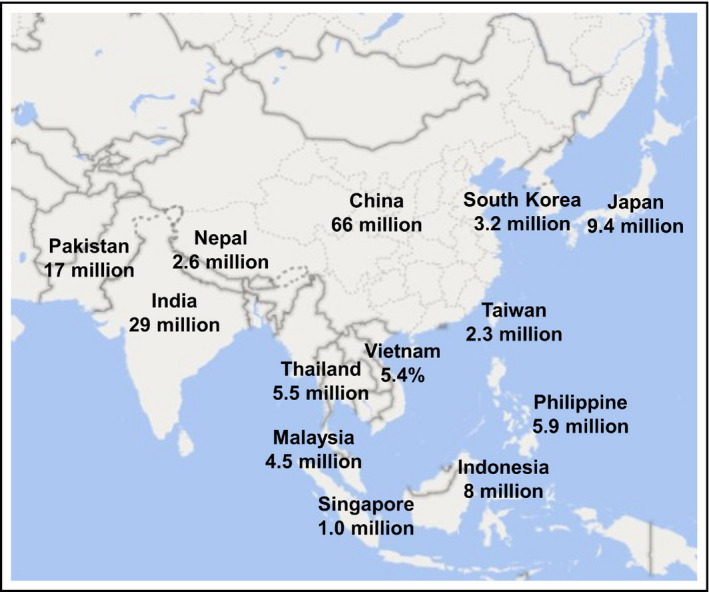
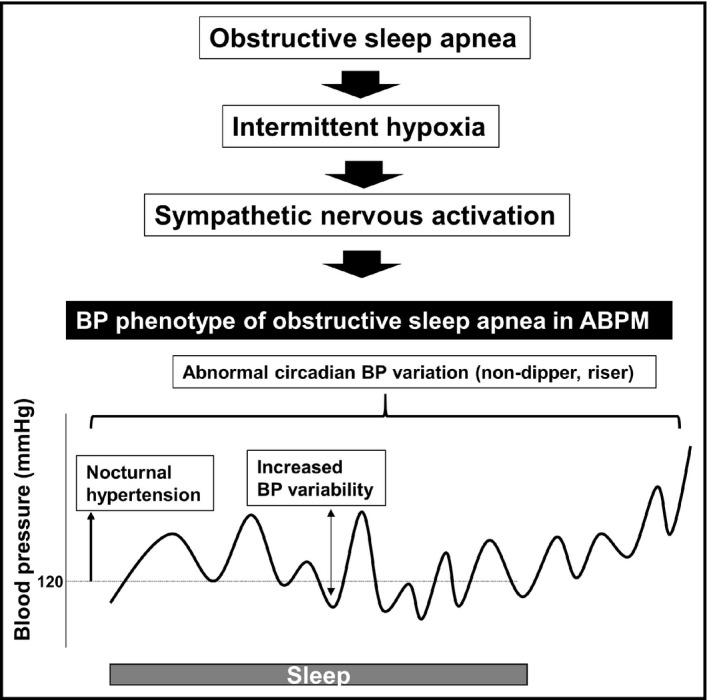
Obstructive sleep apnea (OSA) is a risk of hypertension and is associated with cardiovascular disease (CVD) incidence. In Asian countries, the prevalence of OSA is high, as in Western countries. When blood pressure (BP) is evaluated in OSA individuals using ambulatory BP monitoring (ABPM), the BP phenotype often indicates abnormal BP variability, such as increased nighttime BP or abnormal diurnal BP variation, that is, non-dipper pattern, riser pattern, and morning BP surge, and all these conditions have been associated with increased CVD events. Asians have a higher prevalence of increased nighttime BP or morning BP surge than Westerners. Therefore, this review paper focused on OSA and hypertension from an Asian perspective to investigate the importance of the association between OSA and hypertension in the Asian population. Such abnormal BP variability has been shown to be associated with progression of arterial stiffness, and this association could provoke a vicious cycle between abnormal BP phenotypes and arterial stiffness, a phenomenon recognized as systemic hemodynamic atherothrombotic syndrome (SHATS). OSA may be one of the background factors that augment SHATS. An oxygen-triggered nocturnal oscillometric BP measurement device combined with a pulse oximeter for continuous SpO monitoring could detect BP variability caused by OSA. In addition to treating the OSA, accurate and reliable detection and treatment of any residual BP elevation and BP variability caused by OSA would be necessary to prevent CVD events. However, more detailed detection of BP variability, such as beat-by-beat BP monitoring, would further help to reduce CV events.
阻塞性睡眠呼吸暂停(OSA)是高血压的风险因素,并与心血管疾病(CVD)的发生有关。在亚洲国家,OSA 的患病率与西方国家一样高。当使用动态血压监测(ABPM)评估 OSA 个体的血压时,血压表型通常表明血压变异性异常,例如夜间血压升高或昼夜血压变化异常,即非杓型、升型和晨峰血压,所有这些情况都与 CVD 事件增加有关。亚洲人夜间血压升高或晨峰血压升高的患病率高于西方人。因此,本文从亚洲人的角度重点关注 OSA 和高血压,以探讨 OSA 与高血压在亚洲人群中的相关性的重要性。这种异常的血压变异性已被证明与动脉僵硬度的进展有关,这种关联可能在异常血压表型和动脉僵硬度之间引发恶性循环,这种现象被认为是系统性血流动力学动脉粥样血栓形成综合征(SHATS)。OSA 可能是增强 SHATS 的背景因素之一。一种结合了脉搏血氧仪进行连续 SpO 监测的氧气触发的夜间振荡血压测量设备可以检测到 OSA 引起的血压变异性。除了治疗 OSA 之外,还需要准确可靠地检测和治疗任何由 OSA 引起的残留血压升高和血压变异性,以预防 CVD 事件。然而,更详细的血压变异性检测,如逐拍血压监测,将有助于进一步降低 CV 事件的发生。