Instituto de Nutrición y Tecnología de los Alimentos, Universidad de Chile, Avenida El Líbano 5524, Macul, Santiago, Chile.
Keiser University, 1900 W Commercial Blvd, Fort Lauderdale, FL, 33309, USA.
BMC Geriatr. 2021 Mar 11;21(1):176. doi: 10.1186/s12877-021-02126-9.
Chile has one of the longest life expectancies of Latin America. The country is characterised by an important macroeconomic growth and persisting socioeconomic inequalities. This study analyses socioeconomic differences in life expectancy (LE) and disability-free life expectancy (DFLE) among Chilean older people.
The sample of the Social Protection Survey, a longitudinal study, was analysed. Five waves, from 2004 to 2016, were considered. The indicator was disability, defined as having difficulties to perform at least one basic activity of daily living. Type of health insurance was used to determine socioeconomic position (SEP). Total LE and DFLE were estimated with multistate life table models.
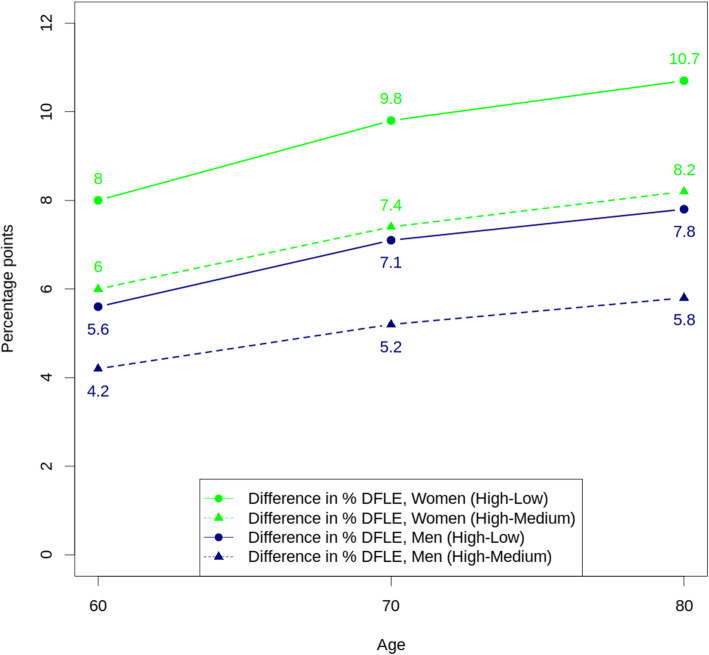
At age 60, men in the higher SEP could expect to live 3.7 years longer (22.2; 95% CI 19.6-24.8) compared to men of the same age in the medium SEP (18.4; 95% CI 17.4-19.4), and 4.9 years longer than men of the same age in the lower SEP (17.3; 95% CI 16.4-18.2). They also had a DFLE (19.4; 95% CI 17.1-21.7) 4 (15.4; 95% CI 14.6-16.1) and 5.2 (14.2; 95% CI 13.4-14.9) years longer, compared to the same groups. Women aged 60 years in the higher SEP had a LE (27.2; 95% CI 23.7-30.8) 4.6 (22.7; 95% CI 21.9-23.5) and 5.6 (21.6; 20.6-22.6) years longer, compared to women in the medium and the lower SEP. The difference in DFLE, for the same age and groups was 4.9 and 6.1 years, respectively (high: 21.4; 95% CI 19.5-23.3; medium: 16.5; 95% CI 15.8-17.1; low: 15.3; 95% CI 14.6-16.0). Socioeconomic differences in LE and DFLE were observed among both sexes until advanced age.
Socioeconomic inequalities in LE and DFLE were found among Chilean older men and women. Older people in the highest SEP live longer and healthier lives.
A reform to the Chilean health system should be considered, in order to guarantee timely access to care and benefits for older people who are not in the wealthiest group.
智利是拉丁美洲预期寿命最长的国家之一。该国的特点是宏观经济增长显著,但社会经济不平等仍然存在。本研究分析了智利老年人的社会经济地位差异与预期寿命(LE)和无残疾预期寿命(DFLE)之间的关系。
分析了社会保护调查的样本,这是一项纵向研究。考虑了从 2004 年到 2016 年的五个波次。残疾被定义为在进行至少一项基本日常生活活动方面有困难,以此作为指标。健康保险类型用于确定社会经济地位(SEP)。使用多状态生命表模型估计总 LE 和 DFLE。
在 60 岁时,处于较高 SEP 的男性比处于中等 SEP 的同年龄段男性预期寿命长 3.7 年(22.2;95%CI 19.6-24.8),比处于较低 SEP 的同年龄段男性预期寿命长 4.9 年(17.3;95%CI 16.4-18.2)。与同一组相比,他们的 DFLE(19.4;95%CI 17.1-21.7)也分别长 4(15.4;95%CI 14.6-16.1)和 5.2(14.2;95%CI 13.4-14.9)年。60 岁的女性中,处于较高 SEP 的女性的 LE(27.2;95%CI 23.7-30.8)比处于中等和较低 SEP 的女性长 4.6 年(22.7;95%CI 21.9-23.5)和 5.6 年(21.6;20.6-22.6)。对于同一年龄和组,DFLE 的差异分别为 4.9 年和 6.1 年(高:21.4;95%CI 19.5-23.3;中:16.5;95%CI 15.8-17.1;低:15.3;95%CI 14.6-16.0)。在两性中,直到老年,社会经济地位差异在 LE 和 DFLE 中都有体现。
在智利的老年男性和女性中,发现了预期寿命和无残疾预期寿命方面的社会经济不平等。处于最高 SEP 的老年人寿命更长,生活更健康。
应考虑对智利卫生系统进行改革,以确保不属于最富裕群体的老年人能够及时获得医疗和福利。