Department of Ophthalmology, The First Affiliated Hospital with Nanjing Medical University, Nanjing, China.
Department of Child Healthcare, The First Affiliated Hospital with Nanjing Medical University, Nanjing, China.
Eye (Lond). 2022 Feb;36(2):448-456. doi: 10.1038/s41433-021-01489-y. Epub 2021 Mar 11.
To explore the association between sleep disorders and subfoveal choroidal thickness (SFCT) in preschool children.
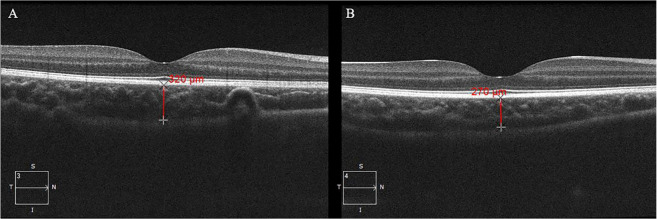
In this population-based cross-sectional study, children aged 60-72 months were measured for SFCT using spectral-domain optical coherence tomography (SD-OCT) and for sleep disorders using the Chinese version of Children's Sleep Habits Questionnaire (CSHQ). Multiple linear regression analyses were performed to assess the association between sleep disorders and SFCT.
A total of 1337 children (mean (SD) age: 66.88 (3.41) months) were included in the analyses. In multivariable linear analysis, a higher total CSHQ score (indicating higher likelihood of sleep disorders) was associated with a thinner subfoveal choroid (beta, -0.070; 95% CI, -0.141 to -0.001; P = 0.046). When each of eight CSHQ subscale scores was analysed by the multivariable model, only the Daytime Sleepiness subscale score was negatively associated with the SFCT (beta, -0.115; 95% CI, -0.183 to -0.046; P = 0.001). The children with clinically significant daytime sleepiness (n = 364, 27.2%) had significantly thinner subfoveal choroid than other children (295.47 vs. 308.52 μm, P = 0.007).
Only daytime sleepiness was significantly associated with SFCT in preschool children in this study. The potential relationship between sleep disorders during childhood and children's ocular development needs further research.
探讨学龄前儿童睡眠障碍与中心凹下脉络膜厚度(SFCT)的关系。
本研究为基于人群的横断面研究,采用频域光相干断层扫描(SD-OCT)测量 60-72 月龄儿童的 SFCT,采用中文版儿童睡眠习惯问卷(CSHQ)评估睡眠障碍。采用多元线性回归分析评估睡眠障碍与 SFCT 的关系。
共纳入 1337 名儿童(平均(SD)年龄:66.88(3.41)个月)进行分析。多元线性分析显示,CSHQ 总分较高(提示睡眠障碍可能性较大)与 SFCT 较薄呈负相关(β值,-0.070;95%置信区间,-0.141 至 -0.001;P=0.046)。当按照多元模型分析 CSHQ 的 8 个分量表评分时,只有日间嗜睡分量表评分与 SFCT 呈负相关(β值,-0.115;95%置信区间,-0.183 至 -0.046;P=0.001)。患有临床显著日间嗜睡(n=364,27.2%)的儿童 SFCT 明显较薄(295.47μm 比 308.52μm,P=0.007)。
在本研究中,只有日间嗜睡与学龄前儿童的 SFCT 显著相关。儿童睡眠障碍与儿童眼部发育之间的潜在关系需要进一步研究。