Department of Neurology, School of Medicine, Universitas Syiah Kuala, Banda Aceh, Aceh, 23111, Indonesia.
Department of Neurology, Dr. Zainoel Abidin Hospital, Banda Aceh, Aceh, 23111, Indonesia.
F1000Res. 2021 Jan 19;10:34. doi: 10.12688/f1000research.42308.1. eCollection 2021.
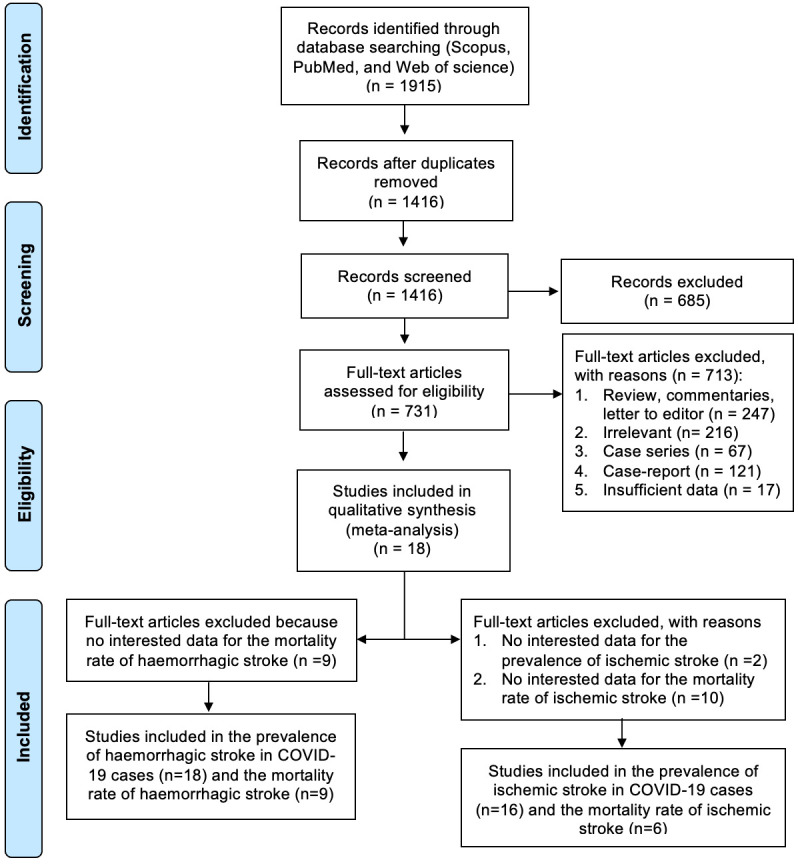
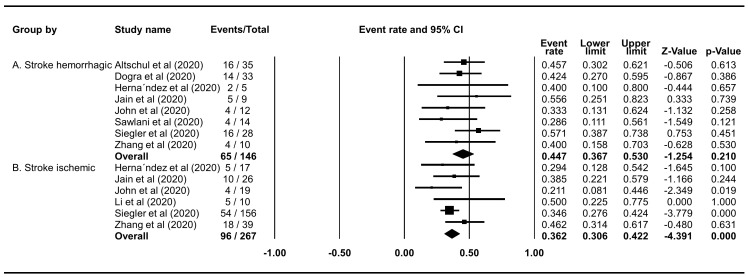
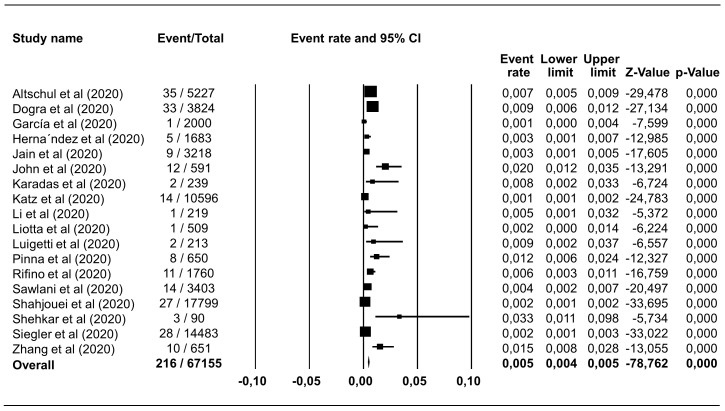
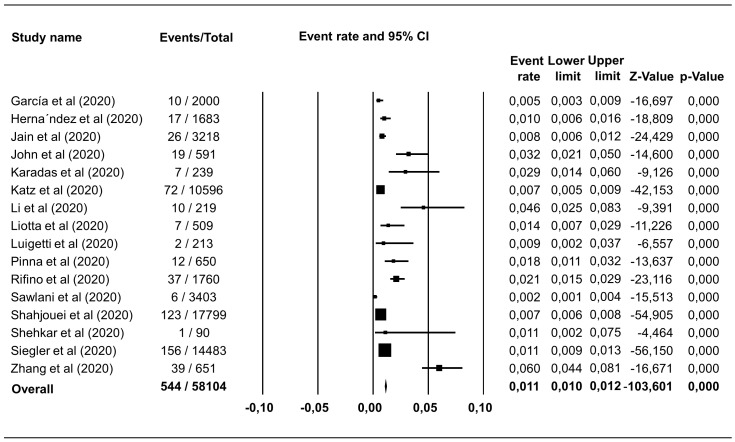
: In this study, we aimed to determine the global prevalence, chronological order of symptom appearance, and mortality rates with regard to hemorrhagic and ischemic stroke in patients with coronavirus disease 2019 (COVID-19) and to discuss possible pathogeneses of hemorrhagic and ischemic stroke in individuals with the disease. : We searched the PubMed, Scopus, and Web of Science databases for relevant articles published up to November 8, 2020. Data regarding study characteristics, hemorrhagic stroke, ischemic stroke, and COVID-19 were retrieved in accordance with the PRISMA guidelines. The Newcastle-Ottawa scale was used to assess the quality of the eligible studies. The pooled prevalence and mortality rate of hemorrhagic and ischemic stroke were calculated. : The pooled estimate of prevalence of hemorrhagic stroke was 0.46% (95% CI 0.40%-0.53%; =89.81%) among 67,155 COVID-19 patients and that of ischemic stroke was 1.11% (95% CI 1.03%-1.22%; =94.07%) among 58,104 COVID-19 patients. Ischemic stroke was more predominant (incidence: 71.58%) than hemorrhagic stroke (incidence: 28.42%) in COVID-19 patients who experienced a stroke. In COVID-19 patients who experienced a stroke, hospital admission with respiratory symptoms was more commonly reported than that with neurological symptoms (20.83% for hemorrhagic stroke and 5.51% for ischemic stroke versus 6.94% for hemorrhagic stroke and 5.33% for ischemic stroke, respectively). The pooled mortality rate of COVID-19 patients who experienced a hemorrhagic and ischemic stroke was 44.72% (95% CI 36.73%-52.98%) and 36.23% (95% CI 30.63%-42.24%), respectively. : Although the occurrence of hemorrhagic and ischemic stroke is low, the mortality rates of both stroke types in patients with COVID-19 are concerning, and therefore, despite several potential pathogeneses that have been proposed, studies aimed at definitively elucidating the mechanisms of hemorrhagic and ischemic stroke in individuals with COVID-19 are warranted. CRD42020224470 (04/12/20).
在这项研究中,我们旨在确定患有 2019 年冠状病毒病(COVID-19)的患者中出血性和缺血性卒中的全球患病率、症状出现的时间顺序和死亡率,并讨论疾病患者发生出血性和缺血性卒中的可能发病机制。我们在 PubMed、Scopus 和 Web of Science 数据库中检索了截至 2020 年 11 月 8 日发表的相关文章。根据 PRISMA 指南检索有关研究特征、出血性卒中、缺血性卒中和 COVID-19 的数据。使用纽卡斯尔-渥太华量表评估合格研究的质量。计算出血性和缺血性卒中的汇总患病率和死亡率。在 67155 例 COVID-19 患者中,出血性卒中的汇总患病率为 0.46%(95%CI 0.40%-0.53%; =89.81%),58104 例 COVID-19 患者中缺血性卒中的患病率为 1.11%(95%CI 1.03%-1.22%; =94.07%)。在发生卒中的 COVID-19 患者中,缺血性卒中比出血性卒中更为常见(发病率:71.58%比 28.42%)。在发生卒中的 COVID-19 患者中,以呼吸道症状入院的情况比以神经症状入院的情况更为常见(出血性卒中为 20.83%,缺血性卒中为 5.51%,而出血性卒中为 6.94%,缺血性卒中为 5.33%)。发生出血性和缺血性卒中的 COVID-19 患者的死亡率分别为 44.72%(95%CI 36.73%-52.98%)和 36.23%(95%CI 30.63%-42.24%)。尽管出血性和缺血性卒中的发生率较低,但 COVID-19 患者这两种类型卒中的死亡率令人担忧,因此,尽管提出了几种潜在的发病机制,但有必要进行研究以明确 COVID-19 患者发生出血性和缺血性卒中的机制。CRD42020224470(04/12/20)。