• 文献检索
  • 文档翻译
  • 深度研究
  • 学术资讯
  • Suppr Zotero 插件Zotero 插件
  • 邀请有礼
  • 套餐&价格
  • 历史记录
应用&插件
Suppr Zotero 插件Zotero 插件浏览器插件Mac 客户端Windows 客户端微信小程序
定价
高级版会员购买积分包购买API积分包
服务
文献检索文档翻译深度研究API 文档MCP 服务
关于我们
关于 Suppr公司介绍联系我们用户协议隐私条款
关注我们

Suppr 超能文献

核心技术专利:CN118964589B侵权必究
粤ICP备2023148730 号-1Suppr @ 2026

文献检索

告别复杂PubMed语法,用中文像聊天一样搜索,搜遍4000万医学文献。AI智能推荐,让科研检索更轻松。

立即免费搜索

文件翻译

保留排版,准确专业,支持PDF/Word/PPT等文件格式,支持 12+语言互译。

免费翻译文档

深度研究

AI帮你快速写综述,25分钟生成高质量综述,智能提取关键信息,辅助科研写作。

立即免费体验

SARS-CoV-2 感染引起的嗅觉丧失和味觉障碍:发生率及其对 COVID-19 严重程度和死亡率的影响,以及可能的病理生物学机制——系统评价和荟萃分析。

Anosmia and dysgeusia in SARS-CoV-2 infection: incidence and effects on COVID-19 severity and mortality, and the possible pathobiology mechanisms - a systematic review and meta-analysis.

机构信息

Department of Neurology, School of Medicine, Universitas Syiah Kuala, Banda Aceh, Aceh, 23111, Indonesia.

Department of Neurology, Dr. Zainoel Abidin Hospital, Banda Aceh, Aceh, 23111, Indonesia.

出版信息

F1000Res. 2021 Jan 21;10:40. doi: 10.12688/f1000research.28393.1. eCollection 2021.

DOI:10.12688/f1000research.28393.1
PMID:33824716
原文链接:https://pmc.ncbi.nlm.nih.gov/articles/PMC7993408/
Abstract

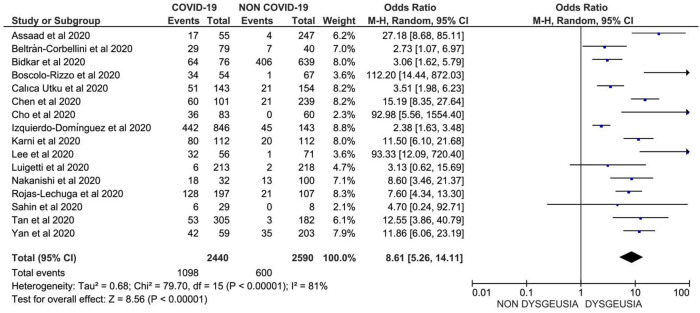
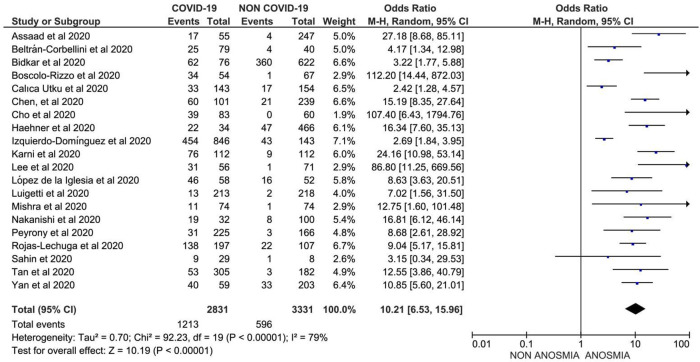
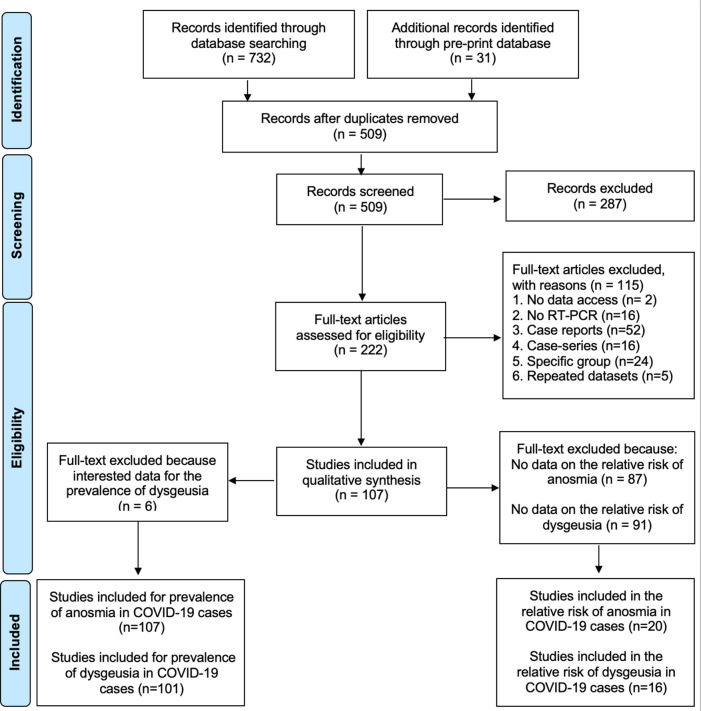
: The present study aimed to determine the global prevalence of anosmia and dysgeusia in coronavirus disease 2019 (COVID-19) patients and to assess their association with severity and mortality of COVID-19. Moreover, this study aimed to discuss the possible pathobiological mechanisms of anosmia and dysgeusia in COVID-19. : Available articles from PubMed, Scopus, Web of Science, and preprint databases (MedRxiv, BioRxiv, and Researchsquare) were searched on November 10th, 2020. Data on the characteristics of the study (anosmia, dysgeusia, and COVID-19) were extracted following the Preferred Reporting Items for Systematic Reviews and Meta-Analyses (PRISMA) guideline. Newcastle-Ottawa scale was used to assess research quality. Moreover, the pooled prevalence of anosmia and dysgeusia were calculated, and the association between anosmia and dysgeusia in presence of severe acute respiratory syndrome coronavirus 2 (SARS-CoV-2) was assessed using the Z test. : Out of 32,142 COVID-19 patients from 107 studies, anosmia was reported in 12,038 patients with a prevalence of 38.2% (95% CI: 36.5%, 47.2%); whereas, dysgeusia was reported in 11,337 patients out of 30,901 COVID-19 patients from 101 studies, with prevalence of 36.6% (95% CI: 35.2%, 45.2%), worldwide. Furthermore, the prevalence of anosmia was 10.2-fold higher (OR: 10.21; 95% CI: 6.53, 15.96, < 0.001) and that of dysgeusia was 8.6-fold higher (OR: 8.61; 95% CI: 5.26, 14.11, < 0.001) in COVID-19 patients compared to those with other respiratory infections or COVID-19 like illness. To date, no study has assessed the association of anosmia and dysgeusia with severity and mortality of COVID-19. : Anosmia and dysgeusia are prevalent in COVID-19 patients compared to those with the other non-COVID-19 respiratory infections. Several possible mechanisms have been hypothesized; however, future studies are warranted to elucidate the definitive mechanisms of anosmia and dysgeusia in COVID-19. PROSPERO CRD42020223204.

摘要

目的

本研究旨在确定 2019 年冠状病毒病(COVID-19)患者中嗅觉丧失和味觉障碍的全球患病率,并评估其与 COVID-19 严重程度和死亡率的关系。此外,本研究旨在探讨 COVID-19 中嗅觉丧失和味觉障碍的可能病理生物学机制。

方法

于 2020 年 11 月 10 日检索 PubMed、Scopus、Web of Science 和预印本数据库(MedRxiv、BioRxiv 和 Researchsquare)中的可用文章。根据系统评价和荟萃分析的首选报告项目(PRISMA)指南提取研究特征(嗅觉丧失、味觉障碍和 COVID-19)的数据。纽卡斯尔-渥太华量表用于评估研究质量。此外,计算嗅觉丧失和味觉障碍的总患病率,并使用 Z 检验评估严重急性呼吸综合征冠状病毒 2(SARS-CoV-2)存在时嗅觉丧失和味觉障碍之间的关系。

结果

在来自 107 项研究的 32142 例 COVID-19 患者中,有 12038 例(患病率为 38.2%(95%CI:36.5%,47.2%))报告有嗅觉丧失,而在来自 101 项研究的 30901 例 COVID-19 患者中,有 11337 例(患病率为 36.6%(95%CI:35.2%,45.2%))报告有味觉障碍。此外,与其他呼吸道感染或 COVID-19 样疾病患者相比,COVID-19 患者嗅觉丧失的患病率高 10.2 倍(OR:10.21;95%CI:6.53,15.96,<0.001),味觉障碍的患病率高 8.6 倍(OR:8.61;95%CI:5.26,14.11,<0.001)。迄今为止,尚无研究评估嗅觉丧失和味觉障碍与 COVID-19 严重程度和死亡率的关系。

结论

与其他非 COVID-19 呼吸道感染患者相比,COVID-19 患者嗅觉丧失和味觉障碍更为常见。已经假设了几种可能的机制;然而,需要进一步的研究来阐明 COVID-19 中嗅觉丧失和味觉障碍的确切机制。
https://cdn.ncbi.nlm.nih.gov/pmc/blobs/3fd8/7993408/bf993340c01a/f1000research-10-31412-g0002.jpg
https://cdn.ncbi.nlm.nih.gov/pmc/blobs/3fd8/7993408/6b919d3f499e/f1000research-10-31412-g0000.jpg
https://cdn.ncbi.nlm.nih.gov/pmc/blobs/3fd8/7993408/c8352ea6f664/f1000research-10-31412-g0001.jpg
https://cdn.ncbi.nlm.nih.gov/pmc/blobs/3fd8/7993408/bf993340c01a/f1000research-10-31412-g0002.jpg
https://cdn.ncbi.nlm.nih.gov/pmc/blobs/3fd8/7993408/6b919d3f499e/f1000research-10-31412-g0000.jpg
https://cdn.ncbi.nlm.nih.gov/pmc/blobs/3fd8/7993408/c8352ea6f664/f1000research-10-31412-g0001.jpg
https://cdn.ncbi.nlm.nih.gov/pmc/blobs/3fd8/7993408/bf993340c01a/f1000research-10-31412-g0002.jpg

相似文献

1
Anosmia and dysgeusia in SARS-CoV-2 infection: incidence and effects on COVID-19 severity and mortality, and the possible pathobiology mechanisms - a systematic review and meta-analysis.SARS-CoV-2 感染引起的嗅觉丧失和味觉障碍:发生率及其对 COVID-19 严重程度和死亡率的影响,以及可能的病理生物学机制——系统评价和荟萃分析。
F1000Res. 2021 Jan 21;10:40. doi: 10.12688/f1000research.28393.1. eCollection 2021.
2
COVID-19 with and without anosmia or dysgeusia: A case-control study.伴有或不伴有嗅觉丧失或味觉障碍的 COVID-19:一项病例对照研究。
J Med Virol. 2021 Apr;93(4):2499-2504. doi: 10.1002/jmv.26784. Epub 2021 Jan 22.
3
Global prevalence and pathogenesis of headache in COVID-19: A systematic review and meta-analysis.COVID-19 相关头痛的全球患病率和发病机制:系统评价和荟萃分析。
F1000Res. 2020 Nov 12;9:1316. doi: 10.12688/f1000research.27334.2. eCollection 2020.
4
Pathogenesis and progression of anosmia and dysgeusia during the COVID-19 pandemic.新冠疫情期间嗅觉丧失和味觉障碍的发病机制和进展。
Eur Arch Otorhinolaryngol. 2023 Feb;280(2):505-509. doi: 10.1007/s00405-022-07689-w. Epub 2022 Oct 9.
5
Long-Term Neurological Sequelae Among Severe COVID-19 Patients: A Systematic Review and Meta-Analysis.重症 COVID-19 患者的长期神经后遗症:系统评价与荟萃分析
Cureus. 2022 Sep 28;14(9):e29694. doi: 10.7759/cureus.29694. eCollection 2022 Sep.
6
Can symptoms of anosmia and dysgeusia be diagnostic for COVID-19?嗅觉丧失和味觉障碍的症状能作为 COVID-19 的诊断依据吗?
Brain Behav. 2020 Nov;10(11):e01839. doi: 10.1002/brb3.1839. Epub 2020 Sep 16.
7
A comparative study on the clinical features of COVID-19 with non-SARS-CoV-2 respiratory viral infections.新型冠状病毒与非 SARS-CoV-2 呼吸道病毒感染的临床特征比较研究。
J Med Virol. 2021 Mar;93(3):1548-1555. doi: 10.1002/jmv.26486. Epub 2020 Sep 29.
8
Prevalence of symptoms, comorbidities, and reinfections in individuals infected with Wild-Type SARS-CoV-2, Delta, or Omicron variants: a comparative study in western Mexico.在墨西哥西部,比较感染野生型 SARS-CoV-2、Delta 或 Omicron 变异株的个体的症状、合并症和再感染的流行情况:一项比较研究。
Front Public Health. 2023 Apr 27;11:1149795. doi: 10.3389/fpubh.2023.1149795. eCollection 2023.
9
COVID-19 associated central nervous system manifestations, mental and neurological symptoms: a systematic review and meta-analysis.COVID-19 相关的中枢神经系统表现、精神和神经系统症状:系统评价和荟萃分析。
Rev Neurosci. 2021 Jan 13;32(3):351-361. doi: 10.1515/revneuro-2020-0108. Print 2021 Apr 27.
10
Does COVID-19 cause permanent damage to olfactory and gustatory function?新冠病毒会对嗅觉和味觉功能造成永久性损害吗?
Med Hypotheses. 2020 Oct;143:110086. doi: 10.1016/j.mehy.2020.110086. Epub 2020 Jul 9.

引用本文的文献

1
Concordance of Anosmia Between Household Members Affected by COVID-19 Infection.新冠病毒感染家庭中家庭成员嗅觉丧失的一致性
J Assoc Med Microbiol Infect Dis Can. 2025 May 29;10(2):186-191. doi: 10.3138/jammi-2025-0002. eCollection 2025 Jun.
2
Unraveling Dysgeusia in SARS-CoV-2 Infection: Clinical and Laboratory Insights from Hospitalized COVID-19 Patients in Romania.解析新型冠状病毒感染中的味觉障碍:罗马尼亚住院新冠肺炎患者的临床与实验室见解
Pathogens. 2025 Mar 21;14(4):300. doi: 10.3390/pathogens14040300.
3
Optimization of a panel of behavioral tests for use in containment using a golden Syrian hamster model.

本文引用的文献

1
CT scan bilateral interstitial pneumonia caused by SARS-CoV 2.由严重急性呼吸综合征冠状病毒2(SARS-CoV 2)引起的双侧间质性肺炎的CT扫描
Pan Afr Med J. 2020 May 6;35(Suppl 2):22. doi: 10.11604/pamj.supp.2020.35.2.23114. eCollection 2020.
2
Self-Rated Smell Ability Enables Highly Specific Predictors of COVID-19 Status: A Case-Control Study in Israel.自我评估嗅觉能力可实现对新冠病毒感染状态的高度特异性预测:以色列的一项病例对照研究。
Open Forum Infect Dis. 2020 Dec 28;8(2):ofaa589. doi: 10.1093/ofid/ofaa589. eCollection 2021 Feb.
3
Self-reported Taste and Smell Disorders in Patients with COVID-19: Distinct Features in China.
使用金黄叙利亚仓鼠模型优化用于隔离的一组行为测试。
J Virol Methods. 2025 Jun;335:115132. doi: 10.1016/j.jviromet.2025.115132. Epub 2025 Mar 3.
4
Histopathology of the tongue in a hamster model of COVID-19.新冠病毒病仓鼠模型中舌部的组织病理学
BMC Oral Health. 2025 Jan 23;25(1):121. doi: 10.1186/s12903-025-05420-9.
5
An Epigenetic Locus Associated with Loss of Smell in COVID-19.一个与新冠病毒感染后嗅觉丧失相关的表观遗传位点。
Diagnostics (Basel). 2024 Dec 15;14(24):2823. doi: 10.3390/diagnostics14242823.
6
MRI evidence of gray matter loss in COVID-19 patients with cognitive and olfactory disorders.MRI 证据显示 COVID-19 患者伴有认知和嗅觉障碍时灰质丢失。
Ann Clin Transl Neurol. 2024 Sep;11(9):2457-2472. doi: 10.1002/acn3.52164. Epub 2024 Jul 30.
7
Histopathology of the Tongue in a Hamster Model of COVID-19.新冠病毒肺炎仓鼠模型中舌部的组织病理学
Res Sq. 2024 Jul 4:rs.3.rs-4590482. doi: 10.21203/rs.3.rs-4590482/v1.
8
SARS-CoV-2 and Other Respiratory Viruses in Human Olfactory Pathophysiology.严重急性呼吸综合征冠状病毒2(SARS-CoV-2)及其他呼吸道病毒在人类嗅觉病理生理学中的作用
Microorganisms. 2024 Mar 7;12(3):540. doi: 10.3390/microorganisms12030540.
9
Global prevalence of persistent neuromuscular symptoms and the possible pathomechanisms in COVID-19 recovered individuals: A systematic review and meta-analysis.新冠康复者中持续性神经肌肉症状的全球患病率及可能的发病机制:一项系统综述和荟萃分析
Narra J. 2021 Dec;1(3):e48. doi: 10.52225/narra.v1i3.48. Epub 2021 Dec 1.
10
A Comprehensive Review of COVID-19-Related Olfactory Deficiency: Unraveling Associations with Neurocognitive Disorders and Magnetic Resonance Imaging Findings.COVID-19相关嗅觉障碍的综合综述:揭示与神经认知障碍和磁共振成像结果的关联
Diagnostics (Basel). 2024 Feb 7;14(4):359. doi: 10.3390/diagnostics14040359.
新冠病毒患者自报的味觉和嗅觉障碍:中国的独特特征。
Curr Med Sci. 2021 Feb;41(1):14-23. doi: 10.1007/s11596-021-2312-7. Epub 2021 Feb 13.
4
Antivirals for COVID-19: A critical review.用于治疗新型冠状病毒肺炎的抗病毒药物:一项批判性综述。
Clin Epidemiol Glob Health. 2021 Jan-Mar;9:90-98. doi: 10.1016/j.cegh.2020.07.006. Epub 2020 Jul 28.
5
SARS-CoV-2 Receptors and Entry Genes Are Expressed in the Human Olfactory Neuroepithelium and Brain.严重急性呼吸综合征冠状病毒2型(SARS-CoV-2)受体和进入基因在人嗅神经上皮和大脑中表达。
iScience. 2020 Dec 18;23(12):101839. doi: 10.1016/j.isci.2020.101839. Epub 2020 Nov 25.
6
Neurological Symptoms as Initial Manifestation of Covid-19 - An Observational Study.新冠病毒病以神经系统症状为首发表现的观察性研究
Ann Indian Acad Neurol. 2020 Jul-Aug;23(4):482-486. doi: 10.4103/aian.AIAN_560_20. Epub 2020 Aug 14.
7
Recent advances in vaccine and immunotherapy for COVID-19.COVID-19 的疫苗和免疫疗法的最新进展。
Hum Vaccin Immunother. 2020 Dec 1;16(12):3011-3022. doi: 10.1080/21645515.2020.1825896. Epub 2020 Nov 6.
8
Headache associated with COVID-19: Frequency, characteristics and association with anosmia and ageusia.与 COVID-19 相关的头痛:频率、特征以及与嗅觉丧失和味觉丧失的关联。
Cephalalgia. 2020 Nov;40(13):1443-1451. doi: 10.1177/0333102420966770.
9
Dysosmia and dysgeusia in patients with COVID-19 in northern Taiwan.台湾北部 COVID-19 患者的嗅觉障碍和味觉障碍。
J Formos Med Assoc. 2021 Jan;120(1 Pt 2):311-317. doi: 10.1016/j.jfma.2020.10.003. Epub 2020 Oct 20.
10
Evaluation of Olfactory Acuity in Patients with Coronavirus Disease 2019 (COVID-19).2019年冠状病毒病(COVID-19)患者嗅觉敏锐度的评估。
Indian J Otolaryngol Head Neck Surg. 2022 Oct;74(Suppl 2):2772-2779. doi: 10.1007/s12070-020-02241-w. Epub 2020 Oct 27.