Department of Infectious Diseases, Infection Control and Employee Health, The University of Texas MD Anderson Cancer Center, Houston, Texas, USA.
Biomed Res Int. 2021 Feb 25;2021:2710484. doi: 10.1155/2021/2710484. eCollection 2021.
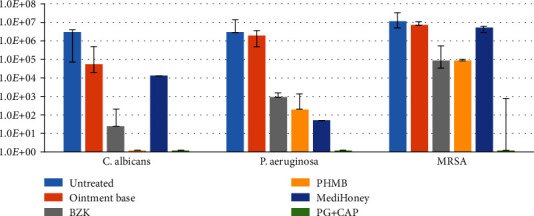
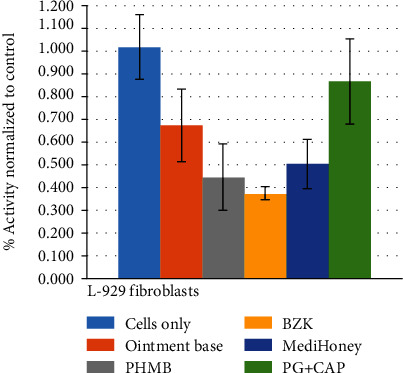
Antiseptic wound ointments are widely used to treat dermal wounds that are microbially contaminated. Polygalacturonic acid (PG)+caprylic acid (CAP) is a novel combination that has been shown to eradicate biofilms. We developed a novel PG+CAP ointment and compared the biofilm eradication capability and cytotoxicity of PG+CAP with that of commercially available antiseptic wound ointments. We used a well-established biofilm model to quantitatively assess the eradication of organisms following exposure to the wound ointments for 2 hours. PG+CAP ointment completely eradicated , multidrug-resistant , and methicillin-resistant biofilms, whereas MediHoney, polyhexamethylene biguanide (PHMB), and benzalkonium chloride (BZK) ointments failed to eradicate all biofilms within 2 hours. We assessed cytotoxicity by exposing L-929 fibroblasts to extracts of each ointment; Trypan blue exclusion was used to assess cell viability, and Alamar blue conversion was used to assess metabolic function. After exposure to PG+CAP and MediHoney, fibroblast viability was 96.23% and 95.23%, respectively (Trypan blue), and was comparable to untreated cells (98.77%). PHMB and BZK showed reduced viability (83.25% and 77.83%, respectively, < 0.05). Metabolic activity results followed a similar pattern. Cytotoxicity of PG+CAP ointment towards erythrocytes was comparable to saline. PG+CAP ointment seems to be safe and can rapidly eradicate microbial biofilm; thus, PG+CAP ointment merits further in vivo testing as a potential antimicrobial wound ointment.
抗菌伤口软膏广泛用于治疗微生物污染的皮肤伤口。聚半乳糖醛酸(PG)+辛酸(CAP)是一种新型组合,已被证明可以消除生物膜。我们开发了一种新型 PG+CAP 软膏,并比较了 PG+CAP 与市售抗菌伤口软膏的生物膜清除能力和细胞毒性。我们使用成熟的生物膜模型定量评估了在接触伤口软膏 2 小时后对生物膜的清除能力。PG+CAP 软膏可完全清除多药耐药和耐甲氧西林生物膜,而 MediHoney、聚六亚甲基双胍(PHMB)和苯扎氯铵(BZK)软膏在 2 小时内未能清除所有生物膜。我们通过将每种软膏的提取物暴露于 L-929 成纤维细胞来评估细胞毒性;使用台盼蓝排除法评估细胞活力,使用 Alamar blue 转化法评估代谢功能。暴露于 PG+CAP 和 MediHoney 后,成纤维细胞活力分别为 96.23%和 95.23%(台盼蓝),与未处理的细胞相似(98.77%)。PHMB 和 BZK 显示出较低的活力(分别为 83.25%和 77.83%,均<0.05)。代谢活性结果也呈现出类似的模式。PG+CAP 软膏对红细胞的细胞毒性与生理盐水相当。PG+CAP 软膏似乎安全且能迅速清除微生物生物膜;因此,PG+CAP 软膏作为一种有潜力的抗菌伤口软膏值得进一步进行体内试验。