Department of Cognitive, Perceptual and Brain Sciences, University College London, London, UK.
Center for Medical Image Computing, Department of Computer Science, University College London, London, UK.
MAGMA. 2021 Oct;34(5):677-687. doi: 10.1007/s10334-021-00914-3. Epub 2021 Mar 12.
To investigate whether varied or repeated b-values provide better diffusion MRI data for discriminating cortical areas with a data-driven approach.
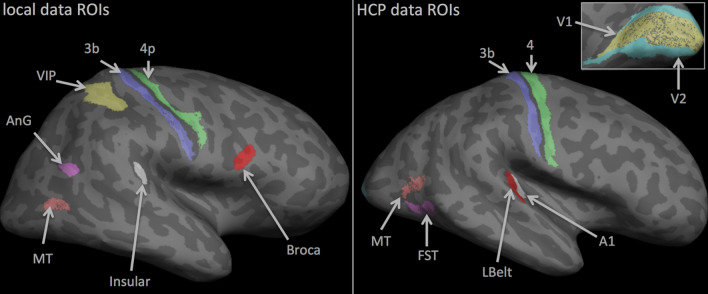
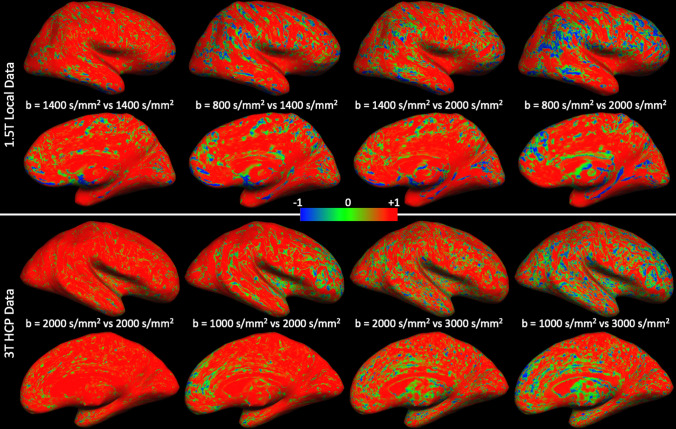
Data were acquired from three volunteers at 1.5T with b-values of 800, 1400, 2000 s/mm along 64 diffusion-encoding directions. The diffusion signal was sampled from gray matter in seven regions of interest (ROIs). Rotational invariants of the local diffusion profile were extracted as features that characterize local tissue properties. Random forest classification experiments assessed whether classification accuracy improved when data with multiple b-values were used over repeated acquisition of the same (1400 s/mm) b-value to compare all possible pairs of the seven ROIs. Three data sets from the Human Connectome Project were subjected to similar processing and analysis pipelines in eight ROIs.
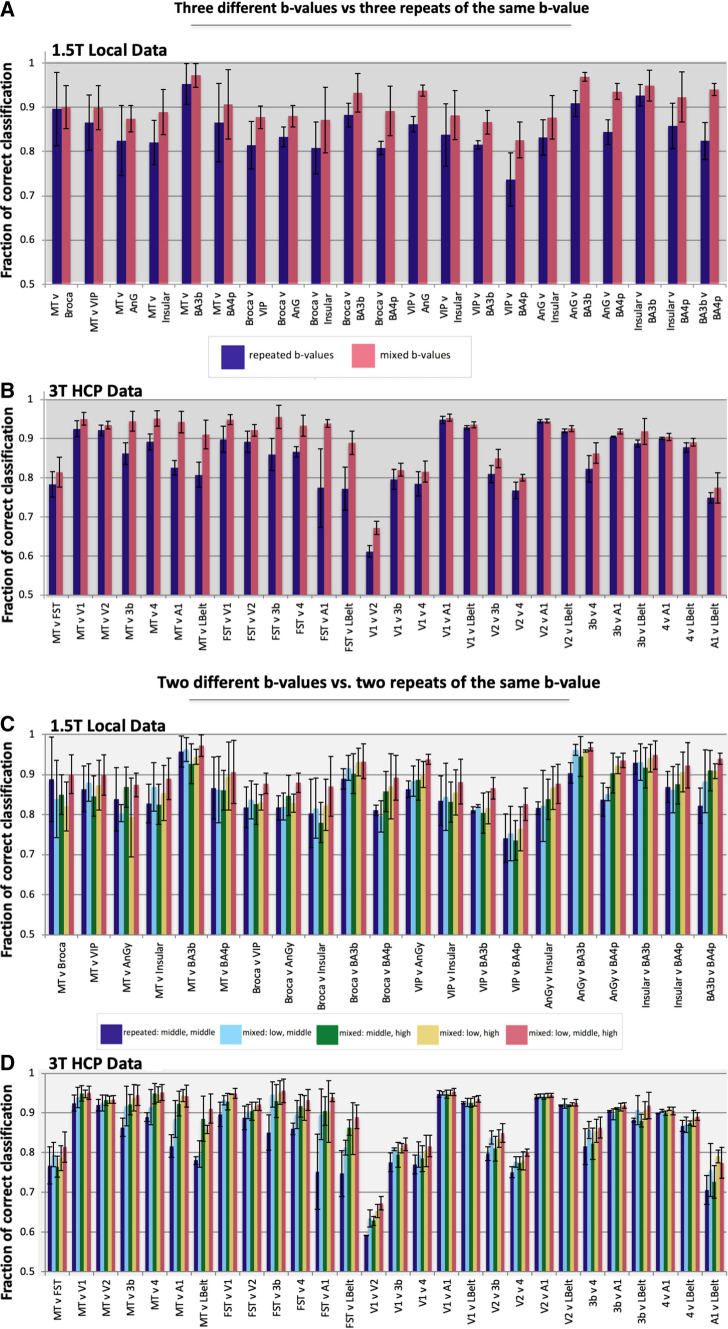
Three different b-values showed an average improvement in correct classification rates of 5.6% and 4.6%, respectively, in the local and HCP data over repeated measurements of the same b-value. The improvement in correct classification rate reached as high as 16% for individual binary classification experiments between two ROIs. Often using only two of the available three b-values were adequate to make such an improvement in classification rates.
Acquisitions with varying b-values are more suitable for discriminating cortical areas.
通过数据驱动的方法,探究不同或重复的 b 值是否能提供更好的弥散磁共振成像(diffusion MRI)数据来区分皮质区域。
在 1.5T 扫描仪上,3 名志愿者的 b 值分别为 800、1400 和 2000 s/mm,共采集 64 个扩散编码方向的数据。扩散信号从 7 个感兴趣区(ROI)的灰质中采集。作为描述局部组织特性的特征,提取局部扩散轮廓的旋转不变量。随机森林分类实验评估了使用多个 b 值的数据是否能提高分类准确性,与重复采集相同(1400 s/mm)b 值相比,以比较 7 个 ROI 之间的所有可能对。对来自人类连接组计划(Human Connectome Project)的 3 个数据集,在 8 个 ROI 中进行了类似的处理和分析流程。
在本地和 HCP 数据中,与重复测量相同 b 值相比,三个不同的 b 值平均可分别提高 5.6%和 4.6%的正确分类率。在两个 ROI 之间的个别二进制分类实验中,正确分类率的提高高达 16%。通常,仅使用三种可用 b 值中的两种就足以提高分类率。
不同 b 值的采集更适合区分皮质区域。