Department of Cell, Developmental & Regenerative Biology.
Graduate School of Biomedical Sciences.
Blood Adv. 2021 Mar 23;5(6):1605-1616. doi: 10.1182/bloodadvances.2020003658.
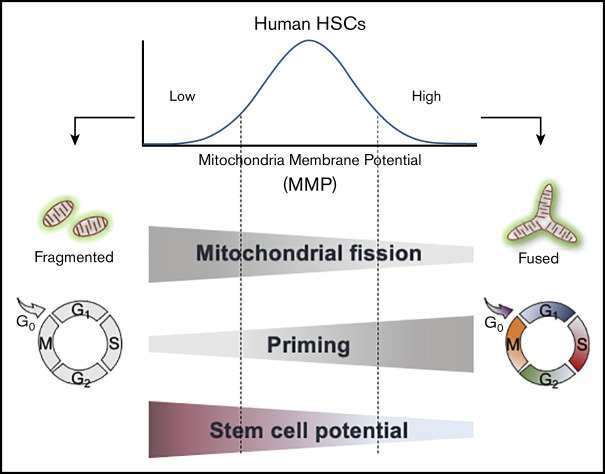
Hematopoietic cell transplantation is a critical curative approach for many blood disorders. However, obtaining grafts with sufficient numbers of hematopoietic stem cells (HSCs) that maintain long-term engraftment remains challenging; this is due partly to metabolic modulations that restrict the potency of HSCs outside of their native environment. To address this, we focused on mitochondria. We found that human HSCs are heterogeneous in their mitochondrial activity as measured by mitochondrial membrane potential (MMP) even within the highly purified CD34+CD38-CD45RA-CD90+CD49f+ HSC population. We further found that the most potent HSCs exhibit the lowest mitochondrial activity in the population. We showed that the frequency of long-term culture initiating cells in MMP-low is significantly greater than in MMP-high CD34+CD38-CD45RA-CD90+ (CD90+) HSCs. Notably, these 2 populations were distinct in their long-term repopulating capacity when transplanted into immunodeficient mice. The level of chimerism 7 months posttransplantation was >50-fold higher in the blood of MMP-low relative to MMP-high CD90+ HSC recipients. Although more than 90% of both HSC subsets were in G0, MMP-low CD90+ HSCs exhibited delayed cell-cycle priming profile relative to MMP-high HSCs. These functional differences were associated with distinct mitochondrial morphology; MMP-low in contrast to MMP-high HSCs contained fragmented mitochondria. Our findings suggest that the lowest MMP level selects for the most potent, likely dormant, stem cells within the highly purified HSC population. These results identify a new approach for isolating highly potent human HSCs for further clinical applications. They also implicate mitochondria in the intrinsic regulation of human HSC quiescence and potency.
造血细胞移植是许多血液疾病的重要治疗方法。然而,获得具有足够数量维持长期植入能力的造血干细胞(HSCs)仍然具有挑战性;这部分是由于代谢调节限制了 HSCs 在其天然环境之外的效力。为了解决这个问题,我们专注于线粒体。我们发现,即使在高度纯化的 CD34+CD38-CD45RA-CD90+CD49f+HSC 群体中,人类 HSCs 的线粒体活性也存在异质性,这种异质性可以通过线粒体膜电位(MMP)来衡量。我们还发现,群体中最具活力的 HSCs 的线粒体活性最低。我们表明,在 MMP 低的群体中,长期培养起始细胞的频率明显大于 MMP 高的 CD34+CD38-CD45RA-CD90+(CD90+)HSCs。值得注意的是,当移植到免疫缺陷小鼠中时,这两个群体在长期重建能力上存在明显差异。移植后 7 个月,MMP 低的 CD90+HSC 受体血液中的嵌合率比 MMP 高的 CD90+HSC 受体高 50 多倍。尽管两个 HSC 亚群中超过 90%的细胞都处于 G0 期,但 MMP 低的 CD90+HSCs 相对于 MMP 高的 HSCs 表现出延迟的细胞周期启动特征。这些功能差异与不同的线粒体形态有关;与 MMP 高的 HSCs 相比,MMP 低的 CD90+HSCs 含有碎片化的线粒体。我们的研究结果表明,最低的 MMP 水平选择了高度纯化的 HSC 群体中最具活力、可能休眠的干细胞。这些结果为进一步的临床应用鉴定了一种分离高活力人类 HSCs 的新方法。它们还表明线粒体参与了人类 HSC 静止和活力的内在调节。