Coalition for Epidemic Preparedness Innovations, Oslo, Norway; Harvard Medical School, Boston, MA, USA.
National Emerging Infectious Diseases Laboratory, Boston University, Boston, MA, USA.
Lancet. 2021 Mar 27;397(10280):1229-1236. doi: 10.1016/S0140-6736(21)00503-1. Epub 2021 Mar 9.
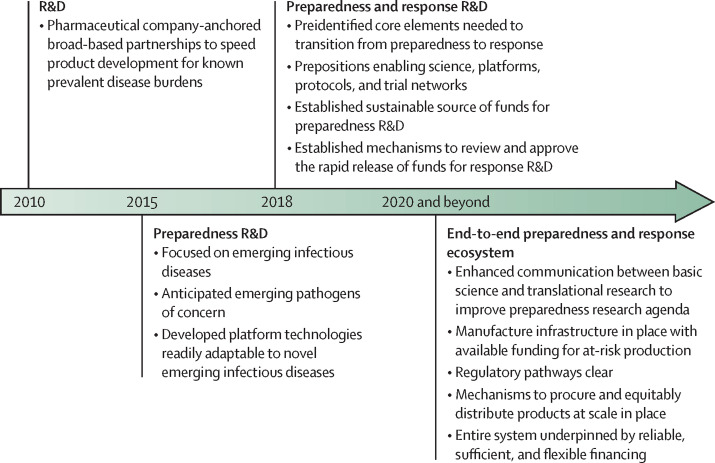
The research and development (R&D) ecosystem has evolved over the past decade to include pandemic infectious diseases, building on experience from multiple recent outbreaks. Outcomes of this evolution have been particularly evident during the COVID-19 pandemic with accelerated development of vaccines and monoclonal antibodies, as well as novel clinical trial designs. These products were developed, trialled, manufactured, and authorised for use in several countries within a year of the pandemic's onset. Many gaps remain, however, that must be bridged to establish a truly efficient and effective end-to-end R&D preparedness and response ecosystem. Foremost among them is a global financing system. In addition, important changes are required for multiple aspects of enabling sciences and product development. For each of these elements we identify priorities for improved and faster functionality. There will be no better time than now to seriously address these needs, however difficult, as the ravages of COVID-19 continue to accelerate with devastating health, social, and economic consequences for the entire community of nations.
过去十年中,研发(R&D)生态系统不断发展,包括大流行性传染病,借鉴了最近多次暴发的经验。这一演变的结果在 COVID-19 大流行期间尤为明显,疫苗和单克隆抗体的开发以及新的临床试验设计得到了加速。这些产品在大流行开始后的一年内就在多个国家得到了开发、试验、制造和授权使用。然而,仍有许多差距需要弥合,以建立一个真正高效和有效的端到端研发准备和应对生态系统。其中最重要的是全球融资系统。此外,还需要对多个方面的支持科学和产品开发进行重要变革。对于这些要素中的每一个,我们都确定了改进和加快功能的优先事项。现在是认真解决这些需求的最佳时机,尽管这很困难,但 COVID-19 的肆虐仍在继续,给整个国际社会带来了毁灭性的健康、社会和经济后果。