Silver Jason S, Günay K Arda, Cutler Alicia A, Vogler Thomas O, Brown Tobin E, Pawlikowski Bradley T, Bednarski Olivia J, Bannister Kendra L, Rogowski Cameron J, Mckay Austin G, DelRio Frank W, Olwin Bradley B, Anseth Kristi S
Department of Chemical and Biological Engineering, University of Colorado, Boulder, CO, USA.
BioFrontiers Institute, University of Colorado, Boulder, CO, USA.
Sci Adv. 2021 Mar 12;7(11). doi: 10.1126/sciadv.abe4501. Print 2021 Mar.
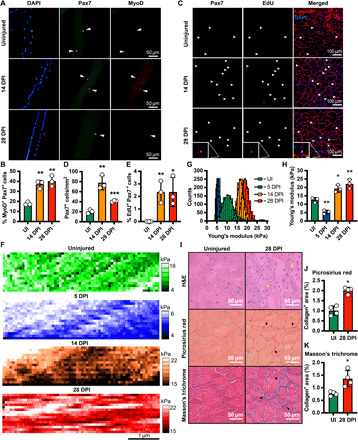
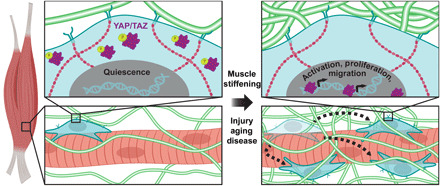
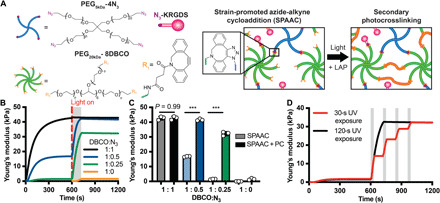
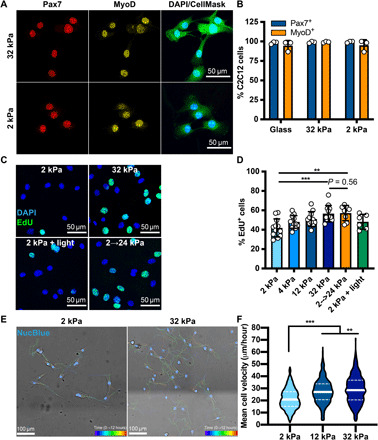
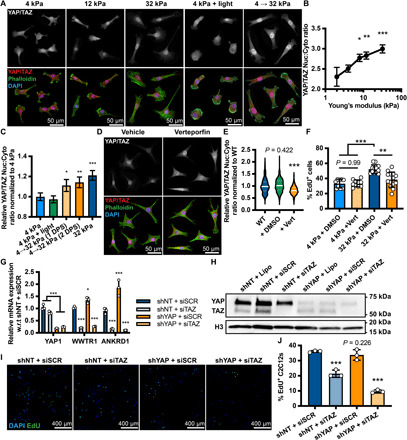
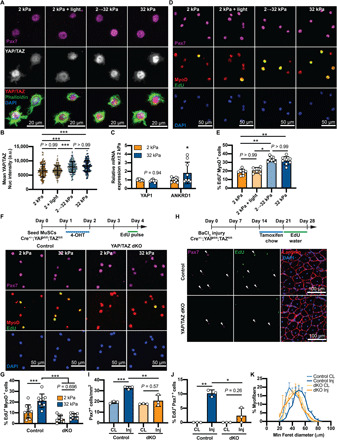
The skeletal muscle microenvironment transiently remodels and stiffens after exercise and injury, as muscle ages, and in myopathic muscle; however, how these changes in stiffness affect resident muscle stem cells (MuSCs) remains understudied. Following muscle injury, muscle stiffness remained elevated after morphological regeneration was complete, accompanied by activated and proliferative MuSCs. To isolate the role of stiffness on MuSC behavior and determine the underlying mechanotransduction pathways, we cultured MuSCs on strain-promoted azide-alkyne cycloaddition hydrogels capable of in situ stiffening by secondary photocrosslinking of excess cyclooctynes. Using pre- to post-injury stiffness hydrogels, we found that elevated stiffness enhances migration and MuSC proliferation by localizing yes-associated protein 1 (YAP) and WW domain-containing transcription regulator 1 (WWTR1; TAZ) to the nucleus. Ablating YAP and TAZ in vivo promotes MuSC quiescence in postinjury muscle and prevents myofiber hypertrophy, demonstrating that persistent exposure to elevated stiffness activates mechanotransduction signaling maintaining activated and proliferating MuSCs.
运动、损伤后,随着肌肉衰老以及在患有肌病的肌肉中,骨骼肌微环境会发生短暂重塑并变硬;然而,这些硬度变化如何影响驻留的肌肉干细胞(MuSCs)仍未得到充分研究。肌肉损伤后,形态学再生完成后肌肉硬度仍保持升高,同时伴有活化和增殖的MuSCs。为了分离硬度对MuSC行为的作用并确定潜在的机械转导途径,我们将MuSCs培养在能够通过过量环辛炔的二次光交联进行原位变硬的应变促进叠氮化物-炔烃环加成水凝胶上。使用损伤前至损伤后的硬度水凝胶,我们发现硬度升高通过将Yes相关蛋白1(YAP)和含WW结构域的转录调节因子1(WWTR1;TAZ)定位到细胞核来增强迁移和MuSC增殖。在体内消除YAP和TAZ可促进损伤后肌肉中MuSC的静止,并防止肌纤维肥大,这表明持续暴露于升高的硬度会激活机械转导信号,维持活化和增殖的MuSCs。