Christensen Julia F, Vartanian Meghedi, Sancho-Escanero Luisa, Khorsandi Shahrzad, Yazdi S H N, Farahi Fahimeh, Borhani Khatereh, Gomila Antoni
Department for Language and Literature, Max Planck Institute for Empirical Aesthetics, Frankfurt am Main, Germany.
Department of Psychology, University of Tehran, Tehran, Iran.
Front Psychol. 2021 Feb 25;11:588948. doi: 10.3389/fpsyg.2020.588948. eCollection 2020.
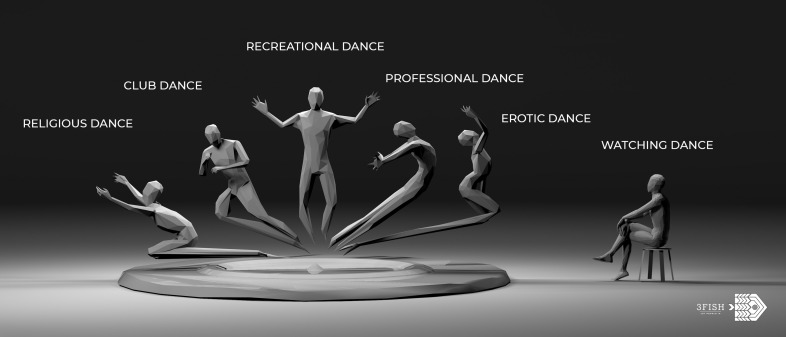
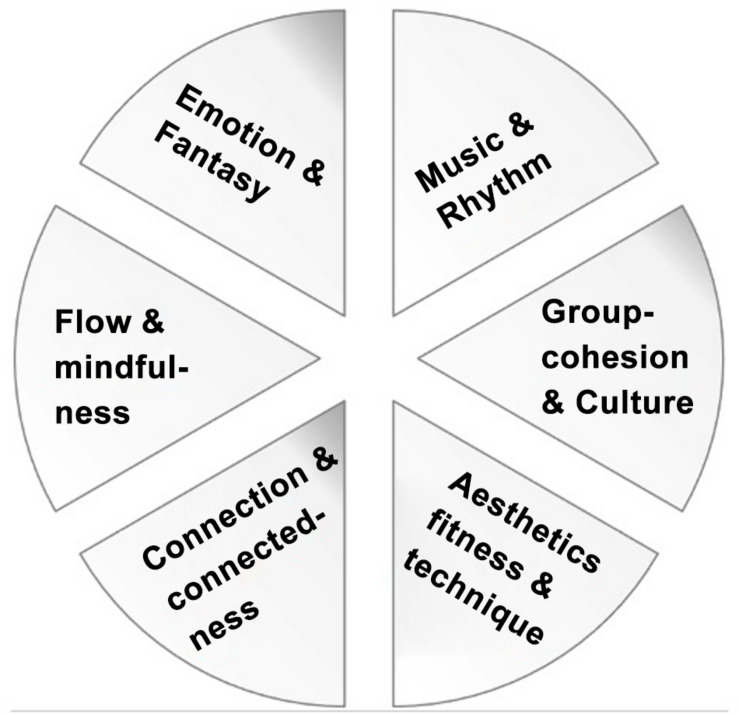
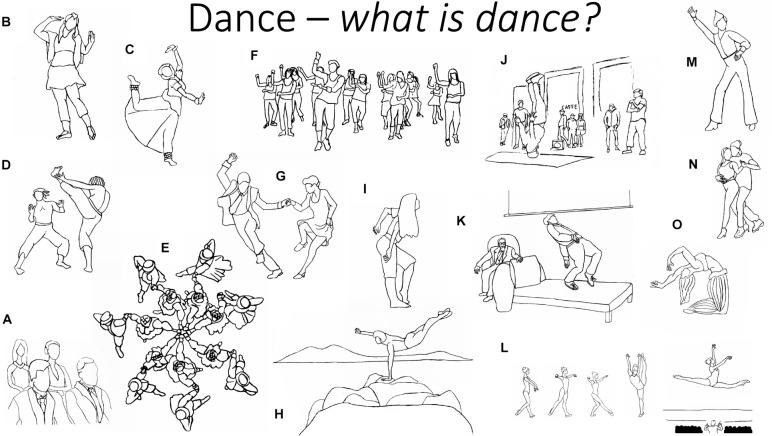
"Dance" has been associated with many psychophysiological and medical health effects. However, varying definitions of what constitute "dance" have led to a rather heterogenous body of evidence about such potential effects, leaving the picture piecemeal at best. It remains unclear what exact parameters may be driving positive effects. We believe that this heterogeneity of evidence is partly due to a lack of a clear definition of dance for such empirical purposes. A differentiation is needed between (a) the effects on the individual when the activity of "dancing" is enjoyed within (e.g., type of dance, dance, dance, dancing, (DMT), and what is commonly known as or dance), and (b) the effects on the individual within these different domains, as a dancer of the (solo dance, partnering dance, group dance; and all the different styles within these). Another separate category of dance engagement is, not as a dancer, but as a spectator of all of the above. "" as part of an audience has its own set of psychophysiological and neurocognitive effects on the individual, and depends on the context where dance is witnessed. With the help of dance professionals, we first outline some different dance domains and dance styles, and outline aspects that differentiate them, and that may, therefore, cause differential empirical findings when compared regardless (e.g., amount of interpersonal contact, physical exertion, context, cognitive demand, type of movements, complexity of technique and ratio of choreography/improvisation). Then, we outline commonalities between all dance styles. We identify six basic components that are part of any dance practice, as part of a continuum, and review and discuss available research for each of them concerning the possible health and wellbeing effects of each of these components, and how they may relate to the psychophysiological and health effects that are reported for "dancing": (1) rhythm and music, (2) sociality, (3) technique and fitness, (4) connection and connectedness (self-intimation), (5) flow and mindfulness, (6) aesthetic emotions and imagination. Future research efforts might take into account the important differences between types of dance activities, as well as the six components, for a more targeted assessment of how "dancing" affects the human body.
“舞蹈”已被认为与许多心理生理和医学健康效应相关。然而,对于“舞蹈”构成要素的不同定义导致了关于此类潜在效应的证据相当零散,至多只能拼凑出一幅不完整的画面。目前尚不清楚究竟哪些确切参数可能推动了积极效应。我们认为,这种证据的异质性部分归因于缺乏一个为此类实证研究目的而明确界定的舞蹈定义。需要区分以下两点:(a)当在特定情境中享受“跳舞”活动时(例如舞蹈类型、舞蹈、舞蹈、跳舞、舞蹈冥想,以及通常所说的舞蹈或社交舞蹈)对个体的影响;以及(b)作为某种特定舞蹈形式(独舞、双人舞、群舞;以及这些形式中的所有不同风格)的舞者,在这些不同领域内对个体的影响。另一类单独的舞蹈参与形式并非作为舞者,而是作为上述所有舞蹈形式的观众。作为观众的“舞蹈”对个体有其自身一系列的心理生理和神经认知效应,并且取决于观看舞蹈的情境。在舞蹈专业人士的帮助下,我们首先概述一些不同的舞蹈领域和舞蹈风格,并概述区分它们的方面,因此,当进行比较时,这些方面可能会导致不同的实证研究结果(例如人际接触量、体力消耗、情境、认知需求、动作类型、技术复杂性以及编排/即兴创作的比例)。然后,我们概述所有舞蹈风格之间的共性。我们确定了任何舞蹈实践中作为一个连续统一体的六个基本组成部分,并回顾和讨论关于每个组成部分可能对健康和幸福产生的影响以及它们如何与“跳舞”所报告的心理生理和健康效应相关的现有研究:(1)节奏与音乐,(2)社交性,(3)技术与体能,(4)连接与连通性(自我暗示),(5)心流与正念,(6)审美情感与想象力。未来的研究工作可能需要考虑舞蹈活动类型之间的重要差异以及这六个组成部分,以便更有针对性地评估“跳舞”如何影响人体。