Procaccia Rossella, Segre Giulia, Tamanza Giancarlo, Manzoni Gian Mauro
Faculty of Psychology, eCampus University, Novedrate, Italy.
Department of Psychology, Catholic University of Milan, Milan, Italy.
Front Psychol. 2021 Feb 25;12:624176. doi: 10.3389/fpsyg.2021.624176. eCollection 2021.
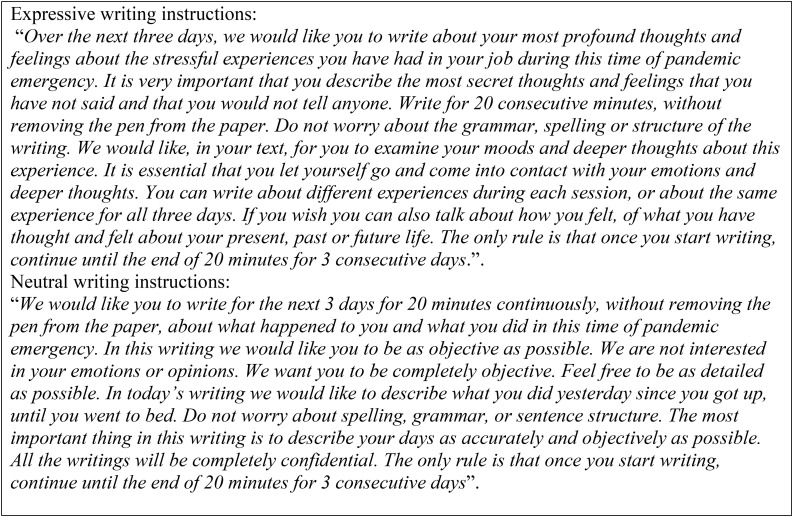
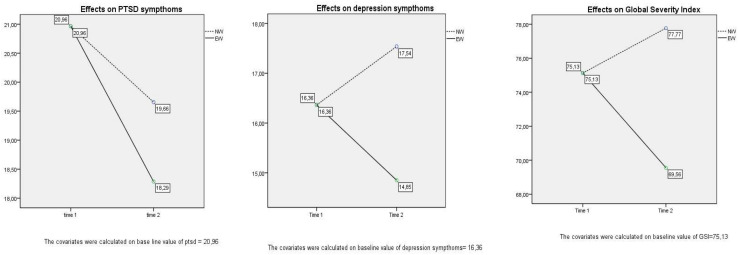
COVID-19 outbroke in Wuhan, China, in December 2019 and promptly became a pandemic worldwide, endangering health and life but also causing mild-to-severe psychological distress to lots of people, including healthcare workers (HCWs). Several studies have already showed a high prevalence of depression, anxiety, and post-traumatic symptoms in HCWs but less is known about the efficacy of psychological interventions for relieving their mental distress. The aims of this study were: (1) to evaluate the psychological adjustment of Italian HCWs during the COVID-19 pandemic; (2) to investigate the efficacy of an expressive writing (EW) intervention, based on Pennebaker's paradigmatic protocol, on their psychological adjustment; (3) to analyze if outcomes of EW vary in function of individual differences (age, gender, marital status, and baseline values of symptoms). Fifty-five HCWs were randomly assigned to one of two writing conditions: EW ( = 30) or neutral writing (NW; = 25). Psychological adjustment (in terms of ptsd, depression and global psychopathology's symptoms, perceived social support, and resilience) was assessed before and after three writing sessions. Participants who received the EW intervention showed higher improvements in ptsd, depression, and global psychopathology symptoms. Improvements in EW group varied in function of age, gender, marital status, and baseline values: young, men, married participants and those who had higher baseline scores showed a higher reduction of psychological distress symptoms while women, single and those who had lower baseline value showed increased social support, and resilience. In conclusion, the EW intervention had positive effects which varied in function of individual differences on HCWs' psychological health.
2019年12月,新型冠状病毒肺炎(COVID-19)在中国武汉爆发,并迅速成为全球大流行疾病,不仅危及健康和生命,还给包括医护人员在内的许多人造成了轻至重度的心理困扰。多项研究已表明医护人员中抑郁、焦虑和创伤后症状的患病率很高,但对于缓解他们心理困扰的心理干预措施的效果了解较少。本研究的目的是:(1)评估意大利医护人员在COVID-19大流行期间的心理调适情况;(2)基于彭尼贝克的范式方案,研究一种表达性写作(EW)干预措施对他们心理调适的效果;(3)分析EW的结果是否因个体差异(年龄、性别、婚姻状况和症状基线值)而有所不同。55名医护人员被随机分配到两种写作条件之一:EW组(n = 30)或中性写作组(NW;n = 25)。在三次写作 sessions 前后评估心理调适情况(根据创伤后应激障碍、抑郁和总体精神病理学症状、感知到的社会支持和心理韧性)。接受EW干预的参与者在创伤后应激障碍、抑郁和总体精神病理学症状方面有更大改善。EW组的改善因年龄、性别、婚姻状况和基线值而异:年轻、男性、已婚参与者以及基线分数较高的参与者心理困扰症状减轻幅度更大,而女性、单身者以及基线值较低的参与者社会支持和心理韧性有所增加。总之,EW干预产生了积极效果,且因个体差异对医护人员的心理健康产生不同影响。