Manrique-Millones Denisse, Wiium Nora, Pineda-Marín Claudia, Fernández-Arata Manuel, Alfonso-Murcia Diego, López-Martínez José Luis, Millones-Rivalles Rosa
Faculty of Communication Sciences, Tourism and Psychology, Research Institute of Psychology, Universidad San Martín de Porres, Lima, Peru.
Department of Psychosocial Science, Faculty of Psychology, University of Bergen, Bergen, Norway.
Front Psychol. 2021 Feb 25;12:639578. doi: 10.3389/fpsyg.2021.639578. eCollection 2021.
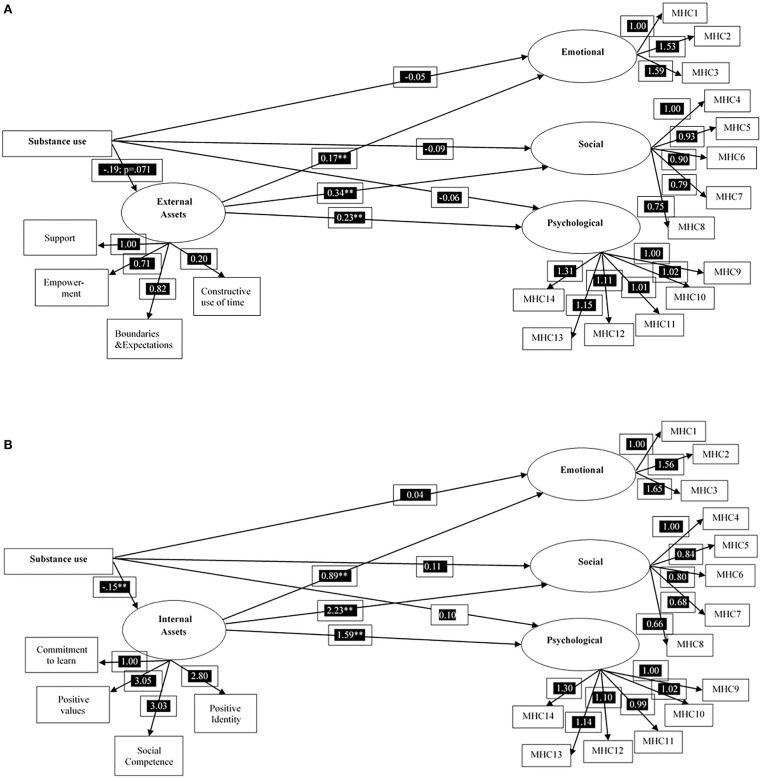
Positive Youth Development (PYD) is an approach that promotes resilience and focuses on youth strengths rather than their weaknesses as done by the traditional deficit-based perspective. Research in Europe and North America show that developmental assets are associated with school success, psychological well-being, and lower health risks among youth and young adults. However, not much research has been done on these associations in Latin American contexts. The purpose of this research study is to assess the association between substance use behaviors, such as drunkenness and the use of illicit drugs, and mental health, together with the mediating role of developmental assets representing youth strengths (e.g., social competence) and contextual resources (e.g., social support at home or school). Cross-national data was collected from Colombian ( = 210; 70.4% females) and Peruvian = 349; 66.5% females) 1st year university students. Results shed light on the protective role of developmental assets regarding substance use behaviors and mental well-being. Specifically, the results showed direct negative associations between developmental assets and substance use behaviors and positive associations of developmental assets with mental health indicators. Internal assets appear to be a stronger predictor of social, emotional, and psychological well-being compared to external assets. We did not find any statistical significance in the association of substance use behavior and mental health. We discuss implications regarding research, policy, and practice.
积极青少年发展(PYD)是一种促进复原力的方法,它关注青少年的优势而非弱点,这与传统的基于缺陷的观点不同。欧洲和北美的研究表明,发展资产与青少年和青年的学业成功、心理健康以及较低的健康风险相关。然而,在拉丁美洲背景下,关于这些关联的研究并不多。本研究的目的是评估诸如醉酒和使用非法药物等物质使用行为与心理健康之间的关联,以及代表青少年优势的发展资产(如社交能力)和背景资源(如家庭或学校的社会支持)的中介作用。从哥伦比亚(n = 210;70.4%为女性)和秘鲁(n = 349;66.5%为女性)的一年级大学生中收集了跨国数据。研究结果揭示了发展资产在物质使用行为和心理健康方面的保护作用。具体而言,结果显示发展资产与物质使用行为之间存在直接的负相关,与心理健康指标存在正相关。与外部资产相比,内部资产似乎是社会、情感和心理健康更强有力的预测指标。我们没有发现物质使用行为与心理健康之间的关联具有任何统计学意义。我们讨论了研究、政策和实践方面的影响。