Zhang Qiang, Zou Rong, Guo Min, Duan Mengmeng, Li Quan, Zheng Huajun
Department of Obstetrics and Gynecology, Affiliated Hospital of Zunyi Medical University, Zunyi, China.
NHC Key Lab. of Reproduction Regulation (Shanghai Institute of Planned Parenthood Research), Fudan University, Shanghai, China.
PeerJ. 2021 Mar 1;9:e10946. doi: 10.7717/peerj.10946. eCollection 2021.
Autism spectrum disorder (ASD) and obesity are serious global public health problems. Studies have shown that ASD children are at a higher risk of obesity than the general population. To investigate the gut microbe characteristics of adults ASD and obese adults, we compared the gut microbiota of adults with ASD to obese adults.
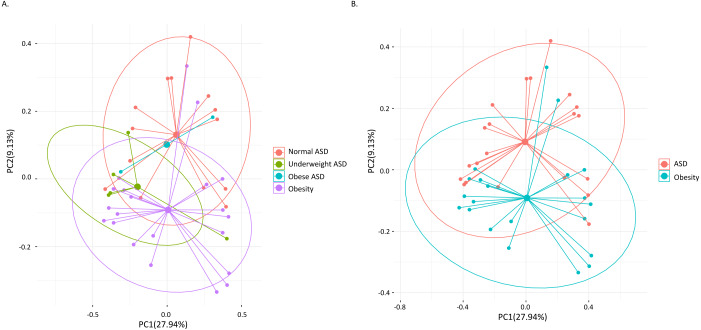
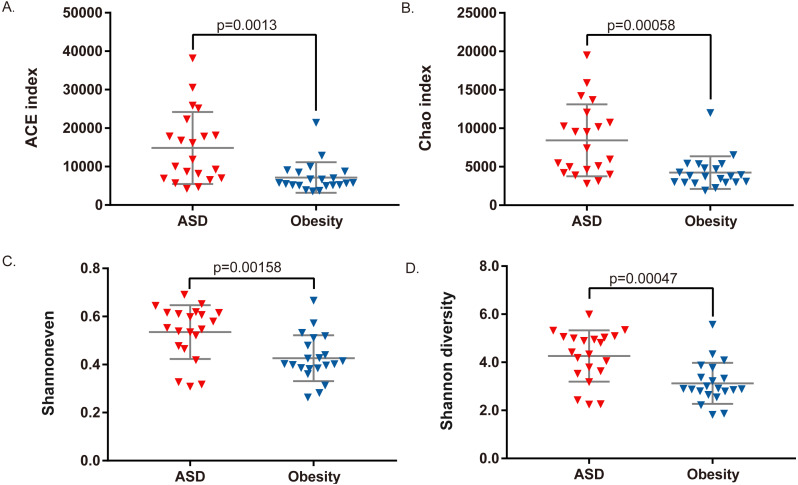
The fecal samples were collected from 21 adult patients with ASD and 21 obese adults, and V3-V4 regions of 16S rRNA genes were sequenced by high-throughput DNA sequencing. The gut microbiota of adults with ASD and obese adults was compared.
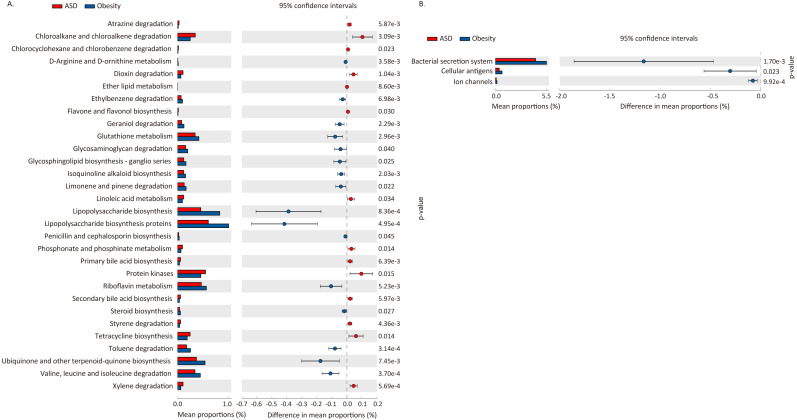
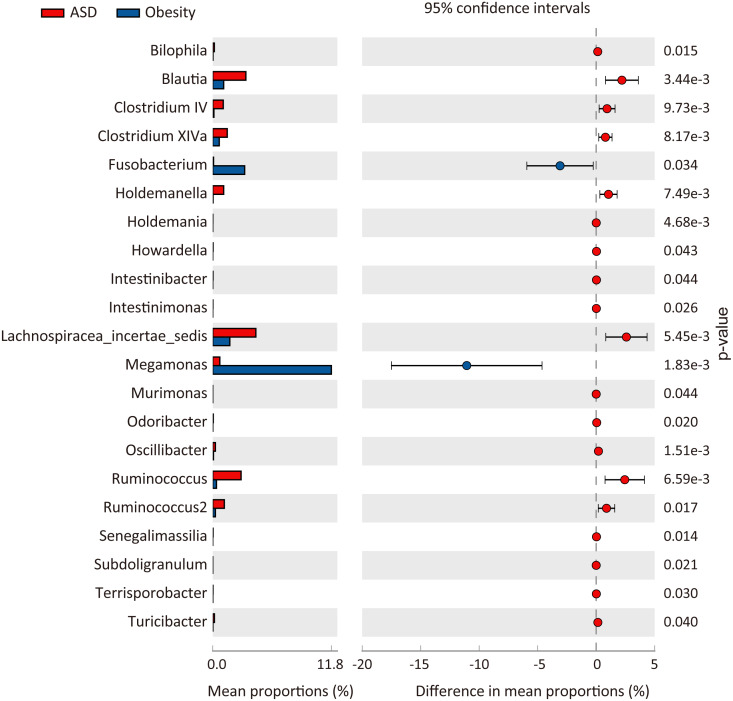
We observed the proportion of in ASD was significantly increased, with families and significantly enriched in adult ASD. Eighteen genera, including , , , and were significantly increased in adult ASD, whereas and were significantly increased in obesity. At the species level, we found six species enriched in ASD and three species enriched in obesity, including producing propionate. may be as a biomarker for predicting obesity, as well as may be a common-owned pathogens of ASD and obesity.
Some conflicting results have been reported in microbiota studies of ASD, which may be related to age and obesity. Thus, the body mass index should be evaluated before analyzing the gut microbiota of patients with ASD, as obesity is prevalent in these individuals and gut microbiota is severally affected by obesity.
自闭症谱系障碍(ASD)和肥胖是严重的全球公共卫生问题。研究表明,ASD儿童比普通人群患肥胖症的风险更高。为了研究成年ASD患者和肥胖成年人的肠道微生物特征,我们将成年ASD患者的肠道微生物群与肥胖成年人进行了比较。
收集21例成年ASD患者和21例肥胖成年人的粪便样本,通过高通量DNA测序对16S rRNA基因的V3-V4区域进行测序。比较成年ASD患者和肥胖成年人的肠道微生物群。
我们观察到ASD中[此处原文缺失具体内容]的比例显著增加,[此处原文缺失具体家族名称]家族在成年ASD中显著富集。在成年ASD中,包括[此处原文缺失具体属名]等18个属显著增加,而在肥胖症中[此处原文缺失具体属名]显著增加。在物种水平上,我们发现ASD中富集了6个物种,肥胖症中富集了3个物种,包括产生丙酸盐的[此处原文缺失具体物种名]。[此处原文缺失具体物种名]可能是预测肥胖的生物标志物,[此处原文缺失具体物种名]可能是ASD和肥胖的共同病原体。
在ASD的微生物群研究中报道了一些相互矛盾的结果,这可能与年龄和肥胖有关。因此,在分析ASD患者的肠道微生物群之前应评估体重指数,因为肥胖在这些个体中很普遍,并且肠道微生物群受到肥胖的严重影响。