Kim Hyun Jong, Park Seorin, Shin Hui Young, Nam Yu Ran, Lam Hong Phan Thi, Chin Young-Won, Nam Joo Hyun, Kim Woo Kyung
Department of Physiology, Dongguk University College of Medicine, Gyeong-ju, Gyeongsangbuk-do, Republic of Korea.
Channelopathy Research Center (CRC), College of Medicine, Dongguk University, Goyang, Gyeonggi-do, Republic of Korea.
PeerJ. 2021 Mar 3;9:e10973. doi: 10.7717/peerj.10973. eCollection 2021.
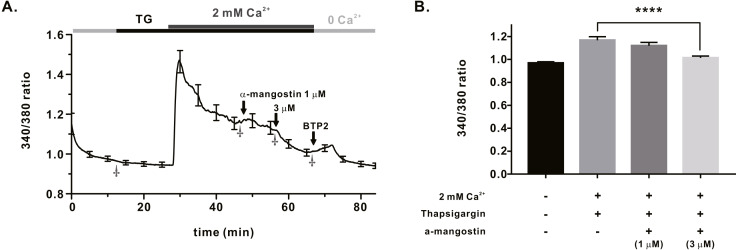
As one of the main components of mangosteen (), a tropical fruit, -mangostin has been reported to have numerous pharmacological benefits such as anti-cancer, anti-inflammatory, and anti-allergic effects through various mechanisms of action. The effects of -mangostin on intracellular signaling proteins is well studied, but the effects of -mangostin on ion channels and its physiological effects in immune cells are unknown. Generation of intracellular calcium signaling is a fundamental step for T cell receptor stimulation. This signaling is mediated not only by the ORAI1 calcium channel, but also by potassium ion channels, which provide the electrical driving forces for generating sufficient calcium ion influx. This study investigated whether -mangosteen suppress T cell stimulation by inhibiting ORAI1 and two kinds of potassium channels (K1.3 and K3.1), which are normally expressed in human T cells.
This study analyzed the inhibitory effect of -mangostin on immune cell activity via inhibition of calcium and potassium ion channels expressed in immune cells.
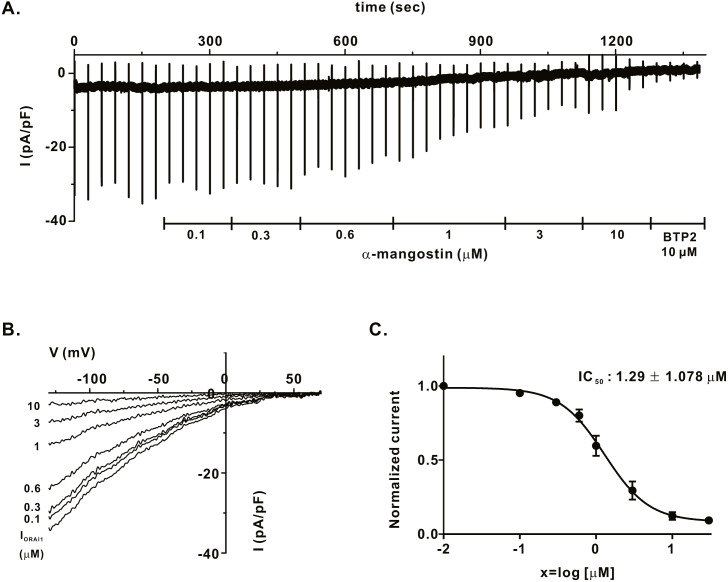
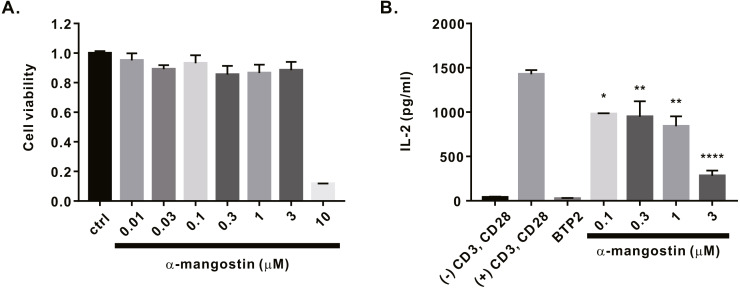
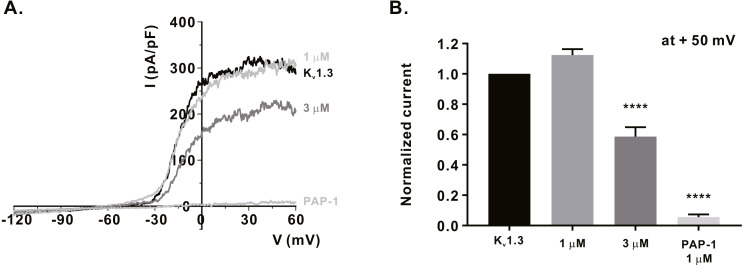
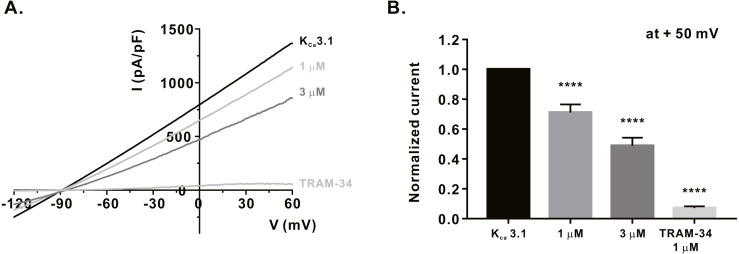
-mangostin inhibited ORAI1 in a concentration-dependent manner, and the IC value was 1.27 ± 1.144 µM. K1.3 was suppressed by 41.38 ± 6.191% at 3 µM, and K3.1 was suppressed by 51.16 ± 5.385% at 3 µM. To measure the inhibition of cytokine secretion by immune cells, Jurkat T cells were stimulated to induce IL-2 secretion, and -mangostin was found to inhibit it. This study demonstrated the anti-inflammatory effect of -mangostin, the main component of mangosteen, through the regulation of calcium signals.
作为热带水果山竹的主要成分之一,γ-倒捻子素已被报道具有多种药理益处,如通过各种作用机制发挥抗癌、抗炎和抗过敏作用。γ-倒捻子素对细胞内信号蛋白的影响已得到充分研究,但其对离子通道的影响及其在免疫细胞中的生理作用尚不清楚。细胞内钙信号的产生是T细胞受体刺激的一个基本步骤。这种信号不仅由ORAI1钙通道介导,还由钾离子通道介导,钾离子通道为产生足够的钙离子内流提供电驱动力。本研究调查了γ-山竹黄酮是否通过抑制正常表达于人类T细胞中的ORAI1和两种钾通道(K1.3和K3.1)来抑制T细胞刺激。
本研究通过抑制免疫细胞中表达的钙和钾离子通道,分析了γ-山竹黄酮对免疫细胞活性的抑制作用。
γ-山竹黄酮以浓度依赖性方式抑制ORAI1,IC值为1.27±1.144μM。在3μM时,K1.3被抑制41.38±6.191%,K3.1在3μM时被抑制51.16±5.385%。为了测量免疫细胞对细胞因子分泌的抑制作用,刺激Jurkat T细胞诱导IL-2分泌,发现γ-山竹黄酮可抑制其分泌。本研究通过调节钙信号证明了山竹主要成分γ-山竹黄酮的抗炎作用。