van der Aalst Carlijn M, Ten Haaf Kevin, de Koning Harry J
Department of Public Health, Erasmus MC-University Medical Center Rotterdam, Rotterdam, The Netherlands.
Transl Lung Cancer Res. 2021 Feb;10(2):1050-1063. doi: 10.21037/tlcr-20-985.
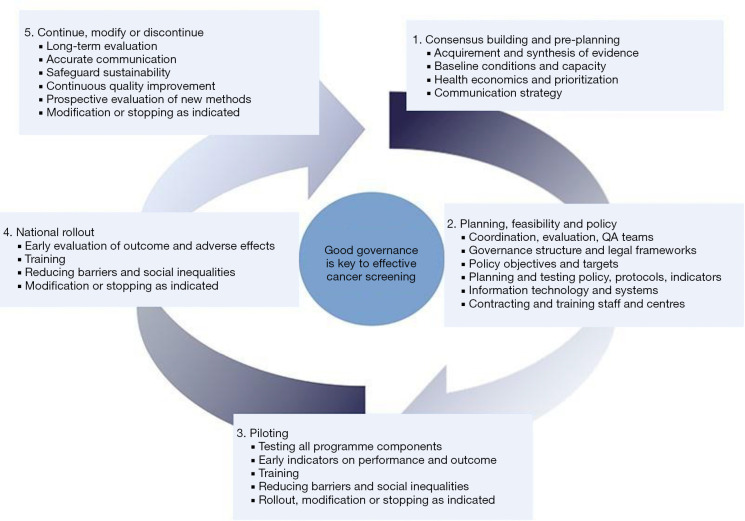
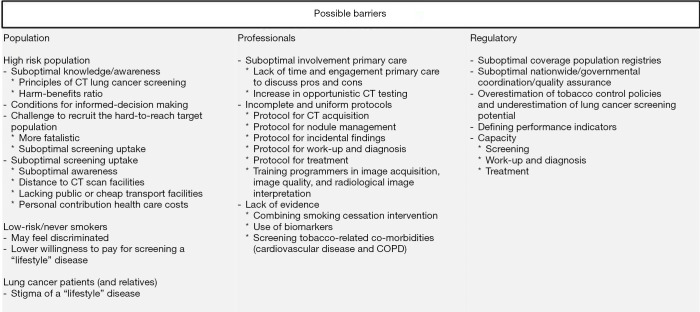
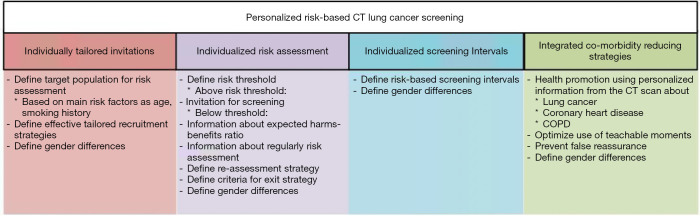
Two large-scale RCTs have shown computed tomography (CT) lung cancer screening to be efficacious in reducing lung cancer mortality (8-24% in men, 26-59% in women). However, lung cancer screening implicitly means personalised and risk-based approaches. Health care systems' implementation of personalised screening and prevention is still sparse, and likely to be of variable quality, because of important remaining uncertainties, which have been incompletely addressed or not at all so far. Further optimisation of lung cancer screening programs is expected to reduce harms and maintain or enhance benefit for eligible European citizens, whilst significantly reducing health care costs. Some main uncertainties (e.g., Risk-based eligibility, Risk-based screening intervals, Volume CT screening, Smoking Cessation, Gender and Sex differences, Cost-Effectiveness) are discussed in this review. 4-IN-THE-LUNG-RUN (acronym for: Towards INdividually tailored INvitations, screening INtervals and INtegrated co-morbidity reducing strategies in lung cancer screening) is the first multi-centred implementation trial on volume CT lung cancer screening amongst 24,000 males and females, at high risk for developing lung cancer, across five European countries, started in January 2020. Through providing answers to the remaining questions with this trial, many EU citizens will swiftly benefit from this high-quality screening technology, others will face less harms than previously anticipated, and health care costs will be substantially reduced. Implementing a new cancer screening programme is a major task, with many stakeholders and many possible facilitators but also barriers and obstacle.
两项大规模随机对照试验表明,计算机断层扫描(CT)肺癌筛查在降低肺癌死亡率方面是有效的(男性降低8%-24%,女性降低26%-59%)。然而,肺癌筛查隐含着个性化和基于风险的方法。由于仍存在重要的不确定性,而这些不确定性迄今尚未得到充分解决或根本未得到解决,医疗保健系统对个性化筛查和预防的实施仍然很少,而且质量可能参差不齐。预计进一步优化肺癌筛查项目将减少危害,为符合条件的欧洲公民维持或提高益处,同时显著降低医疗保健成本。本综述讨论了一些主要的不确定性(例如,基于风险的资格、基于风险的筛查间隔、容积CT筛查、戒烟、性别差异、成本效益)。4-IN-THE-LUNG-RUN(全称为:肺癌筛查中实现个性化邀请、筛查间隔和综合合并症减少策略)是第一项针对24000名男性和女性进行容积CT肺癌筛查的多中心实施试验,这些人在五个欧洲国家患肺癌的风险很高,该试验于2020年1月开始。通过该试验回答剩余问题,许多欧盟公民将迅速受益于这项高质量的筛查技术,其他人面临的危害将比之前预期的要少,医疗保健成本也将大幅降低。实施一项新的癌症筛查项目是一项重大任务,涉及许多利益相关者以及许多可能的促进因素,但也存在障碍和阻碍。